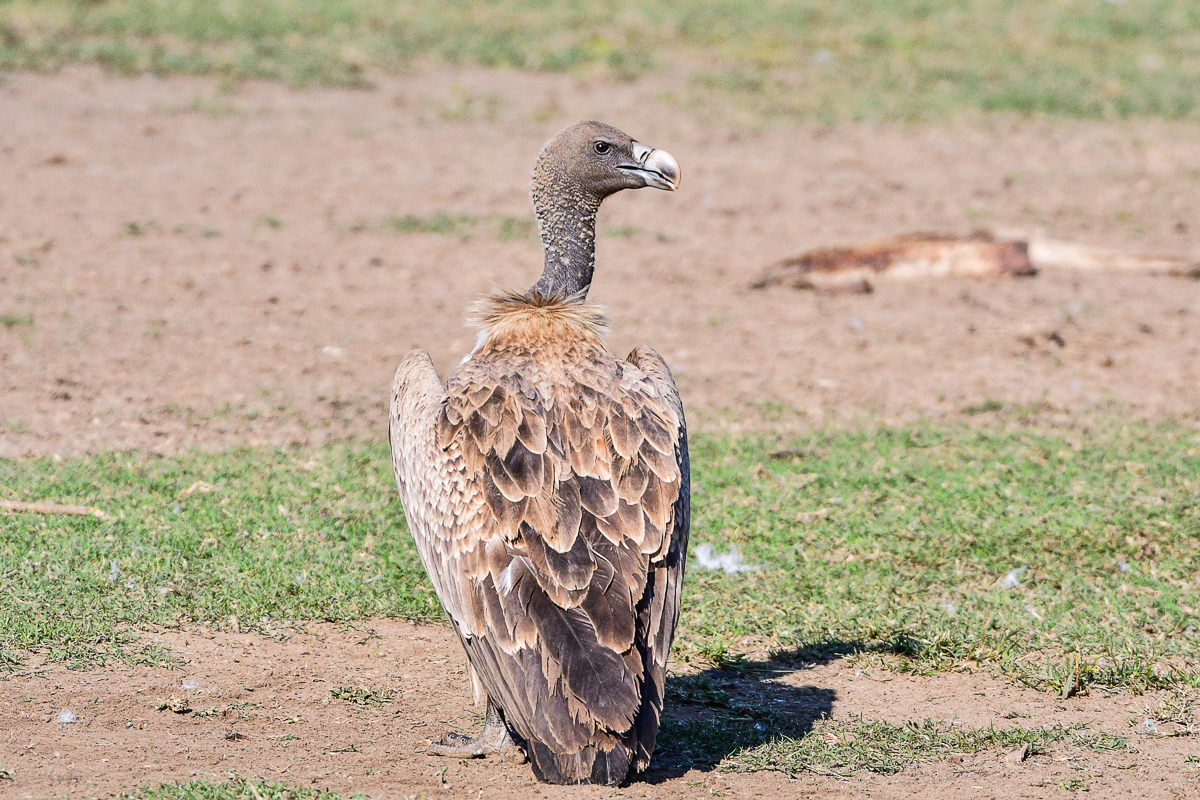
Indian Vulture (also known as Long-billed Vulture)
- Common Name: Indian Vulture
- Scientific Name: Gyps indicus
- Nepali Name(s): लामो ठुँडे गिद्ध (Lamo Thunde Giddha)
- IUCN Red List Status: Critically Endangered (CR)
- National Red List Status (Nepal): Critically Endangered (CR)
- CITES Appendix: Appendix II
- CMS Appendix: Appendix II
Measurements & Physical Profile
- Body Length: 80–103 cm
- Wingspan: 222–258 cm
- Weight: 5,500–6,300 g
Did You Know?
Once confused with the Slender-billed Vulture (Gyps tenuirostris), the Indian Vulture is now confirmed as a distinct species through genetic and behavioral research. Its long, slender beak is a specialized adaptation allowing it to reach deep into carcass cavities for soft tissue.
Distribution & Habitat
Global Distribution
Endemic to the Indian subcontinent. Its historical range spanned the Gangetic plains, the Indus plain, and peninsular India, extending into parts of southern Nepal and Pakistan.
Distribution within Nepal
A rare, localized resident. Populations are primarily concentrated in the southern lowlands and foothills. Conservation efforts, specifically "Vulture Safe Zones," are actively monitoring and attempting to stabilize these groups by ensuring livestock carcasses are free from toxic veterinary drugs.
Preferred Habitats
A cliff-nesting specialist. Unlike tree-nesting vultures, the Indian Vulture prefers nesting on small cliffs, rocky crags, and hilly ravines to secure itself from ground predators. Foraging occurs in open, wooded country, scrublands, and agricultural plains.
Behavior & Ecology
Foraging Behavior
An obligate scavenger that uses communal soaring to scan vast landscapes for carrion. They are highly social, often feeding in mixed-species groups with other Gyps vultures.
Diet & Ecosystem Role
- Diet: Carrion specialist.
- Adaptation: Its powerful, elongated bill is uniquely adapted to extract soft tissues from the interior of large mammalian carcasses.
- Ecological Role: Functions as an apex sanitary cleaner, preventing the spread of diseases from decomposing carcasses.
Breeding Biology
The Long-billed Vulture nests in colonies (or groups) of up to 20 pairs. Traditionally, these vultures place their nests on cliff ledges, rocky outcroppings, and hilly slopes, but biologists have occasionally documented them nesting in trees. The breeding season runs from November to May. They generally build large, sturdy stick platforms on steep, inaccessible rock ledges. They lay a single egg, incubated by both parents for approximately 45–50 days. The chick is altricial and requires roughly 3–4 months to fledge. Parents remain highly devoted, providing regurgitated food and continuing to support the young for several months post-fledging. They exhibit strong site fidelity, often returning to the same nesting colony annually.
Population Status
- Global Population: 5,000 – 15,000 mature individuals.
- Population Trend: Decreasing.
- National Population (Nepal): <10 birds.
Threats
- The Diclofenac Crisis: The primary driver of decline is secondary poisoning from the veterinary drug diclofenac, which causes acute kidney failure and visceral gout.
- Toxic Alternatives: Other NSAIDs (e.g., ketoprofen, aceclofenac, nimesulide) are also highly toxic to vultures and continue to threaten recovery.
- Illegal Use: Despite bans, human-use diclofenac is sometimes diverted for veterinary treatment.
- Habitat Loss: Urbanization and the alteration of traditional grazing landscapes reduce available foraging ranges.
Conservation Actions
Existing Measures
- International: Protected under CITES Appendix II and CMS Appendix II.
- National: Establishment of "Vulture Safe Zones" (VSZ) to promote safe, toxin-free livestock carcass disposal.
Recommended Measures
- Strict Market Enforcement: Continued surveillance to prevent the misuse of human pharmaceutical NSAIDs in the veterinary sector.
- Toxicity Testing: Promotion of meloxicam as the only safe alternative NSAID for livestock.
- Habitat Protection: Safeguarding cliff nesting sites from disturbance and development.
References
- BirdLife International (2021). Species factsheet: Indian Vulture Gyps indicus. Downloaded from https://datazone.birdlife.org/species/factsheet/indian-vulture-gyps-indicus on 05/08/2026
- Clark, W. S., D. A. Christie, and J. S. Marks (2020). Indian Vulture (Gyps indicus), version 1.0. In Birds of the World (J. del Hoyo, A. Elliott, J. Sargatal, D. A. Christie, and E. de Juana, Editors). Cornell Lab of Ornithology, Ithaca, NY, USA. https://doi.org/10.2173/bow.indvul1.01
- Ferguson-Lees, J., & Christie, D. A. (2001). Raptors of the World. Houghton Mifflin Harcourt.
- Naoroji, R. (2006). Birds of Prey of the Indian Subcontinent. Om Books International, New Delhi.
- The Peregrine Fund (2026) Long-billed Vulture. Available at: https://peregrinefund.org/explore-raptors-species/vultures/long-billed-vulture (Accessed: 5 August 2026).