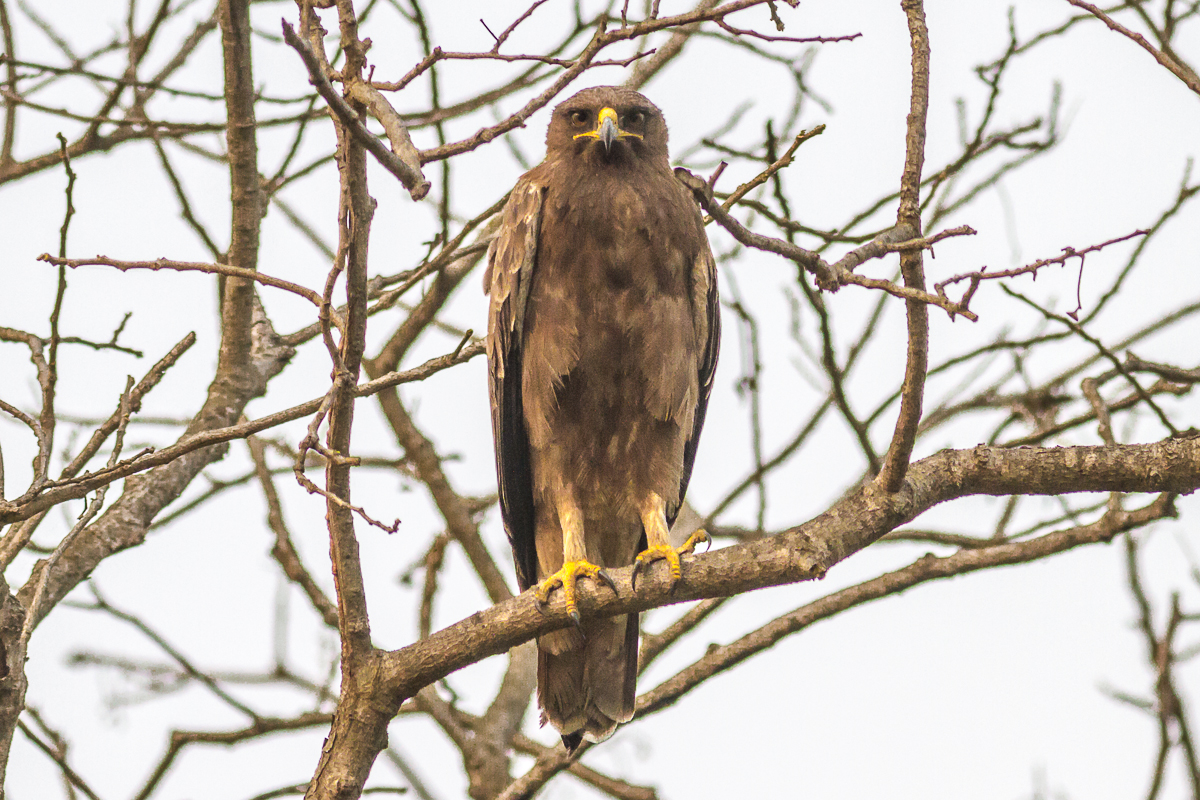
Indian Spotted Eagle
- Scientific Name: Clanga hastata
- Nepali Name: लघु महाचिल (Laghu Mahachil)
- IUCN Red List Status: Vulnerable (VU)
- National Red List Status (Nepal): Vulnerable (VU)
- CITES Appendix: Appendix II
- CMS Appendix: Appendix II
Physical Profile & Morphology
- Body Length: 50 - 60 cm
- Wingspan: 150–168 cm
- Weight: 1250 – 2500 grams
Did You Know?
Despite its name, the Indian Spotted Eagle is often not very "spotted" as an adult. Younger birds exhibit distinct creamy-white spots on their wing coverts and scapulars, but these fade or disappear as the bird matures—a feature that distinguishes them from their close relatives, the Greater and Lesser Spotted Eagles.
Distribution & Habitat
Global Range
Endemic to the Indian subcontinent and parts of Southeast Asia, including India, Nepal, Bangladesh, Myanmar, and Cambodia.
Distribution in Nepal
A resident breeder in the lowland Tarai and Siwalik regions. Key strongholds include Lumbini Farmlands, Chitwan, Bardia, and Shuklaphanta National Parks, as well as the Koshi Tappu Wildlife Reserve. Unlike many other eagles, it shows notable tolerance for human-altered landscapes, frequently perching in trees overlooking paddy fields.
Preferred Habitats
Subtropical and tropical dry forests, agricultural landscapes, and mosaics of woodland, grassland, and wetlands. Unlike the Greater Spotted Eagle, which favors wetlands, this species often hunts in semi-open savannas and near agricultural fields.
Elevational Range
Primarily restricted to the lowlands and foothills, generally below 1,000 meters.
Seasonal Occurrence
Indian Spotted Eagle is resident species in Nepal.
Behavior & Ecology
Flight & Foraging Behavior
An opportunistic hunter, it often uses a "sit-and-wait" strategy from exposed perches to scan for prey. It is also an active soarer, frequently searching for food over open fields, marshy edges, and forest clearings.
Diet & Ecosystem Role
Diet Breakdown
- Amphibians (Primary): In the Terai lowlands, frogs (such as Rana spp.) are a dominant part of their diet, especially during the monsoon season.
- Small Mammals: Rodents and squirrels are significant prey items, particularly during the breeding season.
- Other: Occasionally takes birds, reptiles, and large insects.
Ecological Role
As a specialized apex predator of the Terai lowlands, it helps regulate populations of amphibians and small rodents, serving as an important indicator of the health of lowland forest-grassland mosaics.
Breeding Biology
Mating and nest building occur from late February to mid-March. Pairs construct bulky platforms of thorny twigs (often Acacia or Prosopis). Sites are usually in the highest available trees (including coconut palms) to provide a clear vantage point for nest defence. Females lay 1–2 eggs; incubation takes 45–48 days. The female handles the majority of the brooding, while the male is responsible for provisioning food.
Migration
- Status: Resident; non-migratory.
- Movement: Individuals generally maintain a home range within the lowland Terai throughout the year.
Population Status
- Global Population Estimate: Unknown.
- Population Trend: Decreasing.
- National Population Estimate (Nepal): less than 70 individuals.
- Monitoring & Surveys: Monitored by Himalayan Raptors Team since last one decade through nest-site observation and population surveys.
Threats
- Habitat Loss: Rapid infrastructure development, deforestation, and the degradation of lowland landscapes are the most significant threats.
- Pesticide Use: Potential secondary poisoning from chemicals used in agricultural areas where they hunt.
- Infrastructure Risks: Increasing linear infrastructure (power lines) creates collision hazards and habitat disturbance.
- Disturbance: Nesting sites are susceptible to human encroachment and forest thinning.
Conservation Actions
Existing Measures
- Legal Protections: Listed under CITES Appendix II.
- Protected Area Foothold: Core populations are safeguarded within Nepal's major National Parks and Wildlife Reserves.
Recommended Measures
- Landscape Connectivity: Preserving the mosaic of forest, farmland, and wetland patches in the Terai to maintain prey abundance.
- Community Stewardship: Continued engagement with local forest user groups to protect nesting trees and limit disturbances during the breeding season.
References
- Ashwin, C. P., Alby, M. J., Arjun, M. S., Arun, P. R., & Nandu, V. S. (2023). Raptors and linear infrastructure in Chhattisgarh, India: species composition and conservation concern. Ornis Hungarica, 31(1), 1–12. https://doi.org/10.2478/orhu-2023-0015
- BirdLife International (2025). Species factsheet: Indian Spotted Eagle Clanga hastata. Downloaded from https://datazone.birdlife.org/species/factsheet/indian-spotted-eagle-clanga-hastata on 05/08/2026
- Ferguson-Lees, J., & Christie, D. A. (2001). Raptors of the World. Christopher Helm, London.
- del Hoyo, J., N. Collar, and J. S. Marks (2020). Indian Spotted Eagle (Clanga hastata), version 1.0. In Birds of the World (J. del Hoyo, A. Elliott, J. Sargatal, D. A. Christie, and E. de Juana, Editors). Cornell Lab of Ornithology, Ithaca, NY, USA. https://doi.org/10.2173/bow.inseag1.01
- Inskipp C., Baral H. S., Phuyal S., Bhatt T. R., Khatiwada M., Inskipp, T, Khatiwada A., Gurung S., Singh P. B., Murray L., Poudyal L. and Amin R. (2016). The status of Nepal’s Birds: The national red list series. Zoological Society of London, UK.
- Kumar, S., Sohil, A., Kichloo, M. A., & Sharma, N. (2022). Landscape heterogeneity affects diurnal raptor communities in a sub-tropical region of northwestern Himalayas, India. PLOS ONE, 17(4), e0246555. https://doi.org/10.1371/journal.pone.0246555
- Shivprakash, A. (2005). Notes on the breeding of the Indian Spotted Eagle Aquila hastata. Indian Birds, 2(1), 2–7.