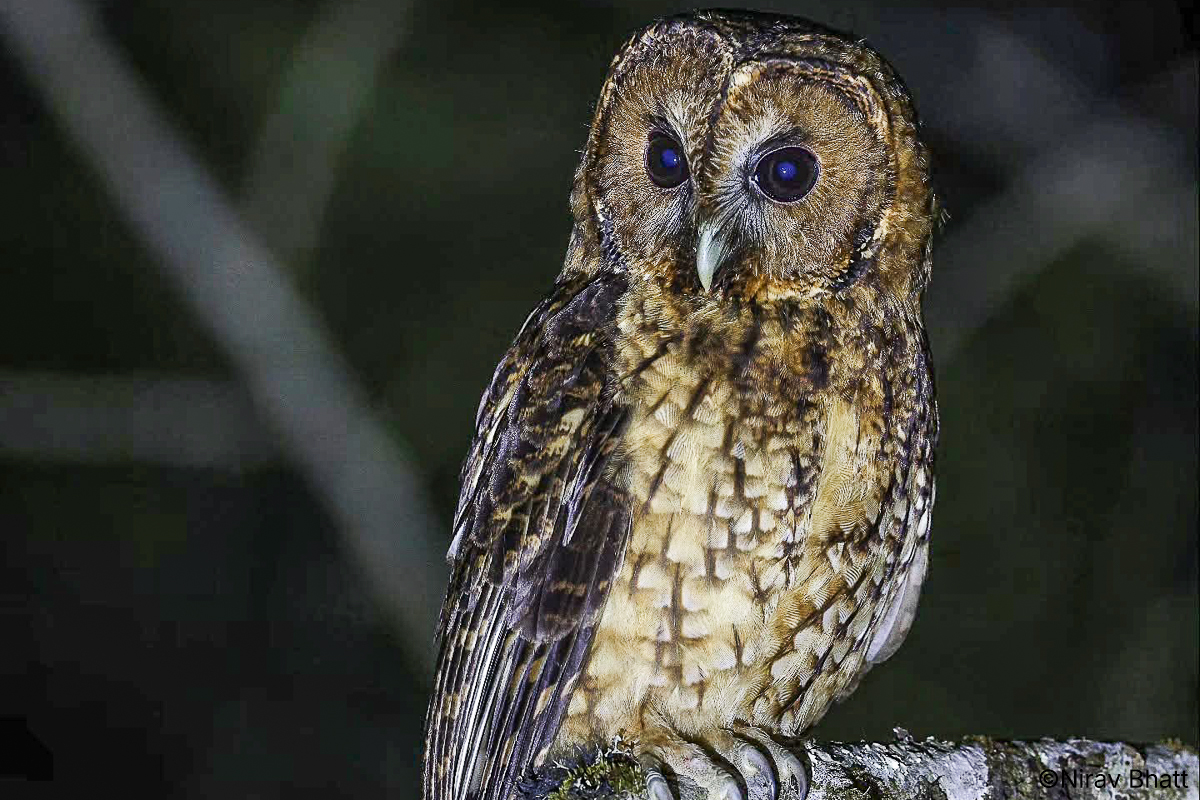
Himalayan Owl
- Common Name: Himalayan Owl
- Scientific Name: Strix nivicolum
- Nepali Name(s): हिमाली उलूक (Himali Uluk)
- IUCN Red List Status: Least Concern (LC)
- National Red List Status (Nepal): Least Concern (LC)
- CITES Appendix: Appendix II
Measurements & Physical Profile
- Body Length: 35–40 cm
- Wing Length: 27.2–32 cm
- Weight: 375–392 g
Did You Know?
Once classified as a subspecies of the European Tawny Owl (Strix aluco), the Himalayan Owl is now recognized as a distinct species. This separation is based on modern bioacoustic research and genetic sequencing, which highlight its darker, more intricate barring and completely unique vocalizations.
Distribution & Habitat
Global Distribution
A montane specialist of the Sino-Himalayan region. The range extends from northeastern Pakistan and Kashmir, eastward along the Himalayan arc across India, Nepal, Bhutan, and southern Tibet, reaching into western and central China, northern Myanmar, and northern Indochina. It is a strictly sedentary, non-migratory resident.
Distribution within Nepal
A localized, nocturnal permanent resident found primarily throughout the temperate middle hills and subalpine zones. Stable breeding populations exist within large protected areas such as Shivapuri Nagarjun, Langtang, and Sagarmatha National Parks, the Annapurna Conservation Area, and the Makalu Barun buffer zones.
Preferred Habitats
A deep-forest obligate. It thrives in mature, undisturbed temperate deciduous woodlands, mixed oak-rhododendron forests, and subalpine coniferous zones (hemlock, fir, and birch). It requires old-growth trees with natural decay cavities for nesting and day-roosting.
Elevational Range
Typically found between 1,800 and 3,800 meters. During severe winter weather, individuals may perform minor altitudinal movements into lower ravines down to 1,200 meters.
Behavior & Ecology
Nocturnal Specialization
Strictly nocturnal, the Himalayan Owl spends days roosting in pairs or singly against tree trunks or in rock crevices, where its plumage provides perfect camouflage. Like other Strix owls, it utilizes specialized comb-like structures on its primary feathers for silent flight.
Vocalizations
The male's territorial call is a haunting, rhythmic, double-noted hoot ("to-whoo" or "bu-booh"), repeated at steady intervals. This call is distinct from the European Tawny Owl and carries clearly through dense forest canopies.
Diet & Ecosystem Role
- Diet Breakdown: Stealthy perch-hunter.
- Small Mammals: Forest mice, voles, rats, and pikas.
- Birds: Sleeping passerines, woodpeckers, and tree-creepers.
- Insects & Others: Large beetles, moths, and occasional frogs.
- Ecological Role: Plays a vital role in regulating forest rodent populations.
Breeding Biology
The breeding cycle occurs from March through June. It does not build its own nest; it lays eggs on the floor of natural tree cavities (broken limbs or old woodpecker holes). Occasionally uses cliff crevices or old hawk/corvid nests. Lays 2 to 3 glossy, pure white eggs. Incubation lasts for 28–30 days, managed by the female while the male provides food. Chicks leave the cavity as "branchers" at 30–35 days and achieve full flight about a week later, remaining dependent on parental feeding throughout the summer.
Migration
- Status: Resident.
- Movement: Non-migratory; remains within high-elevation territories year-round.
Population Status
- Global Population: Unknown.
- Population Trend: Decreasing.
- National Population Estimates (Nepal): Unknown.
Threats
- Loss of Old-Growth Trees: Removal of dead standing trees and mature canopy species for firewood or timber eliminates essential nesting cavities.
- Forest Fragmentation: Infrastructure development and agricultural expansion disrupt territory blocks.
- Pesticide Drift: Secondary contamination risk as owls consume rodents exposed to agricultural pesticides in mountain valleys.
Conservation Actions
Existing Measures
- International: Protected under CITES Appendix II.
- National: Habitat secured within mid-hill national parks and conservation areas.
Recommended Measures
- Habitat Management: Integrate wildlife-friendly guidelines into Community Forest operational plans to protect decaying "hollow trees."
- Monitoring: Use systematic nocturnal playback surveys during the spring breeding window to track population baselines.
- Community Engagement: Educate forest-adjacent communities on the owl's role in rodent control to reduce persecution and roost disturbance.
References
- BirdLife International (2024). Species factsheet: Himalayan Owl Strix nivicolum. Downloaded from https://datazone.birdlife.org/species/factsheet/himalayan-owl-strix-nivicolum on 09/08/2026
-
del Hoyo, J., N. Collar, and J. S. Marks (2020). Himalayan Owl (Strix nivicolum), version 1.0. In Birds of the World (J. del Hoyo, A. Elliott, J. Sargatal, D. A. Christie, and E. de Juana, Editors). Cornell Lab of Ornithology, Ithaca, NY, USA. https://doi.org/10.2173/bow.himowl1.01
- Inskipp C., Baral H. S., Phuyal S., Bhatt T. R., Khatiwada M., Inskipp, T, Khatiwada A., Gurung S., Singh P. B., Murray L., Poudyal L. and Amin R. (2016). The status of Nepal’s Birds: The national red list series. Zoological Society of London, UK.
- König, C., F. Weick, and J.-H. Becking (2008). Owls of the World. Second edition. Christopher Helm, London, UK.