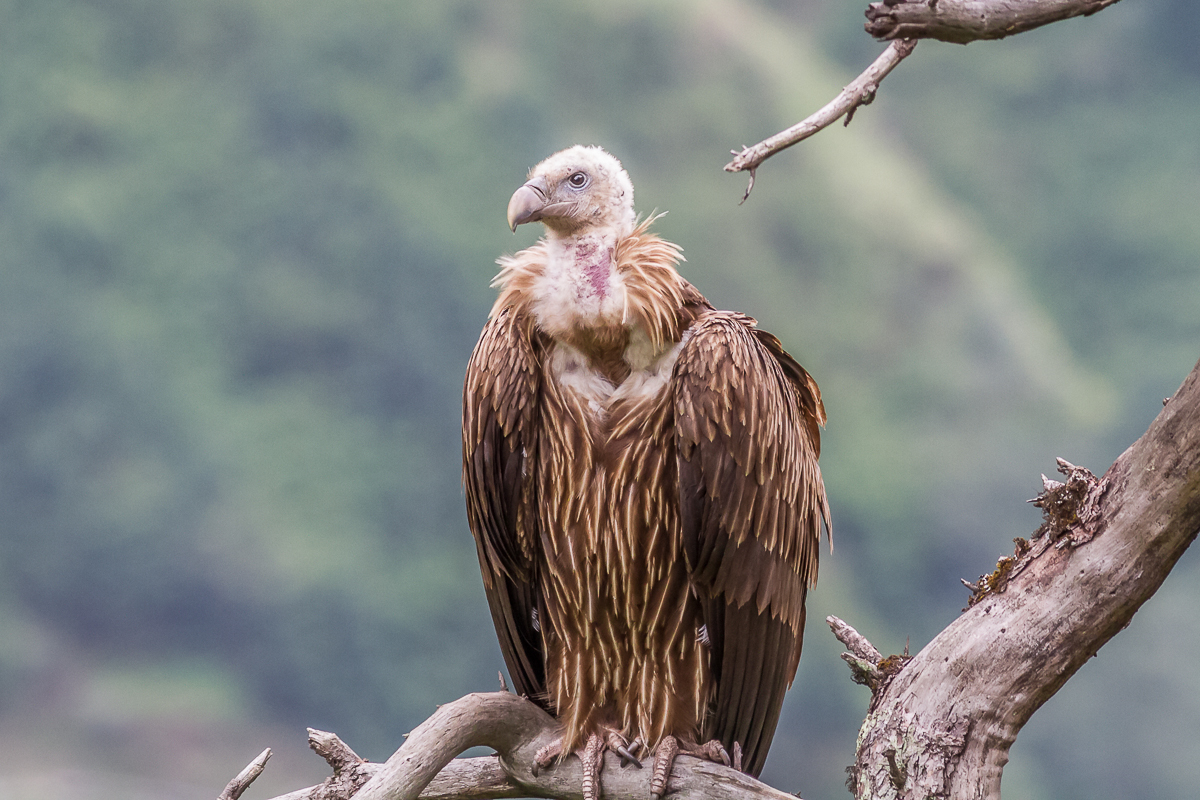
Himalayan Vulture (also known as Himalayan Griffon)
- Common Name: Himalayan Vulture
- Scientific Name: Gyps himalayensis
- Nepali Name(s): हिमाली गिद्ध (Himali Giddha)
- IUCN Red List Status: Near Threatened (NT)
- National Red List Status (Nepal): Vulnerable (VU)
- CITES Appendix: Appendix II
- CMS Appendix: Appendix II
Measurements & Physical Profile
- Body Length: 115–125 cm
- Wingspan: 260–310 cm
- Weight: 8,000–12,000 g
Did You Know?
The Himalayan Vulture is one of the largest and most powerful raptors in the world. Perfectly adapted for life in the thin air of the high Himalayas, these birds have evolved massive wing surfaces that allow them to soar effortlessly over some of the highest mountain peaks on Earth. Interestingly, their hemoglobin has a specialized high-affinity for oxygen, which allows them to function efficiently at altitudes exceeding 8,000 meters—a physiological feat that makes them one of the highest-flying birds on the planet.
Distribution and Habitat
Global Distribution
A high-altitude montane specialist endemic to Central and South Asia. Its core breeding range follows the Himalayan arc from Afghanistan, northern Pakistan, India, Nepal, and Bhutan, extending across the Tibetan Plateau into western China and the Central Asian mountain ranges (Pamir, Tien Shan, Altai).
Distribution within Nepal
A common permanent resident in high-elevation zones and a frequent altitudinal migrant. Breeding occurs on massive cliff faces in the Annapurna Conservation Area, Langtang, Sagarmatha, and Dolpo. During winter (November–April), nomadic juveniles and adults move through the mid-hills and Tarai, often frequenting community-managed "vulture restaurants."
Preferred Habitats
Requires open, rugged montane landscapes including alpine pastures, high-altitude steppes, rocky ravines, and river valleys above the timberline. It relies on sheer, inaccessible mountain cliffs for nesting and communal roosting.
Elevational Range
Core breeding and foraging zones exist between 1,200 and 5,500 meters, with individuals regularly soaring above 6,000 meters. In winter, they may descend to lowland basins as low as 75 meters.
Behavior & Ecology
Foraging & Social Hierarchy
An obligate scavenger that uses thermals to monitor the ground for food. At carcasses, it is highly aggressive and occupies the top of the avian feeding hierarchy in the Himalayas, often displacing smaller vultures. Groups communicate with a cacophony of hisses, guttural grunts, and dry cackles.
Diet & Ecosystem Role
- Diet Breakdown: Specialized in processing large mammalian remains.
- Domestic Livestock: Yaks, dzo, horses, sheep, and cattle.
- Wild Ungulates: Blue sheep (bharal), Himalayan tahr, and argali sheep.
- Cultural/Ecological: Acts as the primary agent in traditional Tibetan sky burials (Jhator).
- Ecological Role: Functions as an apex sanitary cleaner, preventing the spread of diseases from decomposing carcasses.
Breeding Biology
The breeding season runs from January through June. Nest is a large, untidy platform of sticks, twigs, and grass lined with wool or hair, built on an inaccessible cliff ledge or in a sheltered cavity, lay 1 single large egg, incubation last for 54–58 days, shared by both parents. The chick develops slowly over 110–120 days. Since there is only one egg, the species avoids the siblicide seen in other raptors. Juveniles remain dependent on parental food for several months after fledging.
Migration
- Status: Altitudinal Migrant.
- Movement: Adults are largely sedentary or nomadic within the mountain chain, while juveniles and subadults perform significant down-slope migrations during winter.
Population Status
- Global Population: 66,000 – 334,000 mature individuals.
- Population Trend: Decreasing.
- National Population Estimates (Nepal): fewer than 10,000 individuals.
Threats
- NSAID Poisoning: Migration to the lowlands exposes them to livestock carcasses treated with toxic drugs like diclofenac, ketoprofen, or flunixin, causing fatal kidney failure.
- Retaliatory Poisoning: In mountain pastoral zones, carcasses baited with insecticides to kill apex predators (wolves/snow leopards) result in accidental mass poisoning.
- Food Depletion: Modern carcass disposal and changes in herd sizes can lead to local food shortages during winter.
- Infrastructure: Fatal collisions with high-voltage power lines and wind energy infrastructure.
Conservation Actions
Existing Measures
- International: Listed under CITES Appendix II and CMS Appendix II.
- National: Habitat security provided by Nepal's mountain protected area system (e.g., ACAP, Langtang).
- Research: Monitoring migration, GPS transmitter-based study to study habitats and migration routes.
Recommended Measures
- NSAID Surveillance: Maintain market monitoring to ensure banned toxic veterinary drugs do not enter the livestock supply chain.
- Predator Management: Implement secure, predator-proof livestock corrals to reduce retaliatory poisoning of carcasses.
- Power Line Safety: Insulate high-voltage lines and install flight diverters in high-density migratory corridors.
References
- BirdLife International (2021). Species factsheet: Himalayan Griffon Gyps himalayensis. Downloaded from https://datazone.birdlife.org/species/factsheet/himalayan-griffon-gyps-himalayensis on 05/08/2026
- Clark, W. S., P. F. D. Boesman, G. M. Kirwan, J. S. Marks, and C. J. Sharpe (2020). Himalayan Griffon (Gyps himalayensis), version 1.0. In Birds of the World (J. del Hoyo, A. Elliott, J. Sargatal, D. A. Christie, and E. de Juana, Editors). Cornell Lab of Ornithology, Ithaca, NY, USA. https://doi.org/10.2173/bow.himgri1.01
- Ferguson-Lees, J., & Christie, D. A. (2001). Raptors of the World. Christopher Helm, London.
- Inskipp C., Baral H. S., Phuyal S., Bhatt T. R., Khatiwada M., Inskipp, T, Khatiwada A., Gurung S., Singh P. B., Murray L., Poudyal L. and Amin R. (2016). The status of Nepal’s Birds: The national red list series. Zoological Society of London, UK.
- Naoroji, R. (2006). Birds of Prey of the Indian Subcontinent. Om Books International, New Delhi.