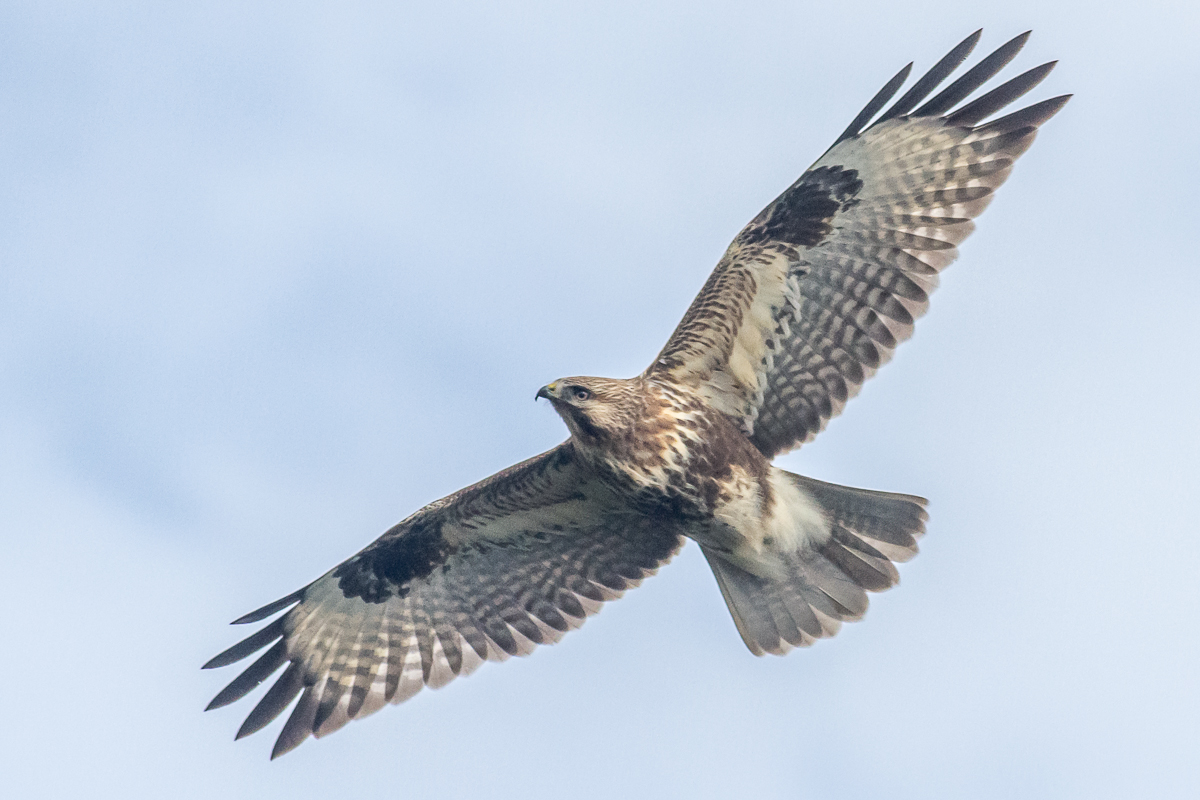
Himalayan Buzzard
- Common Name: Himalayan Buzzard
- Scientific Name: Buteo refectus
- Nepali Name(s): श्येनबाज (Shyen Baaz)
- IUCN Red List Status: Least Concern (LC)
- National Red List Status (Nepal): Least Concern (LC)
- CITES Appendix: Appendix II
Measurements & Physical Profile
- Body Length: 45–53 cm
- Wingspan: na
- Weight: na
Did You Know?
Long shuffled within the Buteo buteo (Common Buzzard) complex, the Himalayan Buzzard is now firmly recognized as a distinct species (Buteo refectus). This classification is supported by recent molecular DNA studies, structural measurements, and a unique vocal profile, confirming its status as an endemic raptor of the high-altitude Himalayan montane zones and the Tibetan Plateau.
Distribution & Habitat
Global Distribution
Restricted to the high-altitude montane regions of the Sino-Himalayan zone. Its range runs continuously along the Himalayan arc from northern Pakistan, through northern India, Nepal, and Bhutan, extending into southwestern China (Yunnan, Sichuan, and the southeastern Tibetan Plateau).
Distribution within Nepal
A common permanent resident and altitudinal migrant. During summer, it is active along high mountain cliffs and alpine pastures in Langtang, Annapurna, and Sagarmatha National Parks. In late autumn, it descends into mid-hill valleys (including Pokhara and Kathmandu) and agricultural plains. Migrating individuals are frequently recorded at the Thoolakharka and Khare watch-sites.
Preferred Habitats
A montane specialist. Breeding occurs along the edges of upper-temperate coniferous and mixed broadleaf forests (Rhododendron, Abies, Quercus), subalpine scrublands, and open alpine meadows. In winter, it adapts to human-altered landscapes, hunting over terraced agricultural hillsides and open river valleys.
Elevational Range
- Breeding Season (Summer): 2,500–4,500 meters above sea level.
- Wintering Season: 700–2,000 meters; occasionally reaches the upper margins of the Tarai.
Behavior & Ecology
Flight & Foraging Behavior
Displays a classic Buteo silhouette: broad, rounded wings and a short, fanned tail, often held in a shallow "V" shape while soaring. It is an active "sit-and-wait" predator, scanning ground from vantage points like pine trees, rocky crags, or utility poles. It is also highly capable of "wind-hovering" over open ridges to spot prey.
Social & Roosting Habits
Highly vocal during the spring courtship phase. It produces a long-drawn, plaintive mewing whistle ("peee-uuu" or "mewww"), which carries across mountain valleys.
Diet & Ecosystem Role
- Diet Breakdown: Highly versatile carnivore.
- Small Mammals (~70%): Voles, field mice, rats, and young Himalayan Pikas (Ochotona spp.).
- Reptiles/Amphibians: Skinks, agamid lizards, and small snakes.
- Birds: Ground-dwelling pipits, finches, and pheasant/partridge chicks.
- Others: Large grasshoppers, beetles, and occasional carrion.
Breeding Biology
The breeding cycle (April–July) aligns with the spring snowmelt and the emergence of prey. A substantial nest of twigs lined with fresh green pine needles or moss. Usually placed 8–20 meters high in a mature coniferous tree (Pinus wallichiana or Abies spectabilis) or on an inaccessible cliff ledge. Lays 2 to 3 eggs, white to pale bluish-white, spotted with reddish-brown. Incubation lasts for 33–38 days, handled primarily by the female. Young fledges at 40–45 days; young remain with parents through late summer before the autumn descent.
Migration
- Status: Altitudinal Migrant.
- Movement: Unlike long-distance Palearctic migrants, this species moves seasonally between high-altitude breeding grounds and lower-elevation wintering valleys.
Population Status
- Global Population: Unknown.
- Population Trend: Unknown
- National Population Estimates (Nepal): Unknown.
Threats
- Loss of Nesting Trees: Timber harvesting and firewood collection reduce the availability of mature conifers for nesting.
- Pesticide Accumulation: Wintering birds in mid-hill agricultural valleys risk secondary poisoning from chemical pesticides.
- Climate Change: Warming temperatures may alter the distribution of subalpine scrub and affect population cycles of key prey like pikas and voles.
Conservation Actions
Existing Measures
- International: Protected under CITES Appendix II.
- National: High-altitude nesting habitats are well-protected within Nepal’s mountain national parks and conservation areas.
Recommended Measures
- Raptor-Safe Farming: Promote organic and low-toxicity farming in wintering valleys to minimize secondary poisoning risks.
- Tree Protection: Partner with Community Forest User Groups to protect mature nesting trees near mountain meadows.
- Monitoring: Maintain long-term raptor migration counts at central hill bottlenecks to monitor population health.
References
- BirdLife International (2024). Species factsheet: Himalayan Buzzard Buteo refectus. Downloaded from https://datazone.birdlife.org/species/factsheet/himalayan-buzzard-buteo-refectus on 06/08/2026
- del Hoyo, J., N. Collar, and J. S. Marks (2020). Himalayan Buzzard (Buteo refectus), version 1.0. In Birds of the World (J. del Hoyo, A. Elliott, J. Sargatal, D. A. Christie, and E. de Juana, Editors). Cornell Lab of Ornithology, Ithaca, NY, USA. https://doi.org/10.2173/bow.combuz9.01