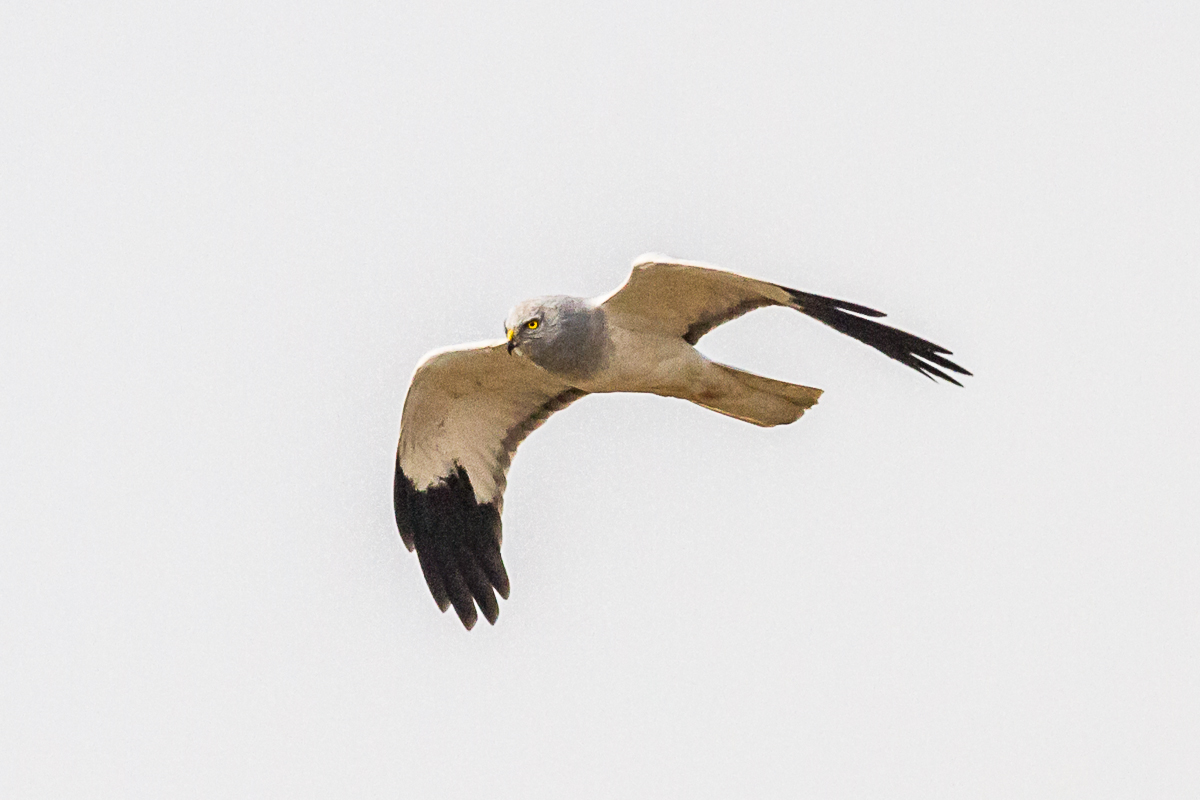
Hen Harrier
- Common Name: Hen Harrier
- Scientific Name: Circus cyaneus
- Nepali Name(s): चल्लाचोर भुइँचील (Challachor Bhuichil)
- IUCN Red List Status: Least Concern (LC)
- National Red List Status (Nepal): Vulnerable (VU)
- CITES Appendix: Appendix II
- CMS Appendix: Appendix II
Measurements & Physical Profile
- Body Length: 42–50 cm
- Wingspan: 100–121 cm
- Weight: 300–708 g
Did You Know?
The Hen Harrier exhibits a striking contrast between the sexes. Adult males feature a ghostly slate-grey upper body with a pure white underbelly and jet-black primary wingtips. Females and juveniles are dark brown above, heavily streaked buff underneath, and possess a conspicuous, brilliant white square rump patch and a long, banded tail.
Distribution & Habitat
Global Distribution
A widespread migratory raptor of the Palearctic region. Its breeding range spans a northern band across Europe, through Russia and Siberia, to northern Mongolia, northeastern China, and parts of northern Japan. Northern populations are strongly migratory, wintering across western/southern Europe, North Africa, the Middle East, Central Asia, and South Asia (including Pakistan, northern India, and Nepal).
Distribution within Nepal
A regular, widely distributed winter visitor and prominent autumn passage migrant. It operates primarily across open lowlands and low-to-mid elevation valley floors. During migration (October–November), individuals are counted crossing the mid-hill ridges at the Thoolakharka watch-site in Kaski. Wintering populations are stable across the expansive grasslands and agricultural landscapes of Nawalparasi, Chitwan, Bardia, Shuklaphanta, and the Koshi Tappu river basin.
Preferred Habitats
An open-country specialist. It favors wide, low-stature vegetation, including alluvial grasslands, extensive reedbeds, damp river floodplains, open agricultural fields (stubble paddies and mustard fields), and arid trans-Himalayan steppes. It avoids closed-canopy forests and dense urban centers.
Elevational Range
Extensive vertical range. Abundant across Tarai plains and Siwalik valleys (75–1,000 meters) in winter; passage migrants are regularly logged crossing high alpine passes and dry valleys up to 4,000 meters.
Behavior & Ecology
Flight & Foraging Behavior
Renowned for its specialized "quartering" flight, weaving 1–3 meters above the ground on narrow wings held in a buoyant "V" shape (dihedral). Like owls, harriers possess a distinct acoustic facial disc—a ring of stiff feathers that funnels faint rustling sounds, allowing them to locate hidden rodents in thick grass before dropping down to capture them.
Social & Roosting Habits
Generally silent during its winter residency in South Asia. In communal winter roosts, they may emit rapid chattering calls when interacting or defending territory.
Diet & Ecosystem Role
- Diet Breakdown: Highly efficient carnivore.
- Small Mammals (60–80%): Voles, field mice, rats, and pikas.
- Passerine Birds: Ground-nesting or feeding songbirds (pipits, larks, finches, buntings).
- Others: Opportunistically takes lizards, skinks, and large grasshoppers.
- Ecological Role: Acts as an important predator of small mammals and ground-dwelling birds, helping regulate prey populations in open ecosystems.
Breeding Biology
Breeding occurs across northern Palearctic zones (May–August). Uniquely, they are strict ground-nesters. Nest is a messy platform of dry grass, heather, and twigs hidden within dense tall grass or reeds. Lays 4 to 6 pale bluish-white eggs. Incubation lasts for 29–31 days, performed solely by the female while the male provides aerial food passes. Chicks fledges at 32–38 days, remaining semi-dependent on parental food drops until southward migration.
Migration
- Status: Migratory.
- Movement: Long-distance migrant; travels from northern breeding grounds through the Central Asian Flyway to reach South Asia.
Population Status
- Global Population: 330,000 – 512,000 mature individuals.
- Population Trend: Declining.
- National Population Estimates (Nepal): <400 individuals.
Threats
- Agricultural Conversion: Loss of traditional, low-intensity farmland mosaics and wild grasslands to intensive monocultures or urban development.
- Pesticide Accumulation: Rodenticides pose a high risk of secondary poisoning as harriers consume contaminated prey.
- Roost Disturbance: Communal ground-roosts are vulnerable to grass harvesting, fires, and disturbance from domestic dogs.
Conservation Actions
Existing Measures
- International: Protected under CITES Appendix II and CMS Appendix II.
- Protected Areas: Preservation of alluvial grasslands in complexes like Koshi Tappu, Chitwan, and Shuklaphanta provides secure, pesticide-free winter foraging hubs.
Recommended Measures
- Roost Protection: Legally safeguard communal winter roosting zones outside protected areas from night-time disturbance and cutting.
- Pest Management: Promote wildlife-safe integrated pest management among farming communities to reduce reliance on rodenticides.
- Monitoring: Expand coordinated raptor counts at watch-sites across the mid-hills to evaluate long-term population trends.
References
- BirdLife International (2021). Species factsheet: Hen Harrier Circus cyaneus. Downloaded from https://datazone.birdlife.org/species/factsheet/hen-harrier-circus-cyaneus on 06/08/2026
- Ferguson-Lees, J., & Christie, D. A. (2001). Raptors of the World. Christopher Helm, London.
- Inskipp C., Baral H. S., Phuyal S., Bhatt T. R., Khatiwada M., Inskipp, T, Khatiwada A., Gurung S., Singh P. B., Murray L., Poudyal L. and Amin R. (2016). The status of Nepal’s Birds: The national red list series. Zoological Society of London, UK.
- Naoroji, R. (2006). Birds of Prey of the Indian Subcontinent. Om Books International, New Delhi.
- Orta, J., G. M. Kirwan, P. F. D. Boesman, J. S. Marks, E. Garcia, and C. J. Sharpe (2020). Hen Harrier (Circus cyaneus), version 1.0. In Birds of the World (J. del Hoyo, A. Elliott, J. Sargatal, D. A. Christie, and E. de Juana, Editors). Cornell Lab of Ornithology, Ithaca, NY, USA. https://doi.org/10.2173/bow.norhar1.01