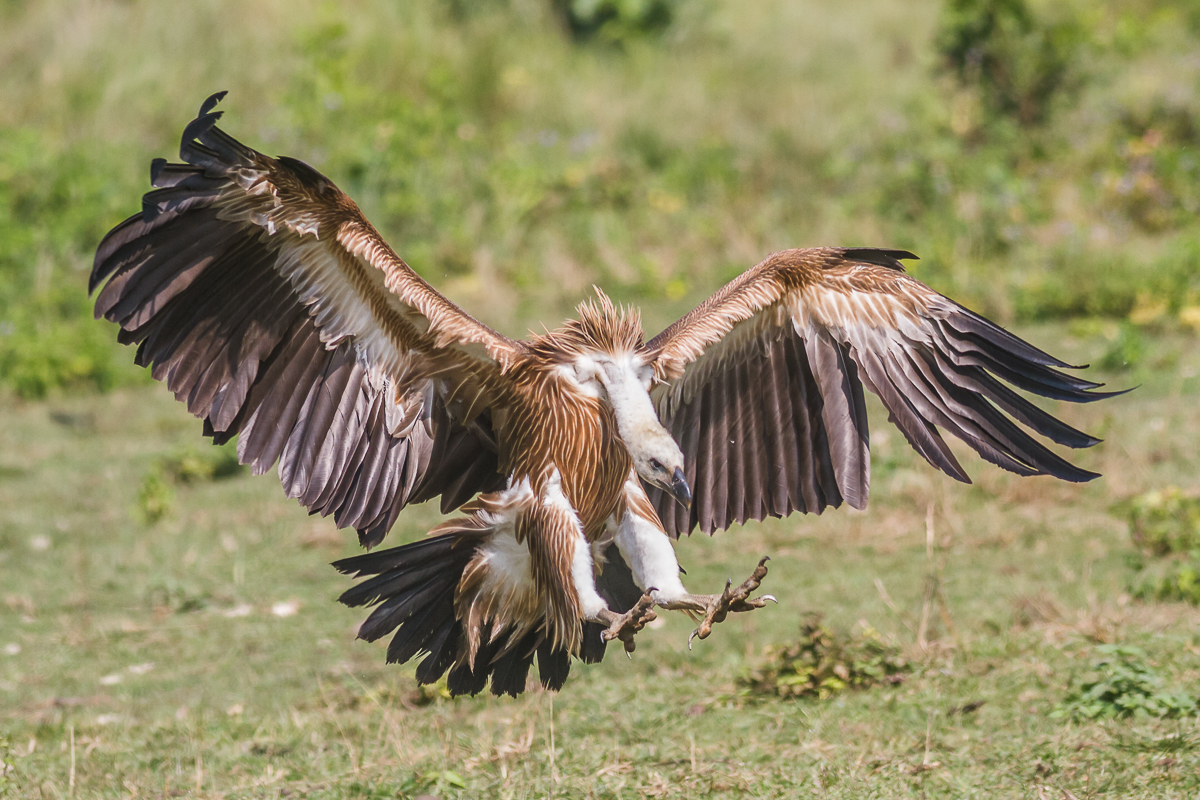
Griffon Vulture
- Common Name: Griffon Vulture (also known as Eurasian Griffon)
- Scientific Name: Gyps fulvus
- Nepali Name(s): खैरो गिद्ध (Khairo Giddha)
- IUCN Red List Status: Least Concern (LC)
- National Red List Status (Nepal): Data Deficient (DD)
- CITES Appendix: Appendix II
- CMS Appendix: Appendix II
Measurements & Physical Profile
- Body Length: 93–110 cm
- Wingspan: 230–269 cm
- Weight: 6.0–11.0 kg
Did You Know?
The Griffon Vulture is a master of soaring energy conservation. To stay aloft for hours while scanning for carrion, it utilizes thermal updrafts to reach heights of over 6,000 meters. By locking its wings in a specific dihedral position, it can glide for hundreds of kilometers with almost zero muscular effort, conserving energy until a carcass is spotted.
Distribution & Habitat
Global Distribution
The Griffon Vulture occupies a vast range across the warm-temperate and subtropical zones of the western and central Palearctic. It breeds locally across the Mediterranean basin, Northwest Africa, the Balkans, Turkey, the Middle East, and the Caucasus, stretching eastward into Central Asia, Iran, Afghanistan, and the western mountains of India.
While Mediterranean populations are mostly sedentary, juveniles and northern Palearctic cohorts carry out extensive nomadic and migratory wanderings during the autumn and winter, drifting deep into sub-Saharan Africa and the South Asian plains.
Distribution within Nepal
In Nepal, it is a scarce but regular winter visitor and passage migrant, primarily recorded in the western and central high-altitude regions of Nepal. Instead, individual wintering birds and wandering subadults move through the mid-hills and lowland Tarai from October to April. They are regularly observed feeding alongside resident species at vulture safe feeding sites ("Vulture Restaurants") and open landscapes within the Kaski (Pokhara Valley), Tanahu, Nawalparasi, Dang, and Chitwan districts.
Preferred Habitats
An open-country generalist. It highly favors wide, exposed landscapes including arid montane steppes, broken shrubby hillsides, rocky ravines, pastoral grasslands, and lowland agricultural plains. It requires open vistas for visual foraging and uses high rocky cliffs or mature, solitary trees for communal roosting.
Elevational Range
Vast vertical limits during winter wandering. It is routinely encountered gliding over lowland plains at 75 meters up to mid-hill ridges and open valleys at 2,500 meters above sea level.
Seasonal Occurrence
Primarily a winter visitor and passage migrant in Nepal. It is most likely to be encountered during the non-breeding season when individuals move south from their breeding grounds in Central Asia.
Behavior & Ecology
Flight & Foraging Behavior
A highly social and gregarious species. They are "obligate scavengers," relying entirely on the discovery of dead animals. They possess an incredibly keen sense of sight, allowing them to spot carcasses from great heights. Once a bird descends to a food source, others follow, leading to rapid communal feeding.
Structurally, its long, bare neck allows it to reach deep inside the chest cavities of large ungulate carcasses. In the feeding hierarchy, it typically dominates smaller Gyps species (like the White-rumped Vulture) but yields ground to the larger Himalayan Vulture and Cinereous Vulture.
Social & Roosting Habits
They are highly colonial, typically roosting on inaccessible cliff ledges. They are social even while feeding, and while they do not have a complex vocal repertoire, they communicate through various hissing and grunting sounds at the carcass.
Diet & Ecosystem Role
- Diet Breakdown: Exclusively carrion. They specialize in consuming the soft tissues of large mammal carcasses, including domestic livestock (cows, buffalo, sheep) and wild ungulates.
- Ecological Role: As primary scavengers, they provide an essential ecosystem service by rapidly removing decaying carcasses. This process significantly reduces the risk of disease outbreaks (such as anthrax) and prevents water contamination in rural environments.
Breeding Biology
In their native breeding range (Central Asia/Europe), they are monogamous and nest on sheltered cliff ledges, its active breeding takes place from January to July. They are highly colonial cliff-nesters, with colonies sometimes exceeding 20 to 50 pairs on a single cliff system. They build a relatively small, messy platform nest out of sticks, grass, and wool tucked onto a sheltered cliff ledge or inside a cave. The female lays a single, large white egg. Both parents share incubation duties for approximately 50–55 days. The chick is altricial and typically remains in the nest for 110–130 days before fledging.
Migration
- Status: Winter visitor and passage migrant.
- Movement: Unlike resident vultures, many populations of Gyps fulvus are migratory. They undertake long-distance journeys from Central Asian breeding grounds to wintering sites across the Indian subcontinent and parts of the Himalayas.
Population Status
- Global Population Estimate: Estimated at 80,000–900,000 matured individuals; population trend is increasing in some parts of Europe but variable elsewhere.
- National Population Estimate (Nepal): Winter visitor; numbers are not well-quantified due to difficulty in distinguishing them from the resident Himalayan Griffon in the field.
- Monitoring & Surveys: Monitored through raptor migration watch points and targeted observations in high-altitude corridors and feeding sites.
Threats
- Veterinary Drug Toxicity: The use of toxic NSAIDs (like Diclofenac, nimesulide, aceclofenac, ketoprofen) in livestock is a critical threat. They are susceptible to secondary poisoning from contaminated carcasses.
- Food Scarcity: Modern carcass disposal methods (e.g., burial or incineration) reduce the available food source for scavenging birds.
- Electrocution: Collisions or electrocution with poorly designed power transmission lines in mountain passes.
- Secondary Poisoning from Baits: Vultures frequently fall victim to accidental secondary poisoning when livestock owners lace carcasses with toxic insecticides to eliminate mammalian predators like leopards or feral dogs.
Conservation Actions
Existing Measures
- Regional Protection: Protected under national laws in many countries within its range.
- Trade Regulations: Regulated under CITES Appendix II to prevent illegal international trade.
Recommended Measures
- Cross-Border Collaboration: Since this is a migratory species, conservation requires transboundary cooperation between Central Asian and South Asian nations to ensure safe "Vulture Safe" corridors.
- Drug Monitoring: Continued vigilance in banning toxic veterinary drugs across the entire migratory flyway.
- Insulating Power Infrastructure: Retrofitting and insulating high-voltage electrical transformers and crossarms inside major cities to eliminate raptor electrocution hotspots.
References
- BirdLife International (2021). Species factsheet: Griffon Vulture Gyps fulvus. Downloaded from https://datazone.birdlife.org/species/factsheet/griffon-vulture-gyps-fulvus on 05/08/2026
- Ferguson-Lees, J., & Christie, D. A. (2001). Raptors of the World. Christopher Helm, London.
- Inskipp C., Baral H. S., Phuyal S., Bhatt T. R., Khatiwada M., Inskipp, T, Khatiwada A., Gurung S., Singh P. B., Murray L., Poudyal L. and Amin R. (2016). The status of Nepal’s Birds: The national red list series. Zoological Society of London, UK.
- Naoroji, R. (2006). Birds of Prey of the Indian Subcontinent. Om Books International, New Delhi.
- Salvador, A. (2026). Eurasian Griffon (Gyps fulvus), version 10.0. In Birds of the World (S. M. Billerman, M. A. Bridwell, and B. K. Keeney, Editors). Cornell Lab of Ornithology, Ithaca, NY, USA. https://doi.org/10.2173/bow.eurgri1.10