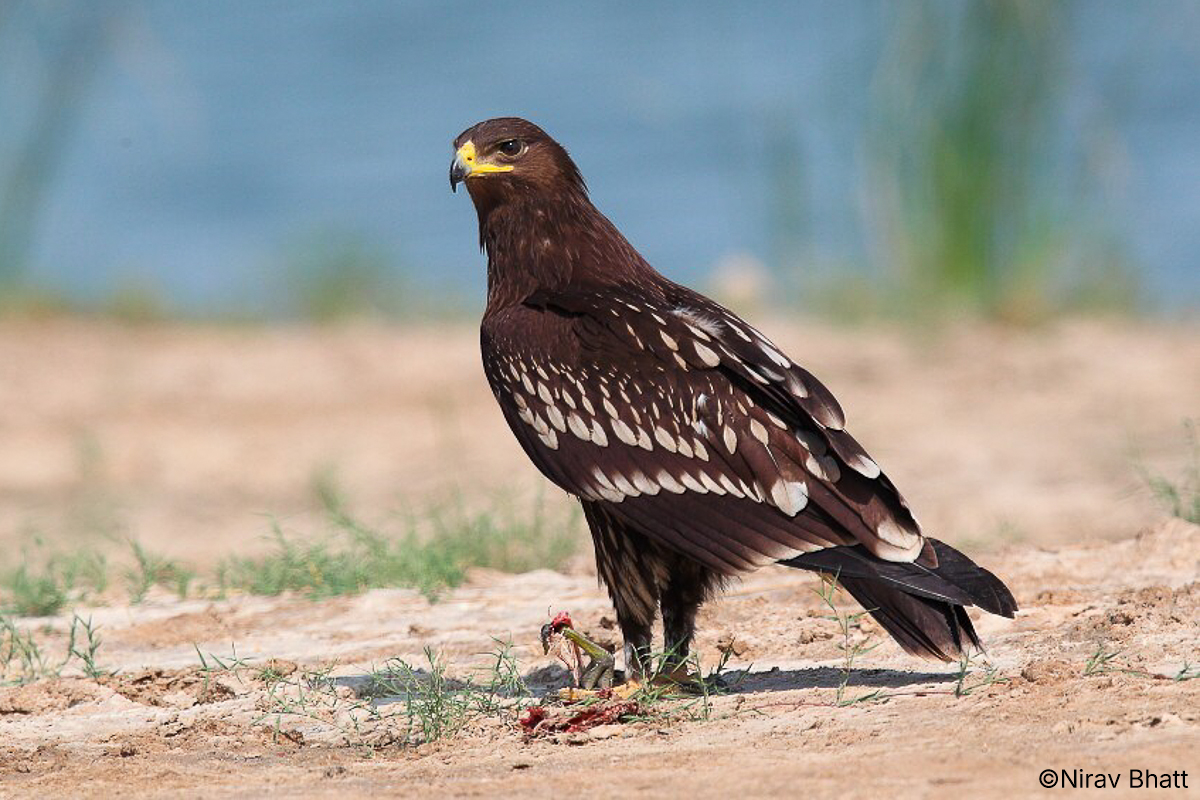
Greater Spotted Eagle
- Common Name: Greater Spotted Eagle
- Scientific Name: Clanga clanga (formerly Aquila clanga)
- Nepali Name(s): जीवाहार महाचिल (Jiwahaar Mahachil)
- IUCN Red List Status: Vulnerable (VU)
- National Red List Status (Nepal): Vulnerable (VU)
- CITES Appendix: Appendix II
- CMS Appendix: Appendix I & II
Measurements & Physical Profile
- Body Length: 59–71 cm
- Wingspan: 155–180 cm
- Weight: 1,500–2,500 g
Did You Know?
The Greater Spotted Eagle is an evolutionary wetland specialist, distinct from most booted eagles (Aquila spp.) that typically inhabit mountain ridges. It is structurally adapted for low-level hunting over waterlogged terrain, possessing comparatively long legs and highly specialized feet designed to plunge into shallow water and mud to capture slippery prey like fish, frogs, and water birds.
Distribution & Habitat
Global Distribution
The Greater Spotted Eagle maintains an extensive but fragmented breeding range across the middle latitudes of the Palearctic, stretching from eastern Poland, Belarus, and the Baltic states eastward through Russia and Siberia to northern Mongolia and northeast China. It is a strongly migratory species that travels south along multi-branched flyways to winter in the Mediterranean basin, northeast Africa, the Middle East, the Indian Subcontinent, and parts of mainland Southeast Asia.
Distribution within Nepal
In Nepal, the species is a regular, widely distributed winter visitor and an active autumn passage migrant, operating primarily across the lowlands and the aquatic margins of the mid-hills. Key winter concentrations are found in large alluvial protected complexes and Ramsar sites, such as Koshi Tappu Wildlife Reserve, Chitwan National Park, Bardia National Park, and Shuklaphanta National Park. It is also regularly recorded in the Pokhara Valley and lowland irrigation barrages.
Preferred Habitats
A strict specialist of wet, mosaic lowland landscapes, it favors flooded alluvial grasslands, riverine forest margins, freshwater marshes, lake edges, peat bogs, and poorly drained agricultural zones. It avoids completely arid deserts and closed-canopy mountain forests.
Elevational Range
Primarily a bird of the lowlands, it occurs most abundantly from 75 meters up to 300 meters within the Tarai. During migration, individuals regularly move through mid-hill lake basins up to 1,000 meters, occasionally crossing higher hill saddles.
Behavior & Ecology
Flight & Foraging Behavior
In flight, it displays a heavy, broad-winged silhouette, holding its long wings with a distinctive down-curved profile that drops notably at the carpal joints (wrists), creating a bowed appearance. The tail is short, broad, and slightly rounded. It frequently hovers or performs low-altitude quartering flights over marshes, or sits on low perches like tree stumps or irrigation dykes before gliding down to strike prey. Vocalizations are generally silent outside of breeding grounds, though it may emit a sharp, barking yelp ("kyak-kyak-kyak" or "tyuck-tyuck") when alarmed or interacting with other raptors.
Diet & Ecosystem Role
Diet Breakdown
- Water Birds: Hunts coots, ducks, grebes, moorhens, and chicks of herons or egrets.
- Small Mammals: Captures water voles, muskrats, field mice, and rats along agricultural dykes and marshy edges.
- Amphibians & Fish: Consumes frogs, toads, large aquatic salamanders, and stranded fish from drying pools.
- Carrion: Opportunistically scavenges on dead fish or livestock scraps, sometimes joining vultures.
Ecological Role
An opportunistic carnivore, its diet shifts to exploit seasonal spikes in wetland wildlife. As a specialized predator of waterlogged terrain, the Greater Spotted Eagle plays a vital ecological role as a consumer of wetland vertebrates, helping to regulate populations of small mammals, amphibians, and various aquatic birds within its mosaic habitat.
Breeding Biology
Breeding occurs within northern Palearctic forest-steppe zones from May to August. Pairs build large, bulky nests (100–120 cm across) of sticks and twigs, lined with fresh green leaves and pine needles, typically in a mature deciduous tree within damp woodlands. It lays 2 eggs, incubation lasts for 42 to 44 days, primarily by the female. Facultative siblicide (Cainism) is common; the older chick usually outcompetes the younger. Surviving eaglets fledge after 60 to 65 days.
Migration
Present in Nepal primarily from October through April. Autumn migrants typically arrive by early to mid-October, and individuals return to the Siberian taiga by late March.
Population Status
- Global Population: 3,900 – 10,000 mature individuals
- Global Trend: Declining.
- National Population Estimates (Nepal): Unknown.
Threats
- Wetland Drainage: Loss of marshes and floodplains to development.
- Agricultural Intensification: Use of chemicals reduces prey abundance (frogs, rodents).
- Hybridization: Genetic threats from interspecific hybridization with the Lesser Spotted Eagle (Clanga pomarina) in western ranges.
- Electrocution & Lead Poisoning: Risks from power lines and ingestion of lead shot in water birds.
Conservation Actions
Existing measures
- International: Protected under CITES Appendix II and CMS Appendix I & II.
- National: Core populations benefit from habitat security within Nepal’s Ramsar sites and national parks.
Recommended Measures
- Preserving traditional, low-intensity, pesticide-free paddy mosaics.
- Restoring wetland connectivity and preventing industrial conversion.
- Expanding satellite-tracking/telemetry studies to monitor migration and wintering hotspots.
References
- BirdLife International (2021). Species factsheet: Greater Spotted Eagle Clanga clanga. Downloaded from https://datazone.birdlife.org/species/factsheet/greater-spotted-eagle-clanga-clanga on 05/08/2026
- Ferguson-Lees, J., & Christie, D. A. (2001). Raptors of the World. Christopher Helm, London.
- Inskipp C., Baral H. S., Phuyal S., Bhatt T. R., Khatiwada M., Inskipp, T, Khatiwada A., Gurung S., Singh P. B., Murray L., Poudyal L. and Amin R. (2016). The status of Nepal’s Birds: The national red list series. Zoological Society of London, UK.
- Meyburg, B.-U., G. M. Kirwan, and E. Garcia (2020). Greater Spotted Eagle (Clanga clanga), version 1.0. In Birds of the World (J. del Hoyo, A. Elliott, J. Sargatal, D. A. Christie, and E. de Juana, Editors). Cornell Lab of Ornithology, Ithaca, NY, USA. https://doi.org/10.2173/bow.grseag1.01
- Naoroji, R. (2006). Birds of Prey of the Indian Subcontinent. Om Books International, New Delhi.