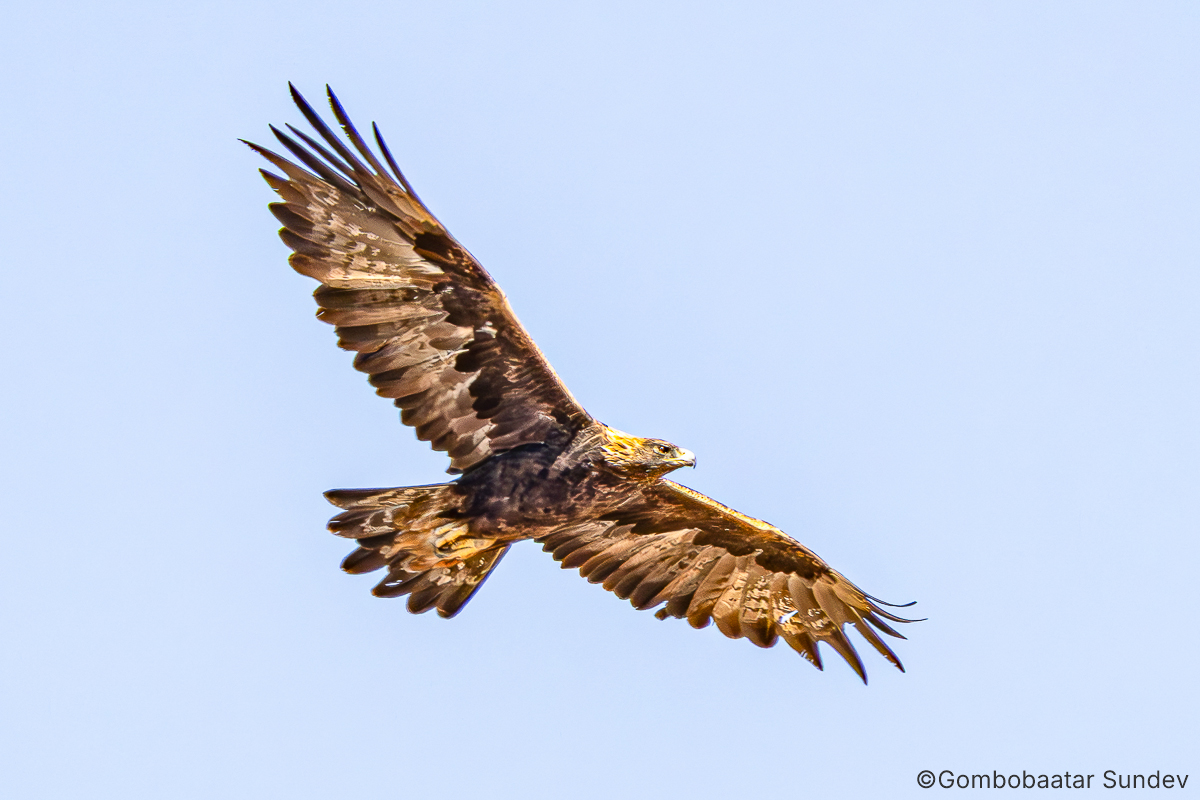
Golden Eagle
- Common Name: Golden Eagle
- Scientific Name: Aquila chrysaetos
- Nepali Name(s): सुवर्ण महाचिल (Subarna Mahachil)
- IUCN Red List Status: Least Concern (LC)
- National Red List Status (Nepal): Vulnerable (VU)
- CITES Appendix: Appendix II
- CMS Appendix: Appendix II
Measurements & Physical Profile
- Body Length: 76–101 cm
- Wingspan: 180–234 cm
- Weight: 2,387 – 6,460 g
Did You Know?
Golden Eagles are extraordinary aerial hunters capable of diving at speeds exceeding 240–320 km/h to strike prey. They possess such immense gripping strength in their feet that they regularly kill mammalian prey weighing significantly more than themselves—including adult mountain goats, deer fawns, and wolves—making them a legendary apex predator of the high ranges.
Distribution & Habitat
Global Distribution
The Golden Eagle is one of the most widely distributed Holarctic raptors, occupying vast, remote wilderness regions across North America, Europe, North Africa, and northern to central Asia. Northern boreal cohorts in Canada, Scandinavia, and Russia are migratory, moving south during harsh winter lockouts. Conversely, mountain populations across the Palearctic and southern zones remain strictly sedentary, defending massive territories year-round.
Distribution within Nepal
In Nepal, it is a scarce, highly territorial permanent resident breeder. It is strictly tied to the rugged, high-altitude alpine zones of the Himalayas and the arid trans-Himalayan rain-shadow plateaus. Stable breeding pairs maintain massive hunting domains across the high cliff networks of Langtang, Mustang, Dolpa, Manang, Humla, Mugu etc. While they are predominantly sedentary, subadults and non-breeding individuals occasionally execute down-slope altitudinal movements in the winter, wandering over the upper mid-hills and lower river gorges.
Preferred Habitats
A specialist of mountainous and open-country terrain. It thrives across high-alpine meadows, desolate rocky crags, open subalpine scrub zones, high-elevation river valleys, and trans-Himalayan steppes. It requires deep, steep-sided cliff networks or precipitous ravines for secure nesting sites, and relies on expansive, un-forested airspaces to detect ground mammals from aloft.
Elevational Range
Thrives almost entirely within the upper tiers of the vertical landscape. In Nepal, it typically breeds and hunts from 3,000 meters up to 5,500 meters above sea level. Foraging individuals are regularly observed soaring over high mountain passes and glacier margins well above the tree line.
Behavior & Ecology
Flight & Foraging Behavior
In flight, the Golden Eagle presents a majestic, long-winged profile. The wings are held in a slight, clean dihedral "V" shape, with long primary flight feathers widely fanned out. Pairs are monogamous, forming intense bonds that endure for life. They fiercely patrol expansive territories that can span anywhere from 50 to over 150 square kilometers, executing spectacular synchronized undulating aerial displays to signal territory lines to intruding eagles.
Diet & Ecosystem Role
The Golden Eagle is a dominant carnivore, adapting its hunting focus to exploit the most abundant medium-sized mammals across the alpine terrain:
- Mammals (~85% of diet): Heavily preys on Himalayan Marmots (Marmota himalayana), hares, and pikas. Regularly targets young ungulates, including kids of Himalayan Goral, Blue Sheep (Pseudois nayaur), and domestic lambs.
- Birds: Captures large ground-dwelling birds on the wing or on rocky slopes, focusing on Snowcocks, pheasants, chukars, and snow pigeons.
- Carrion: Highly reliant on winter carrion. Readily scavenges on winter-killed carcasses of yaks, sheep, and mountain ungulates, frequently dominating food sites over vultures.
Ecological Role
As a critical apex predator within alpine ecosystems, the Golden Eagle functions as a top-tier regulator of high-altitude vertebrate populations. By maintaining long-term territorial stability and preying on a variety of medium-sized mammals and ground-dwelling birds, it exerts top-down pressure that influences the distribution and behavior of its prey species.
Breeding Biology
The breeding timeline kicks off during mid-winter (January to February), allowing young eagles to fledge when marmots and pikas emerge in late spring. Pairs construct massive, heavy platforms of thick sticks and branches, measuring up to 1.5 to 2 meters across. These structures are lined with soft grass, moss, and green evergreen twigs. Nests are usually tucked securely onto inaccessible cliff ledges, deep inside cave openings, or on remote rocky buttresses. A single pair often maintains 2 to 5 alternate nests within their territory, rotating between them over different years. Almost always lays 2 white eggs, heavily speckled with blotches of reddish-brown and lavender. Incubation period lasts 41 to 45 days, handled primarily by the female while the male provides food. The hatched chicks covered in pure white down. Due to obligate or facultative siblicide (Cainism), the older, stronger chick frequently attacks and kills its younger sibling within the first two weeks of hatching. The surviving eaglet develops rapidly and fledges after 70 to 80 days, remaining dependent on parental hunting across the home valley for several months before full autumn dispersal.
Migration
- Status: Predominantly sedentary (resident) in mountainous zones.
- Movement: Northern boreal populations are migratory, undertaking movements to escape harsh winter conditions. In Nepal, while breeding adults remain strictly sedentary, subadults and non-breeding birds may perform localized, down-slope altitudinal movements during winter months.
Population Status
- Global Population: 85,000 – 160,000 mature individuals.
- Population Trend: Stable
- National Population Estimate (Nepal): 100 - 200 individuals.
Threats
- Retaliatory Poisoning: Livestock herders occasionally lace carcasses with toxic pesticides to target large mammalian predators like Snow Leopards or wolves. Scavenging Golden Eagles readily feed on these carcasses, resulting in swift, accidental secondary poisoning.
- Poaching & Nest Disturbance: Occasional illegal nest raiding for falconry or collection for the illegal wildlife trade. Increased human traffic from alpine tourism and livestock herding can cause pairs to abandon active clutches.
- Prey Base Depletion: Overgrazing by high densities of domestic livestock can severely degrade alpine pastures, leading to local declines in critical wild prey like marmots and hares.
Conservation Actions
Existing Measures
- International: Fully protected under CITES Appendix II and Appendix II of the Convention on Migratory Species (CMS).
- National: Core trans-Himalayan breeding strongholds are safely enclosed within large protected areas, including Shey Phoksundo National Park, Langtang National Park, and the Annapurna Conservation Area.
Recommended Measures
- Mitigating Poisoning Hotspots: Expanding community-level livestock insurance programs and running targeted educational campaigns to eliminate the use of toxic carcass baits.
- Enforcing Seasonal Buffers: Establishing strict exclusion zones around known historical nesting cliffs to prevent disturbance from adventure tourism and mountaineering teams during the critical winter incubation phase.
- High-Altitude Raptor Surveys: Setting up systematically coordinated winter occupancy surveys in trans-Himalayan districts to establish precise baseline tracking for this magnificent mountain monarch.
References
- BirdLife International (2021). Species factsheet: Golden Eagle Aquila chrysaetos. Downloaded from https://datazone.birdlife.org/species/factsheet/golden-eagle-aquila-chrysaetos on 06/08/2026
- Katzner, T. E., M. N. Kochert, K. Steenhof, C. L. McIntyre, E. H. Craig, and T. A. Miller (2020). Golden Eagle (Aquila chrysaetos), version 2.0. In Birds of the World (P. G. Rodewald and B. K. Keeney, Editors). Cornell Lab of Ornithology, Ithaca, NY, USA. https://doi.org/10.2173/bow.goleag.02
- Ferguson-Lees, J., & Christie, D. A. (2001). Raptors of the World. Christopher Helm, London.
- Inskipp C., Baral H. S., Phuyal S., Bhatt T. R., Khatiwada M., Inskipp, T, Khatiwada A., Gurung S., Singh P. B., Murray L., Poudyal L. and Amin R. (2016). The status of Nepal’s Birds: The national red list series. Zoological Society of London, UK.
- Naoroji, R. (2006). Birds of Prey of the Indian Subcontinent. Om Books International, New Delhi.