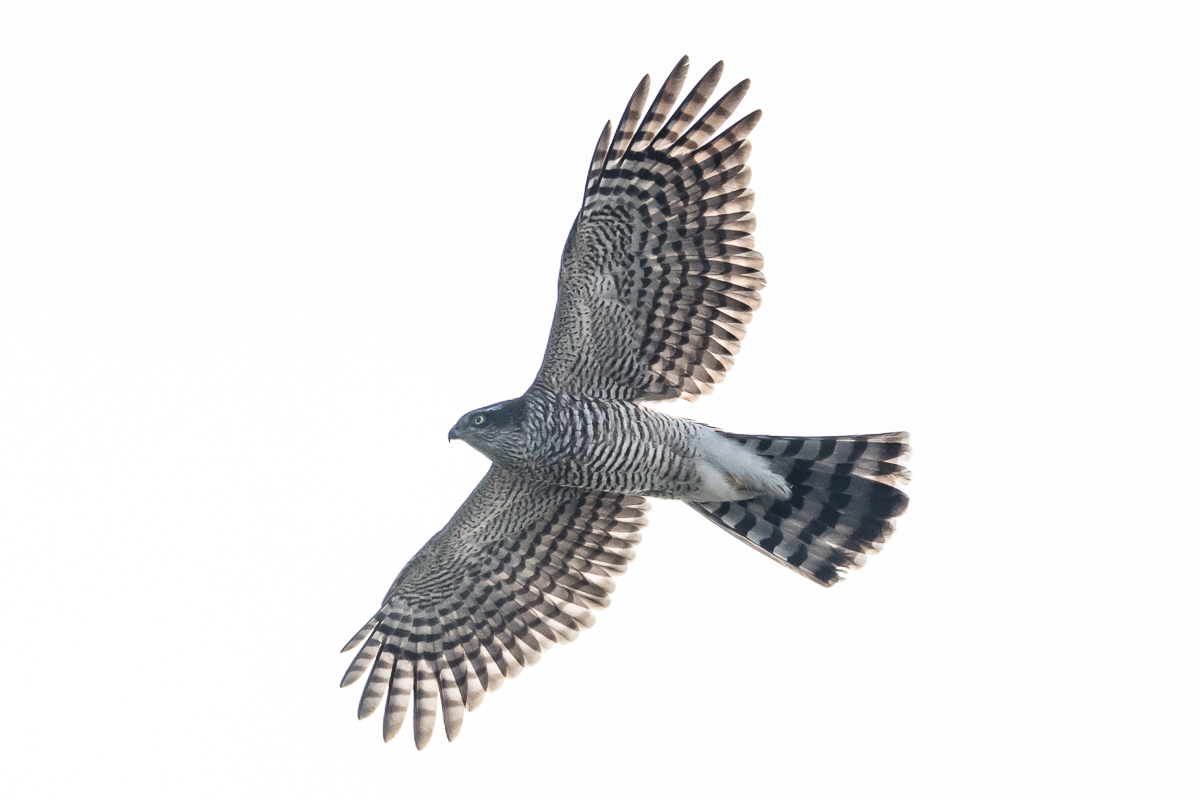
Eurasian Sparrowhawk
- Common Name: Eurasian Sparrowhawk
- Scientific Name: Accipiter nisus
- Nepali Name(s): वन बाज (Ban Baaz)
- IUCN Red List Status: Least Concern (LC)
- National Red List Status (Nepal): Least Concern (LC)
- CITES Appendix: Appendix II
- CMS Appendix: Not listed
Measurements & Physical Profile
- Body Length: 28 – 40 cm
- Wingspan: 56 – 78 cm
- Weight: 105 –350 g
Did You Know?
The Eurasian Sparrowhawk is a master of "flap-flap-glide" flight, a specialized movement pattern that creates an undulating silhouette. This stealthy ambush predator often waits silently under dense foliage before launching a low-level, high-speed dash along hedgerows or buildings to surprise avian prey.
Distribution & Habitat
Global Distribution
The Eurasian Sparrowhawk is an incredibly widespread forest raptor occupying a vast range across the temperate and subtropical zones of the Palearctic. It breeds in suitable woodlands across all of Europe, the Mediterranean basin, parts of Northwest Africa, and a broad northern belt running eastward through Siberia, Central Asia, and northern China to Japan. Northern boreal populations are strongly migratory, flying south in autumn to winter in the Mediterranean, northern Africa, the Middle East, the Arabian Peninsula, and southern Asia (spanning Pakistan, India, Nepal, and Indochina).
Distribution within Nepal
In Nepal, it is a common and widespread winter visitor and a highly visible autumn passage migrant. It can be found across the entire length of the country, utilizing both the lowland Tarai plains and the deep mid-hill valleys. During the peak migration window (October to November), they are tracked crossing the Thoolakharka raptor watch-sites in Kaski district. Wintering cohorts are stable around forest edges in Chitwan National Park, Bardia National Park, and the suburban margins of the Pokhara and Kathmandu valleys.
Preferred Habitats
A highly adapted woodland and forest-edge specialist. It favors deciduous, mixed, and coniferous woodlands, scrubby riverine forests, and orchards. It is incredibly versatile and has adapted cleanly to human-dominated landscapes, frequently hunting through suburban gardens, town parks, and agricultural hedgerows where songbirds congregate.
Elevational Range
Exhibits an immense vertical distribution. In the winter dry season, it is common from the lowlands at 75 meters up to the mid-hills around 2,000 meters. However, during active migration flights, individuals are regularly recorded traversing high-altitude mountain passes and interior Himalayan valleys up to 4,500 meters above sea level.
Behavior & Ecology
Flight & Foraging Behavior
In flight, the Eurasian Sparrowhawk shows a classic Accipiter silhouette: short, broad, rounded wings built for rapid, burst-speed acceleration through dense branches, paired with a long, narrow, square-tipped tail that acts as an agile rudder for sharp mid-air banking.
Social & Roosting Habits
Generally quiet and secretive during its winter stay in South Asia. Near nesting territories or when highly agitated, it produces a rapid, high-pitched, chattering alarm series: "kek-kek-kek-kek-kek" or "kyak-kyak-kyak", which carries a sharp, dry, repetitive cadence.
Diet & Ecosystem Role
The Eurasian Sparrowhawk is a strict, highly specialized carnivore, with small-to-medium birds comprising over 90–97% of its total dietary intake:
- Males (Smaller): Specializes almost entirely on small forest and garden passerines. Targets tits, finches, sparrows, warblers, and pipits weighing between 10 to 40 grams.
- Females (Larger): Capable of tackling much heavier, robust birds. Regularly hunts thrushes, starlings, bulbuls, feral pigeons, doves, and even common mynas weighing up to 150 grams or more.
- Other Prey (Minor): Both sexes will opportunistically take small rodents (voles, shrews, field mice), small lizards, or large emerging beetles if avian prey is locally scarce.
Breeding Biology
The breeding cycle opens in April and extends into August across its temperate range. Courtship features spectacular aerial sky-dancing, where the male performs steep, high-altitude dives and looping flights over the forest canopy to attract a mate. Pairs are seasonally monogamous but frequently shift partners between years. They build a substantial, completely flat platform nest constructed entirely out of thin twigs and dry branches, measuring up to 60 cm across. The nest is typically hidden away close to the main trunk in the lower to mid-canopy of a mature coniferous or dense deciduous tree, often situated near an open forest clearing or trail. Typically lay 4 to 5 pale blue eggs, beautifully blotched with dark chocolate-brown spots. Incubation lasts 33 to 35 days, performed almost exclusively by the female. The young fledge the nest at roughly 26 to 30 days old but continue to linger along the forest edge, receiving parental food drop-offs for another 3 to 4 weeks before fully dispersing.
Migration
- Status: Migratory.
- Movement: Six valid subspecies are recognized. Accipiter nisus nisosimilis breeds from central and eastern Siberia east to Kamchatka and northern Japan; it is the primary migratory form that winters heavily across Nepal and northern India.
Population Status
- Global Population: 2-3.2 million mature individuals.
- Population Trend: Stable.
- National Population Estimates (Nepal): 3,000 – 5,000 individuals
Threats
- Window and Glass Collisions: Modern urban mortality source due to high-speed, low-level hunting.
- Pesticide Abuse: Intensive use in wintering farmlands leads to secondary toxicity.
- Loss of Woodland Connectivity: Degradation of structural cover required for ambush hunting.
Conservation Actions
Existing Measures
- International: Protected under CITES Appendix II.
- National: Forested segments within Nepal's national park network provide exceptional, pesticide-free sanctuary.
Recommended Measures
- Mitigating Urban Window Strikes: Promoting bird-safe UV decals or screens on large windows in suburban developments.
- Preserving Multi-Tiered Hedgerows: Encouraging maintenance of continuous hedgerows to support songbird and predator populations.
- Long-Term Banding and Telemetry: Supporting international ringing studies to map flyway connectivity.
References
- BirdLife International (2021). Species factsheet: Eurasian Sparrowhawk Accipiter nisus. Downloaded from https://datazone.birdlife.org/species/factsheet/eurasian-sparrowhawk-accipiter-nisus on 06/08/2026
- Ferguson-Lees, J., & Christie, D. A. (2001). Raptors of the World. Christopher Helm, London.
- Inskipp C., Baral H. S., Phuyal S., Bhatt T. R., Khatiwada M., Inskipp, T, Khatiwada A., Gurung S., Singh P. B., Murray L., Poudyal L. and Amin R. (2016). The status of Nepal’s Birds: The national red list series. Zoological Society of London, UK.
- Meyburg, B.-U., J. S. Marks, E. Garcia, and Y. Perlman (2025). Eurasian Sparrowhawk (Accipiter nisus), version 1.1. In Birds of the World (J. del Hoyo, A. Elliott, J. Sargatal, D. A. Christie, E. de Juana, and M. G. Smith, Editors). Cornell Lab of Ornithology, Ithaca, NY, USA. https://doi.org/10.2173/bow.eurspa1.01.1
- Naoroji, R. (2006). Birds of Prey of the Indian Subcontinent. Om Books International, New Delhi.