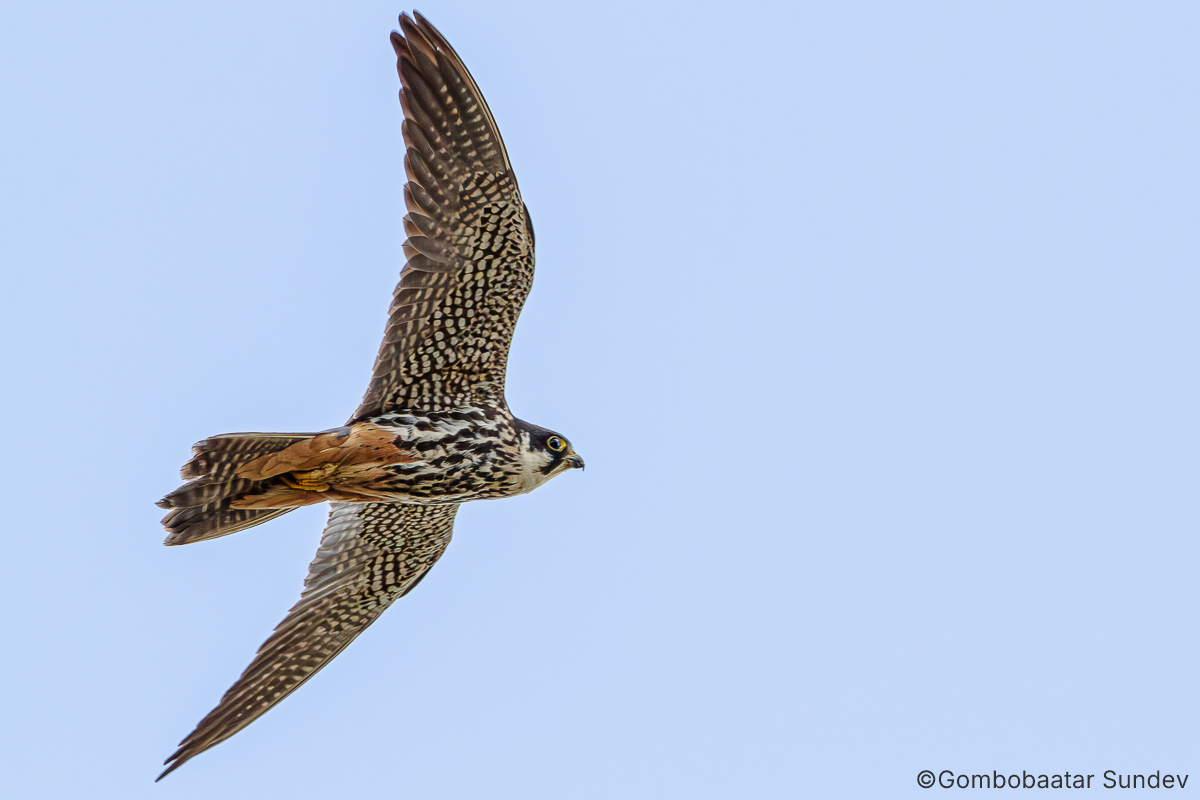
Eurasian Hobby
- Common Name: Eurasian Hobby
- Scientific Name: Falco subbuteo
- Nepali Name(s): जुंगे चिरान्तक बाज (Junge Chirantak Baaz)
- IUCN Red List Status: Least Concern (LC)
- National Red List Status (Nepal): Least Concern (LC)
- CITES Appendix: Appendix II
- CMS Appendix: Appendix II
Measurements & Physical Profile
- Body Length: 28–37 cm
- Wingspan: 69–84 cm
- Weight: 130–340 g
Did You Know?
The Eurasian Hobby is one of the few raptors capable of catching Barn Swallows and Common Swifts in full flight. Possessing extreme aerial speed and manoeuvrability, it actively hunts large insects like dragonflies, transfers them seamlessly from its talons to its beak mid-air, and consumes them entirely while soaring without losing forward momentum.
Distribution & Habitat
Global Distribution
The Eurasian Hobby has an extensive Palearctic and Indo-Malayan range. It breeds across the temperate and boreal belts of Europe and Asia, from Great Britain and Spain eastward through Russia, Central Asia, and Siberia to northern China and Japan. It is a highly migratory, long-distance traveller, undertaking immense journeys to winter in sub-Saharan Africa and across South and Southeast Asia.
Distribution within Nepal
Primarily a regular and widespread passage migrant in autumn and spring, as well as a scarce summer breeding resident in northern montane valleys. During the peak migration (late September to November), significant numbers are tracked soaring along central mid-hill ridges, with regular data collected at the Thoolakharka raptor watch-sites in Kaski district. Transient individuals are frequently observed near water bodies, agricultural valleys, and marshlands in the Pokhara Valley, Chitwan National Park, and Koshi Tappu Wildlife Reserve.
Preferred Habitats
A semi-open landscape specialist. It highly favors open woodland edges, riverine forests, mosaic farmlands, savannas, marshes, and heathlands. It avoids thick, unbroken interior jungle and completely barren high-altitude rock deserts, requiring a mix of open hunting air and scattered mature trees for perching.
Elevational Range
Vast vertical scope. While wintering and passage birds are common across lowland plains and mid-hill valleys (75–2,000 meters), migrating individuals frequently cross high mountain passes and subalpine meadows up to 4,000 meters.
Seasonal Occurrence
Most encounters occur during the autumn passage (September–November) and the return spring passage (March–May). A fraction of the population remains in the lower valleys through the winter, while a small, isolated cohort breeds in northern forest fringes during the summer.
Behavior & Ecology
Flight & Foraging Behavior
In flight, it strongly resembles a giant swift. It features long, narrow, scythe-like pointed wings paired with a short, square-tipped tail. Its flight is swift, direct, and erratic when chasing prey. Outside the breeding phase, it is highly crepuscular, focusing its most intense hunting drives during the cool hours of dawn and dusk when dragonfly swarms and bats emerge.
Social & Roosting Habits
Generally silent away from nesting zones. When alarmed near an active territory or during intense social encounters, it emits a sharp, rapid, and high-pitched chattering scream: "keer-keer-keer-keer" or "kew-kew-kew."
Diet & Ecosystem Role
- Diet Breakdown: Highly specialized aerial hunter.
- Insects: Dragonflies, damselflies, locusts, winged termites, and large moths.
- Small Birds: Aerial passerines, swallows and swift, larks, pipits, finches, and sparrows.
- Mammals: Opportunistically plucks small bats (Pipistrellus spp.) out of the air at twilight.
- Ecological Role: Acts as an apex aerial predator, crucial for controlling populations of flying insects and small birds.
Breeding Biology
The Eurasian Hobby never builds its own nest. Instead, it relies on abandoned stick structures of other large birds, primarily crows, rooks, magpies, or small hawks. The chosen nest tree is usually situated on the extreme outer edge of a forest patch, providing an unobstructed view of hunting grounds. Lays 2 to 3 rich buff-colored eggs. Incubation lasts for 28–31 days, managed almost entirely by the female. Fledges at 28–34 days, practicing complex mid-air food hand-offs with parents before achieving independence by late summer.
Migration
- Status: Migratory.
- Movement: Long-distance migrant; follows established flyways through Nepal's mid-hills and river valleys.
Population Status
- Global Population: 0.9 – 1.5 m mature individuals.
- Population Trend: Decreasing.
- National Population Estimates (Nepal): Unknown.
Threats
- Pesticide Overuse: Heavy application of chemicals in agriculture reduces populations of dragonflies and large insects.
- Loss of Habitat: Felling of solitary mature trees and cutting of hedgerows removes vital perching and nesting (crow-nest) sites.
- Wetland Degradation: Drainage and pollution of marshes reduce the availability of aerial insect swarms.
Conservation Actions
Existing Measures
- International: Protected under CITES Appendix II and CMS Appendix II.
- National: Important transit stopovers are naturally preserved within Nepal’s protected river basins and national parks.
Recommended Measures
- Bio-Friendly Agriculture: Encourage reduced chemical pesticide use in farming blocks to preserve flying insect populations.
- Wetland Protection: Protect open marshy fringes around urban and rural landscapes (e.g., Pokhara lakeshores) to ensure clean foraging zones.
- Monitoring: Expand seasonal raptor migration counting networks across Nepal to track long-term population and staging data.
References
- BirdLife International (2021). Species factsheet: Eurasian Hobby Falco subbuteo. Downloaded from https://datazone.birdlife.org/species/factsheet/eurasian-hobby-falco-subbuteo on 06/08/2026
- Ferguson-Lees, J., & Christie, D. A. (2001). Raptors of the World. Christopher Helm, London.
- Inskipp C., Baral H. S., Phuyal S., Bhatt T. R., Khatiwada M., Inskipp, T, Khatiwada A., Gurung S., Singh P. B., Murray L., Poudyal L. and Amin R. (2016). The status of Nepal’s Birds: The national red list series. Zoological Society of London, UK.
- Kirwan, G. M., J. Orta, J. S. Marks, P. Pyle, and Y. Perlman (2025). Eurasian Hobby (Falco subbuteo), version 1.1. In Birds of the World (G. M. Kirwan and B. K. Keeney, Editors). Cornell Lab of Ornithology, Ithaca, NY, USA. https://doi.org/10.2173/bow.eurhob.01.1
- Naoroji, R. (2006). Birds of Prey of the Indian Subcontinent. Om Books International, New Delhi.