Egyptian Vulture
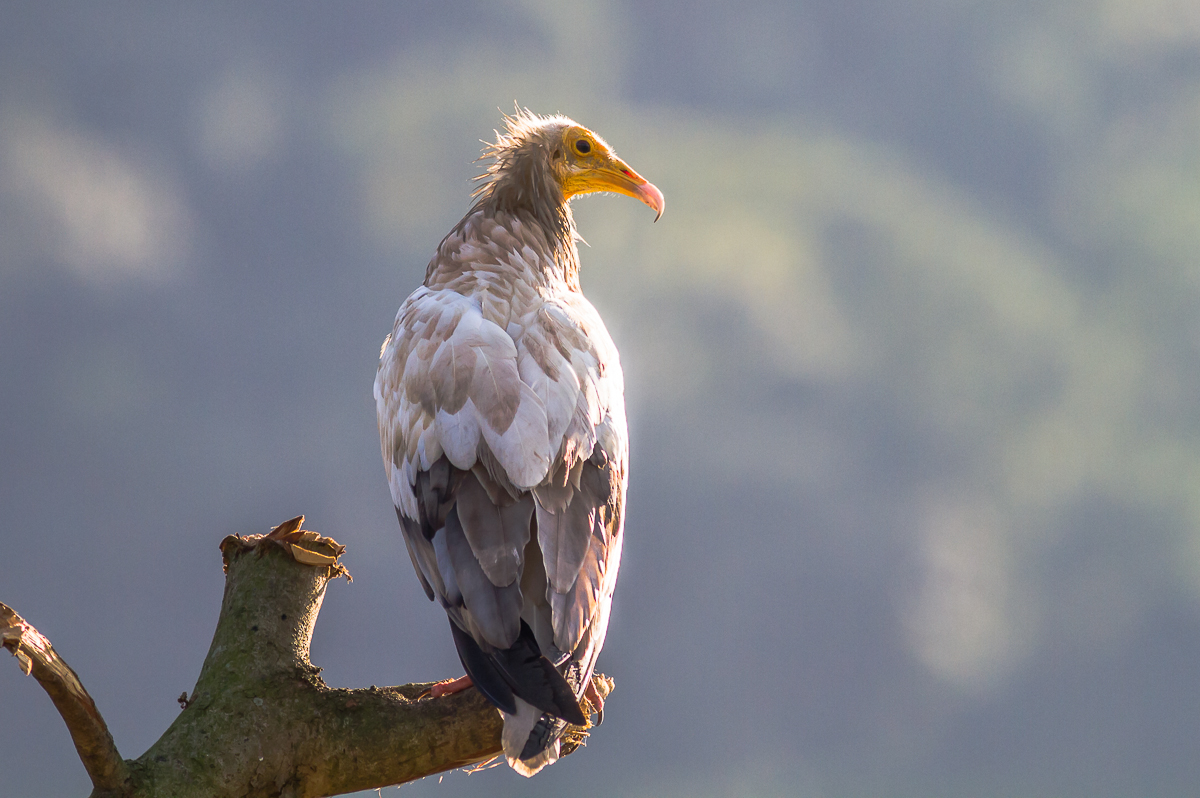
- Common Name: Egyptian Vulture
- Scientific Name: Neophron percnopterus
- Nepali Name(s): सेतो गिद्ध (Seto Giddha)
- IUCN Red List Status: Endangered (EN)
- National Red List Status (Nepal): Vulnerable (VU)
- CITES Appendix: Appendix II
- CMS Appendix: Appendix I
Measurements & Physical Profile
- Body Length: 47–65 cm
- Wingspan: 155–180 cm
- Weight: 1,600–2,400 g
Did You Know?
The Egyptian Vulture is one of the few birds documented using tools. When encountering a large, thick-shelled egg (like an ostrich egg), it will pick up a rounded pebble in its beak and repeatedly fling it downward with tremendous force until the shell cracks. It even displays a cultural preference for specific weights and shapes of stones, passing this knowledge down through generational learning.
Distribution & Habitat
Global Distribution
The Egyptian Vulture maintains a highly fragmented breeding range across the Old World. It stretches from southwestern Europe and northern Africa, eastward across the Middle East, Central Asia, and the Indian Subcontinent. While western populations are strongly migratory, South Asian populations—including those in Nepal—are predominantly sedentary year-round residents, supplemented by migratory visitors in winter.
Distribution within Nepal
A widely distributed permanent resident breeder and a partial altitudinal migrant. It occurs mostly in the western part of the country, mostly in the mountainous ranges and few in the lowland Tarai plains. Key hotspots include rubbish dumps around Pokhara Valley and western parts of country.
Preferred Habitats
A highly versatile open-country scavenger. It favors semi-arid plains, rocky valleys, open alluvial grasslands, and riverbeds. Crucially, it has adapted well to human landscapes, regularly foraging around rural livestock dumps, town landfills, and slaughterhouse margins.
Elevational Range
Predominantly thrives in lowlands and mid-hills (75–1,500 meters), though individuals regularly ascend to 3,000 meters along rugged mountain gorges during the spring pre-monsoon.
Behavior & Ecology
Flight & Foraging Behavior
In flight, the adult displays a distinct silhouette: long, narrow, diamond-shaped tail feathers and broad, white wings bordered by clean black flight feathers. Lacking the heavy bill structure of Gyps vultures, it acts as a secondary scavenger, waiting for other raptors to open tough carcasses before picking off smaller scraps, sinew, and loose skin.
Diet & Ecosystem Role
- Diet Breakdown: Highly opportunistic.
- Carrion: Livestock carcasses, roadkill (frogs, snakes, small mammals), and offal.
- Refuse: Human food scraps and organic waste at landfills.
- Eggs/Nestlings: Raids colonial waterbird colonies.
- Small Prey: Grasshoppers, locusts, termites, and stranded fish.
- Ecological Role: Essential for carcass disposal and waste management, effectively reducing the spread of pathogens in human-influenced landscapes.
Breeding Biology
The breeding season runs from February through July. Pairs perform coordinated aerial displays and build messy, untidy nests of sticks, hair, wool, and rags. Usually build nests on cliff ledges or in caves; occasionally in large trees (Bombax ceiba) or on transmission pylons. Clutch size is typically 2 eggs (creamy-white with reddish-brown blotches). Incubation last for 39–45 days, shared by both parents. Fledging occurs after 70–90 days.
Migration
- Status: Permanent resident breeder with a significant winter influx of migratory nominate percnopterus individuals from Central Asia.
Population Status
- Global Population: 12,400 – 36,000 mature individuals.
- Population Trend: Decreasing
- National Population Estimates (Nepal): 300 – 1000 individuals.
Threats
- NSAID Toxicity: Highly vulnerable to kidney failure caused by scavenging on livestock treated with toxic veterinary drugs like diclofenac, ketoprofen, and flunixin.
- Secondary Poisoning: Victims of retaliatory poisoning (laced carcasses meant for carnivores like leopards).
- Electrocution: Frequent fatalities on uninsulated medium-voltage utility poles.
- Landfill Changes: Modernization of waste management can abruptly remove critical foraging resources.
Conservation Actions
Existing Measures
- International: Listed under CITES Appendix II and CMS Appendix I.
- National: Strict bans on veterinary diclofenac, ketoprofen, and aceclofenac, with ongoing promotion of safe alternatives like meloxicam, GPS transmitters based study to study habitats, movements and threats, study of breeding ecology.
Recommended Measures
- Infrastructure Safety: Retrofit high-risk power lines with insulating sleeves and raptor-safe caps, particularly in hotspots like Pokhara.
- Vulture Restaurants: Expand and maintain community-managed, toxin-free carcass depots.
- Research: Expand GPS-satellite tagging programs to track flyways and identify emerging toxic hotspots.
References
- BirdLife International (2021). Species factsheet: Egyptian Vulture Neophron percnopterus. Downloaded from https://datazone.birdlife.org/species/factsheet/egyptian-vulture-neophron-percnopterus on 05/08/2026
- Ferguson-Lees, J. & Christie, D.A. (2001). Raptors of the World. Christopher Helm, London.
- Inskipp C., Baral H. S., Phuyal S., Bhatt T. R., Khatiwada M., Inskipp, T, Khatiwada A., Gurung S., Singh P. B., Murray L., Poudyal L. and Amin R. (2016). The status of Nepal’s Birds: The national red list series. Zoological Society of London, UK.
- Naoroji, R. (2006). Birds of Prey of the Indian Subcontinent. Om Books International, New Delhi.
- Orta, J., Kirwan, G. M., and J. S. Marks (2020). "Egyptian Vulture (Neophron percnopterus)", version 1.0. In Birds of the World (J. del Hoyo et al., Editors). Cornell Lab of Ornithology, Ithaca, NY, USA.
Our Conservation Partners