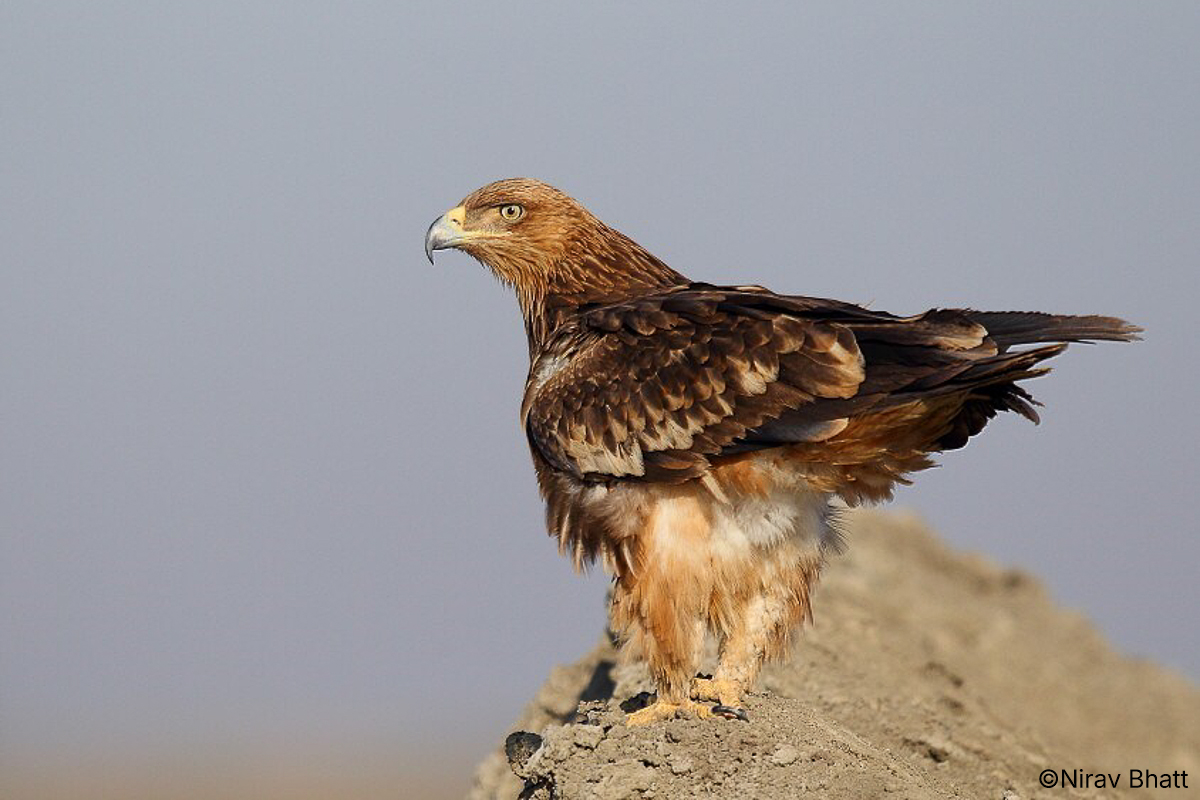
Imperial Eagle
- Common Name: Imperial Eagle
- Scientific Name: Aquila heliaca
- Nepali Name(s): रणमत्त महाचिल (Ranamatta Mahachil)
- IUCN Red List Status: Vulnerable (VU)
- National Red List Status (Nepal): Critically Endangered (CR)
- CITES Appendix: Appendix I
- CMS Appendix: Appendix I
Measurements & Physical Profile
- Body Length: 72–84 cm
- Wingspan: 180–215 cm
- Weight: 2,450–4,530 g
Did You Know?
Adult Imperial Eagles have striking, blackish-brown plumage that contrasts sharply with a beautiful, pale golden-buff patch extending across the back of their crown and nape. They also sport prominent white scapular "epaulettes" on their shoulders. When perched upright, this regal pattern gives them an extraordinarily dignified, crown-and-robe appearance that inspired their name.
Distribution & Habitat
Global Distribution
The Imperial Eagle breeds in a semi-continuous northern belt stretching from central and eastern Europe through southern Russia and Kazakhstan to Mongolia. It is a migratory species, moving south in autumn to winter in northeastern Africa, the Middle East, the Arabian Peninsula, the Indian Subcontinent, and parts of southern China.
Distribution within Nepal
It is a regular but uncommon winter visitor and passage migrant. It occurs predominantly across the lowland Tarai plains and the wide, open valleys of the mid-hills (such as Kathmandu and Pokhara). Stable numbers are observed during winter in protected areas like Chitwan, Bardia, Shuklaphanta, and Koshi Tappu. Migrating individuals are also systematically documented at high-altitude raptor watch-sites (e.g., Thoolakharka, Kaski) during the autumn migration.
Preferred Habitats
An open and semi-open country specialist. In its wintering grounds in Nepal, it favors open alluvial grasslands, riverine floodplains, agricultural plains, and wetlands. It avoids dense, closed-canopy forests and high-altitude alpine slopes, preferring areas with wide, flat vistas.
Elevational Range
Mostly found in the lowlands and lower mid-hills (75–1,500 meters). As a passage migrant, individuals are recorded soaring along mountain ridges and crossing interior Himalayan valleys up to 4,000 meters.
Seasonal Occurrence
A strict seasonal migrant. It arrives in early to mid-October, remains throughout the winter dry season, and departs northward toward its Palearctic breeding grounds by late March or early April.
Behavior & Ecology
Flight & Foraging Behavior
A massive, powerful raptor. In flight, it is distinct from the Golden Eagle by its long, broad wings held completely flat and level with its body. It relies heavily on thermal updrafts to soar over agricultural plains and river basins.
Social & Roosting Habits
Generally solitary while wintering or migrating. It is usually silent during its stay in Nepal.
Diet & Ecosystem Role
- Diet Breakdown: Highly opportunistic.
- Small to Medium Mammals: Hares, large rodents, bandicoot rats, and young mongooses.
- Birds: Waterfowl (ducks, teals), egrets, partridges, lapwings, and feral pigeons.
- Carrion: Frequently visits livestock carcass dumps; also a known kleptoparasite, stealing food from harriers and kites.
- Reptiles: Monitor lizards and terrestrial snakes on sandy riverbanks.
- Ecological Role: Functions as an apex predator and scavenger, regulating small mammal and bird populations in open lowland landscapes.
Breeding Biology
The Imperial Eagle breeds in the Palearctic range (March–July). It builds massive stick nests in mature, isolated trees or occasionally on electricity pylons. Females typically lay 2–3 eggs, with incubation lasting 43–45 days.
Migration
- Status: Migratory (Winter visitor/Passage migrant).
- Movement: Migrates from the Palearctic breeding grounds to South Asia for the winter.
Population Status
- Global Population: 16,000 – 20,000 mature individuals.
- National Population Estimates (Nepal): small population (<50 individuals)
- Monitoring: Tracked via autumn raptor migration counts at key bottlenecks and surveys in lowland protected areas.
Threats
- Electrocution: High mortality risk when perching on uninsulated medium-voltage utility poles.
- Secondary Poisoning: Risk of fatal kidney failure from consuming livestock carcasses contaminated with veterinary NSAIDs (e.g., diclofenac).
- Habitat Loss: Conversion of alluvial grasslands into industrial monocultures and the removal of mature roosting trees.
- Bioaccumulation: Pesticides and rodenticides used in agricultural fields can be ingested through contaminated prey.
Conservation Actions
Existing Measures
- International: Listed on CITES Appendix I and CMS Appendix I, requiring cross-border cooperation.
- Protected Areas: Nepal’s national parks provide critical, pesticide-free foraging grounds and secure roosting sites.
Recommended Measures
- Power Infrastructure: Insulate dangerous power poles along migration pathways.
- Veterinary Safety: Promote the use of eagle-safe alternatives like meloxicam and strictly enforce bans on toxic NSAIDs.
- Safe Feeding: Support community-managed "vulture restaurants" to provide toxin-free food.
- Monitoring: Continue long-term raptor migration counts to track regional population health.
References
- BirdLife International (2025). Species factsheet: Eastern Imperial Eagle Aquila heliaca. Downloaded from https://datazone.birdlife.org/species/factsheet/eastern-imperial-eagle-aquila-heliaca on 05/08/2026
- Ferguson-Lees, J., & Christie, D. A. (2001). Raptors of the World. Christopher Helm, London.
- Inskipp C., Baral H. S., Phuyal S., Bhatt T. R., Khatiwada M., Inskipp, T, Khatiwada A., Gurung S., Singh P. B., Murray L., Poudyal L. and Amin R. (2016). The status of Nepal’s Birds: The national red list series. Zoological Society of London, UK.
- Meyburg, B.-U. and G. M. Kirwan (2020). Imperial Eagle (Aquila heliaca), version 1.0. In Birds of the World (J. del Hoyo, A. Elliott, J. Sargatal, D. A. Christie, and E. de Juana, Editors). Cornell Lab of Ornithology, Ithaca, NY, USA. https://doi.org/10.2173/bow.impeag1.01
- Naoroji, R. (2006). Birds of Prey of the Indian Subcontinent. Om Books International, New Delhi.