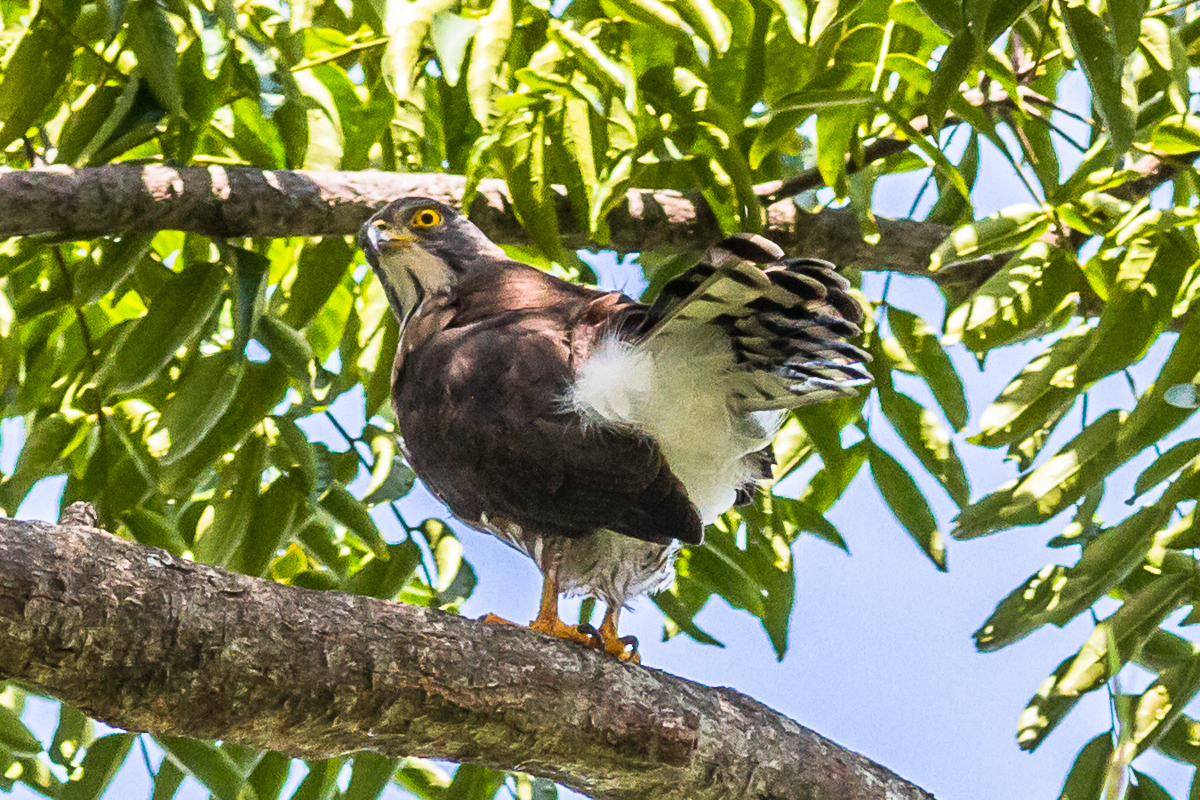
Crested Goshawk
- Common Name: Crested Goshawk
- Scientific Name: Lophospiza trivirgata
- Nepali Name(s): कल्की बेसरा (Kalki Besara)
- IUCN Red List Status: Least Concern (LC)
- National Red List Status: Least Concern (LC)
- CITES Appendix: Appendix II
Measurements & Physical Profile
- Body Length: 30–46 cm
- Wingspan: 68–90 cm
- Weight: 224–563 g
Did You Know?
Unlike open-country falcons, the Crested Goshawk is engineered for stealth inside dense forests. It has short, broad, rounded wings and a long, steering-oar tail that allow it to twist, dodge, and accelerate through tightly packed branches at breakneck speeds. It also sports a tiny, erectile crest on the back of its crown—usually held flat but raised when excited—and a thick, dark vertical "mesial stripe" running straight down its white throat, which acts as a visual anchor when identifying this fierce forest specialist.
Distribution & Habitat
Global Distribution
The Crested Goshawk is native across the Indo-Malayan realm. Its permanent resident range forms a continuous belt along the sub-Himalayan foothills of India, Nepal, and Bhutan, extending eastward into northeastern India, Bangladesh, southern China, and Taiwan. It ranges widely southward through mainland Southeast Asia down to the Sundaic islands of Sumatra, Borneo, Java, and the Philippines.
Distribution within Nepal
In Nepal, it is a resident breeder. It spans the entire length of the country's lower bioclimatic zones, maintaining steady densities across the lowland Tarai plains, the Churia (Siwalik) foothills, and the lush inner Tarai valleys (like Chitwan and Dang). It is reliably monitored and encountered within protected forests such as Chitwan National Park, Bardia National Park, and Suklaphanta National Park, as well as the dense community-managed Sal forests of the mid-hills.
Preferred Habitats
A dedicated forest inhabitant. It heavily favors mature, dense tropical and subtropical evergreen and deciduous woodlands, particularly Sal (Shorea robusta) forests, riverine woodlots, and swampy forest patches. It frequently hunts along internal forest clearings, natural river-cut edges, and old, overgrown woodlots adjacent to traditional rural agriculture. In Southeast Asia it is well adapted in the orchards and city gardens.
Elevational Range
Predominantly a lowland and lower-foothill specialist, mostly found from plains level at 75 meters up to 1,200 meters. Exceptional records have been documented up to 1,800 meters in well-wooded mid-hill river valleys during the warm pre-monsoon breeding season.
Seasonal Occurrence
A strict, permanent non-migratory resident. Pairs maintain year-round territorial boundaries, remaining highly faithful to their core nesting woodlots and rarely making even local altitudinal movements.
Behavior & Ecology
Flight & Foraging Behavior
The Crested Goshawk is a classic "sit-and-wait" ambush predator. It spends hours hidden quietly within the dense middle canopy, perched on a shaded branch scanning for movement. When prey is sighted, it launches a lightning-fast, short-range aerial sally, chasing targets down with incredible agility through the understory.
Social & Roosting Habits
Generally silent for most of the year. During the spring breeding season, it becomes highly conspicuous. Males engage in dramatic territorial display flights high above the forest canopy, characterized by a unique "shivering" or rapid fluttering of the wings held in a stiff, shallow "V" shape, while simultaneously fluffing out their brilliant white undertail coverts to signal rival pairs.
Diet & Ecosystem Role
- Birds (~50% of diet): Highly specialized avian predator: Targets forest-dwelling passerines and non-passerines, including doves, barbets, bulbuls, laughingthrushes, tree pies, and wood-partridges.
- Mammals: Readily ambushes arboreal and terrestrial mammals: Three-striped palm squirrels, forest rats, mice, and fruit bats caught at their daytime roosts.
- Reptiles: Highly accomplished at plucking large tree-climbing lizards, garden lizards, geckos, and small tree snakes directly off tree trunks and branches.
- Amphibians & Insects: Large tree frogs and massive hard-bodied forest beetles are taken opportunistically, particularly during the early monsoon emergence.
Breeding Biology
The active breeding cycle spans from March through July. Crested Goshawk builds its own large, bulky stick nest, lined heavily with fresh, green leaves which serve as a natural disinfectant against parasites. It is typically built 10 to 20 meters high in the fork of a mature forest tree, frequently choosing large Sal, Silk-cotton, or riverine Terminalia trees, often well-hidden by dense foliage.
The female lays 2 to 3 bluish-white or pale greenish eggs. Incubation lasts 30 to 34 days, performed almost entirely by the female. The chicks hatch covered in thick white down, are fed a high-protein diet of plucked birds and lizards, and fledge after approximately 35 to 40 days.
Migration
- Status: Permanent resident; non-migratory.
- Movement: Adults maintain strict, year-round territorial fidelity.
Population Status
- Global Population Estimate: Unknown.
- Population Trend: Decreasing.
- National Population Estimate (Nepal): Unknown
- Monitoring & Surveys: No Monitoring activities for this species, however opportunistically recorded during general bird watching and biodiversity survey.
Threats
- Forest Fragmentation: Selective logging and clear-cutting of mature canopy trees disrupt continuous forest cover, removing the large tree forks required for nesting.
- Removal of Riverine Woodlots: Degradation of riverine forest strips due to gravel mining and developmental encroachment impacts foraging and nesting zones.
- Disturbance: High human foot traffic, livestock grazing, and firewood collection inside community forests during the pre-monsoon nesting window.
Conservation Actions
Existing Measures
- International Conventions: Fully protected under CITES Appendix II.
- Habitat Integrity: Core lowland populations are secured within Nepal's network of Protected Areas and community forest corridors.
Recommended Measures
- Preserving Canopy Nest Trees: Mapping and marking large, mature nesting trees inside Community Forest User Groups (CFUGs) to prevent logging.
- Protecting Riverine Corridors: Enforcing strict buffer zones around riverine forests to preserve core foraging zones.
- Subtropical Raptor Monitoring: Incorporating systematic raptor point-counts to track how forest specialist respond to edge modification.
References
- BirdLife International (2025). Species factsheet: Crested Goshawk Accipiter trivirgatus. Downloaded from https://datazone.birdlife.org/species/factsheet/crested-goshawk-accipiter-trivirgatus on 06/08/2026
- Clark, W. S. and J. S. Marks (2024). Crested Goshawk (Lophospiza trivirgata), version 1.1. In Birds of the World (J. del Hoyo, A. Elliott, J. Sargatal, D. A. Christie, and E. de Juana, Editors). Cornell Lab of Ornithology, Ithaca, NY, USA. https://doi.org/10.2173/bow.cregos1.01.1
- Ferguson-Lees, J., & Christie, D. A. (2001). Raptors of the World. Christopher Helm, London.
- Inskipp C., Baral H. S., Phuyal S., Bhatt T. R., Khatiwada M., Inskipp, T, Khatiwada A., Gurung S., Singh P. B., Murray L., Poudyal L. and Amin R. (2016). The status of Nepal’s Birds: The national red list series. Zoological Society of London, UK.
- Naoroji, R. (2006). Birds of Prey of the Indian Subcontinent. Om Books International, New Delhi.