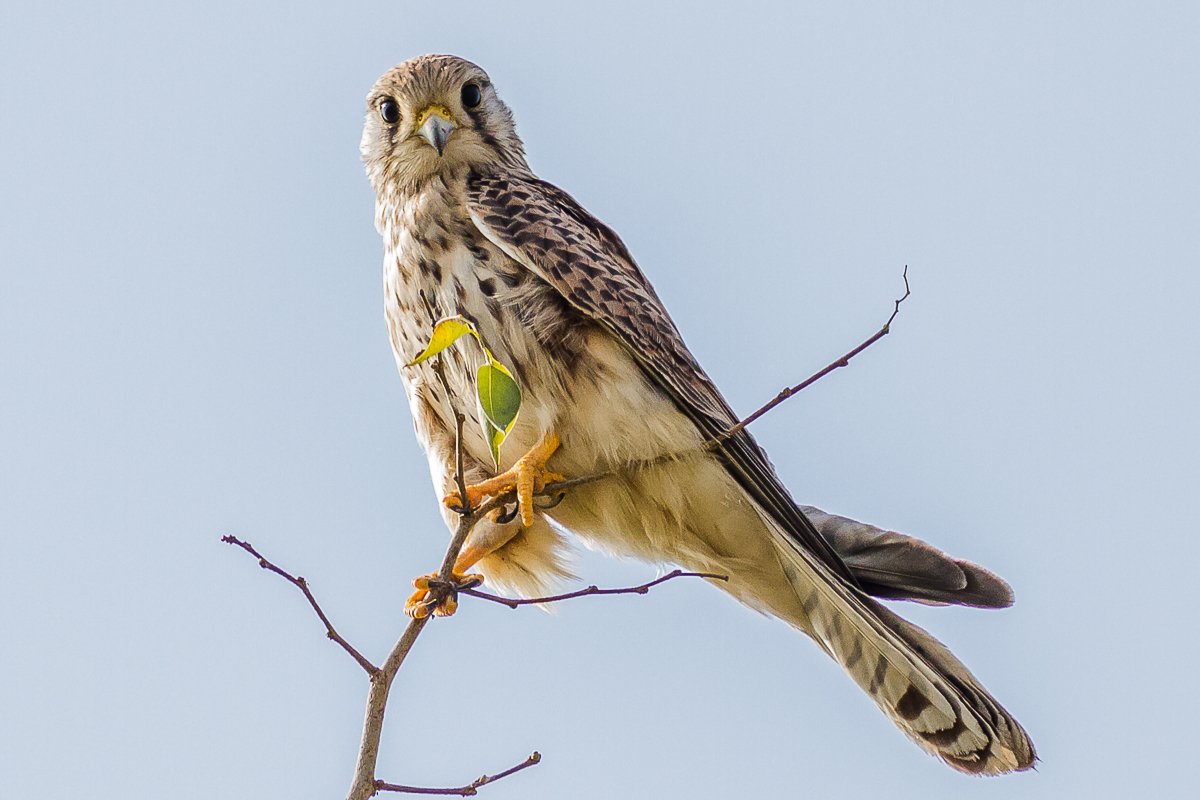
Common Kestrel
- Common Name: Common Kestrel (historically known as the Eurasian Kestrel)
- Scientific Name: Falco tinnunculus
- Nepali Name(s): बौँडाई (Baundai)
- IUCN Red List Status: Least Concern (LC)
- National Red List Status (Nepal): Least Concern (LC)
- CITES Appendix: Appendix II
- CMS Appendix: Not listed
Measurements & Physical Profile
- Body Length: 27–35 cm
- Wingspan: 65–82 cm
- Weight: 136–314 g
Did You Know?
The Common Kestrel is famous for its incredible ability to hover in mid-air. It locks its head perfectly still in space while rapidly fanning out its long, rounded tail and beating its pointed wings into the wind. This precise "windhovering" technique allows the kestrel to scan the grass below with binocular vision. Even more impressive, their eyes can see near-ultraviolet light, allowing them to track the UV-reflective urine trails left by small rodents running through the fields!
Distribution & Habitat
Global Distribution
The Common Kestrel has a massive distribution that spans Europe, Africa, and Asia. It breeds widely across temperate regions of Europe and the Palearctic, with northern populations migrating south during the winter to the Mediterranean, Sub-Saharan Africa, southern Asia, and the Indian Subcontinent.
Distribution within Nepal
In Nepal, it is both a common breeding resident in the mountains and a highly abundant winter visitor and passage migrant across the entire country. During winter, it can be spotted hovering over agricultural fields in the lowland Tarai plains, the Churia hills, the Kathmandu and Pokhara valleys, and high alpine ridges up to the trans-Himalayan zones of Manang and Mustang.
Preferred Habitats
An open-country specialist that strictly avoids dense, closed-canopy forests. It thrives in terraced agricultural lands, open mountain valleys, alpine meadows, grasslands, scrubby hillsides, and the margins of rural towns. It frequently uses human-built infrastructure—such as utility poles, fences, and rooftops—as hunting perches.
Elevational Range
An exceptionally versatile altitudinal generalist. It can be found foraging at sea level (75 meters in the Tarai plains) during the winter, while regular breeding pairs nest in high mountain crags between 2,000 meters and 4,500 meters above sea level. During migration, individuals are regularly observed crossing high Himalayan mountain passes above 5,000 meters.
Seasonal Occurrence
Complex status: present year-round in many mid-hill and mountain areas as a resident. Populations are significantly bolstered during the winter months (October–April) by migratory individuals arriving from northern Asia.
Behavior & Ecology
Flight & Foraging Behavior
While it can soar and glide, it is best known for its hovering behavior. It hunts primarily by sight, using its sharp vision to locate small prey in the grass. It typically drops from its hover or from a lookout perch (such as a telephone pole or rock) to snatch prey with its talons.
Social & Roosting Habits
Generally solitary outside of the breeding season. They are territorial, especially during the breeding period. They roost on cliff ledges, inside old buildings, or in trees, often choosing sites that provide a commanding view of their hunting grounds.
Diet & Ecosystem Role
- Diet: Small mammals (voles, mice, rats) make up the bulk of its diet. It also takes small birds, large insects (grasshoppers, beetles), and occasionally reptiles or earthworms.
- Ecological Role: By preying heavily on rodents, the Kestrel acts as a natural pest-control agent in agricultural areas. It helps maintain the balance of small mammal populations and serves as an indicator of healthy, open-landscape biodiversity.
Breeding Biology
The breeding season in Nepal typically occurs from March to June. Kestrels are not nest-builders; they are opportunistic cavity nesters. They utilize holes in cliffs, crevices in old buildings, or sometimes abandoned nests of other birds (like crows or magpies) in tall trees.
The female lays 3 to 6 reddish-brown speckled eggs. Incubation lasts 27 to 30 days, performed mainly by the female, while the male brings food. The chicks fledge after approximately 27 to 35 days. They are highly successful breeders, often producing large clutches when rodent prey is abundant.
Migration
- Status: Partial migrant; resident and winter visitor.
- Movement: Populations breeding in northern latitudes (Siberia/Central Asia) are migratory, moving south to spend the winter in Nepal and across South Asia. Local populations remain in their territories year-round.
Population Status
- Global Population Estimate: Extremely large; estimated in the millions (4.3 – 6.7 m).
- Population Trend: Decreasing globally.
- National Population Estimate (Nepal): No population estimation available.
- Monitoring & Surveys: Frequently recorded during general bird watching activities and raptor migration watches.
Threats
- Pesticide Bioaccumulation: Rodenticides used to control "pests" in agricultural lands can poison Kestrels if they consume tainted prey.
- Habitat Conversion: Loss of open grasslands and agricultural mosaics to intensive, industrial-style development or forest encroachment.
- Electrocution: While not as vulnerable as large vultures, they are still at risk from collision with power lines in open areas.
Conservation Actions
Existing Measures
- Protected Areas: Well-represented in almost all national parks and conservation areas across Nepal.
- Legal Status: Protected under the National Parks and Wildlife Conservation Act.
Recommended Measures
- Integrated Pest Management (IPM): Promoting farming practices that reduce reliance on rodenticides to protect raptors and other wildlife.
- Nesting Site Preservation: Encouraging the protection of old, historical buildings and natural cliff faces that serve as critical nesting habitat.
- Public Awareness: Educating local communities about the Kestrel's role as a "farmer's friend" due to its consumption of crop-destroying rodents.
References
- BirdLife International (2021). Species factsheet: Common Kestrel Falco tinnunculus. Downloaded from https://datazone.birdlife.org/species/factsheet/common-kestrel-falco-tinnunculus on 06/08/2026
- Ferguson-Lees, J., & Christie, D. A. (2001). Raptors of the World. Christopher Helm, London.
- Inskipp C., Baral H. S., Phuyal S., Bhatt T. R., Khatiwada M., Inskipp, T, Khatiwada A., Gurung S., Singh P. B., Murray L., Poudyal L. and Amin R. (2016). The status of Nepal’s Birds: The national red list series. Zoological Society of London, UK.
- Kirwan, G. M., P. Pyle, and C. Hansasuta (2025). Eurasian Kestrel (Falco tinnunculus), version 1.1. In Birds of the World (G. M. Kirwan and B. K. Keeney, Editors). Cornell Lab of Ornithology, Ithaca, NY, USA. https://doi.org/10.2173/bow.eurkes.01.1
- Naoroji, R. (2006). Birds of Prey of the Indian Subcontinent. Om Books International, New Delhi.