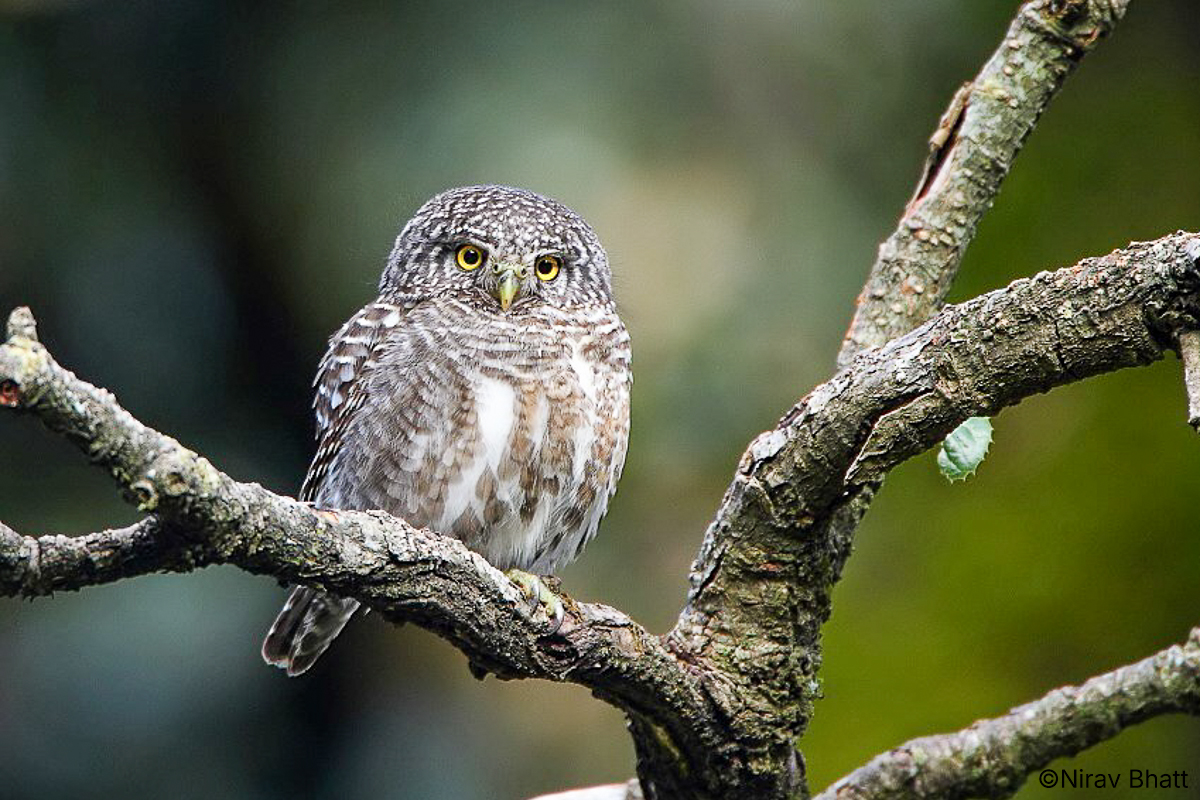
Collared Owlet
- Common Name: Collared Owlet
- Scientific Name: Taenioptynx brodiei (formerly Glaucidium brodiei)
- Nepali Name(s): सानो डुन्डुल (Sano Dundul)
- IUCN Red List Status: Least Concern (LC)
- National Red List Status: Least Concern (LC)
- CITES Appendix: Appendix II
- CMS Appendix: Not listed
Measurements & Physical Profile
- Body Length: 15–17 cm
- Wingspan: 32–38 cm
- Weight: 53–63 g
Did You Know?
The Collared Owlet features a striking evolutionary adaptation on the back of its neck known as an "occipital face." Two large, black spots rimmed with pale buff mimic a pair of wide, staring eyes, giving the illusion of a complete second face looking backward. Because this tiny, fierce raptor regularly hunts during the day, this false face serves a brilliant dual purpose: it deters ambush predators like hawks from striking from behind, and it deeply confuses small songbirds that attempt to mob it, keeping them from figuring out which way the owlet is actually looking!
Distribution & Habitat
Global Distribution
Widely distributed across the Oriental realm. Its continuous resident range runs along the entire length of the Himalayas, stretching across northern Pakistan, northern India, Nepal, and Bhutan into northeastern India. From there, it extends across Bangladesh, Myanmar, southern China, Taiwan, and Southeast Asia down into the Malay Peninsula.
Distribution within Nepal
A very common and widespread resident found in steady densities across the mid-hills and lower montane zones. It is highly abundant within protected areas such as Shivapuri Nagarjun National Park, Langtang National Park (lower valleys), Makalu Barun National Park, and the Annapurna Conservation Area.
Preferred Habitats
A submontane and montane forest specialist. It thrives in open, mixed deciduous-evergreen forests, particularly those dominated by oak (Quercus), rhododendron, chestnut, and alder, as well as subtropical pine forests. It highly prefers edge environments, natural clearings, forest margins near mountain rivers, and mature terraced agricultural orchards.
Elevational Range
Mainly distributed in the mid-altitudes, typically between 1,350 and 2,750 meters above sea level, occasionally moving as low as 700 meters during the winter.
Seasonal Occurrence
A permanent breeding resident, highly sedentary with only minor altitudinal shifts to escape extreme winter weather.
Behavior & Ecology
Flight & Foraging Behavior
Unlike most strictly nocturnal owls, the Collared Owlet is highly diurnal and crepuscular. It is intensely active during daylight, with activity peaking in the early morning and late afternoon. It uses an aggressive ambush strategy, sitting on an open branch or utility wire, bobbing its head to judge distance, and launching lightning-fast, horizontal strikes to snatch prey.
Social & Roosting Habits
It is highly vocal; its primary call—a four-note whistle "wüp-wüwü-wüp"—is iconic in the Himalayas. Because the owlet constantly turns its head while calling, it creates a ventriloquial effect that makes it incredibly difficult to locate. It is frequently mobbed by mixed-species flocks of songbirds that recognize it as a predator.
Diet & Ecosystem Role
- Diet Breakdown: Fierce carnivore despite its size.
- Insects (Primary): Large cicadas, grasshoppers, mantises, moths, and beetles.
- Small Birds: Forest passerines like white-eyes, tits, bulbuls, and munias.
- Mammals: Small rodents and white-toothed pygmy shrews.
- Reptiles: Small skinks, geckos, and lizards.
- Ecological Role: A vital regulator of canopy insects and small rodent populations; it directly influences the anti-predator behaviors of mid-hill songbird communities.
Breeding Biology
The breeding season occurs from March to June. As a strict secondary cavity nester, it relies on abandoned chambers carved by barbets or woodpeckers, as well as natural rot cavities in mature trees. The female lays 3–6 white eggs directly on the cavity floor. Incubation lasts approximately 25 days (performed by the female), with chicks fledging after 25–30 days; both adults feed nestlings.
Migration
- Status: Resident.
- Movement: Non-migratory, though individuals perform localized altitudinal movements to lower elevations (down to 700 meters) during harsh winters.
Population Status
- Global Population Estimate: Unknown
- Population Trend: Decreasing.
- National Population (Nepal): Unknown
- Monitoring & Surveys: Primarily monitored via forest point-counts and automated acoustic recording units (ARUs) targeting their distinctive fluting calls.
Threats
- Loss of Cavity Trees: Selective removal of old, dead, or decaying trees by local communities for firewood directly destroys vital nesting sites.
- Forest Degradation: Road construction and infrastructure projects fragment continuous oak-rhododendron corridors.
- Pesticide Drift: Use of agrochemicals in terraced farms reduces insect prey and may cause low-level bioaccumulation.
Conservation Actions
Existing Measures
- Trade Regulations: Protected internationally under CITES Appendix II.
- Protected Areas: Well-represented across Nepal's mid-elevation and montane national parks and conservation areas.
Recommended Measures
- Community Forest Management: Educate Community Forest User Groups (CFUGs) on the importance of retaining dead, hollow-bearing trees.
- Sustainable Tourism: Train guides in ethical birdwatching, specifically limiting audio playback during the sensitive spring breeding window.
References
- BirdLife International (2021). Species factsheet: Collared Owlet Glaucidium brodiei. Downloaded from https://datazone.birdlife.org/species/factsheet/collared-owlet-glaucidium-brodiei on 07/08/2026
- Holt, D. W., R. Berkley, C. Deppe, P. L. Enríquez, J. L. Petersen, J. L. Rangel Salazar, K. P. Segars, K. L. Wood, J. S. Marks, and P. C. Rasmussen (2021). Collared Owlet (Taenioptynx brodiei), version 1.1. In Birds of the World (P. C. Rasmussen, Editor). Cornell Lab of Ornithology, Ithaca, NY, USA. https://doi.org/10.2173/bow.colowl1.01.1
- Inskipp C., Baral H. S., Phuyal S., Bhatt T. R., Khatiwada M., Inskipp, T, Khatiwada A., Gurung S., Singh P. B., Murray L., Poudyal L. and Amin R. (2016). The status of Nepal’s Birds: The national red list series. Zoological Society of London, UK.