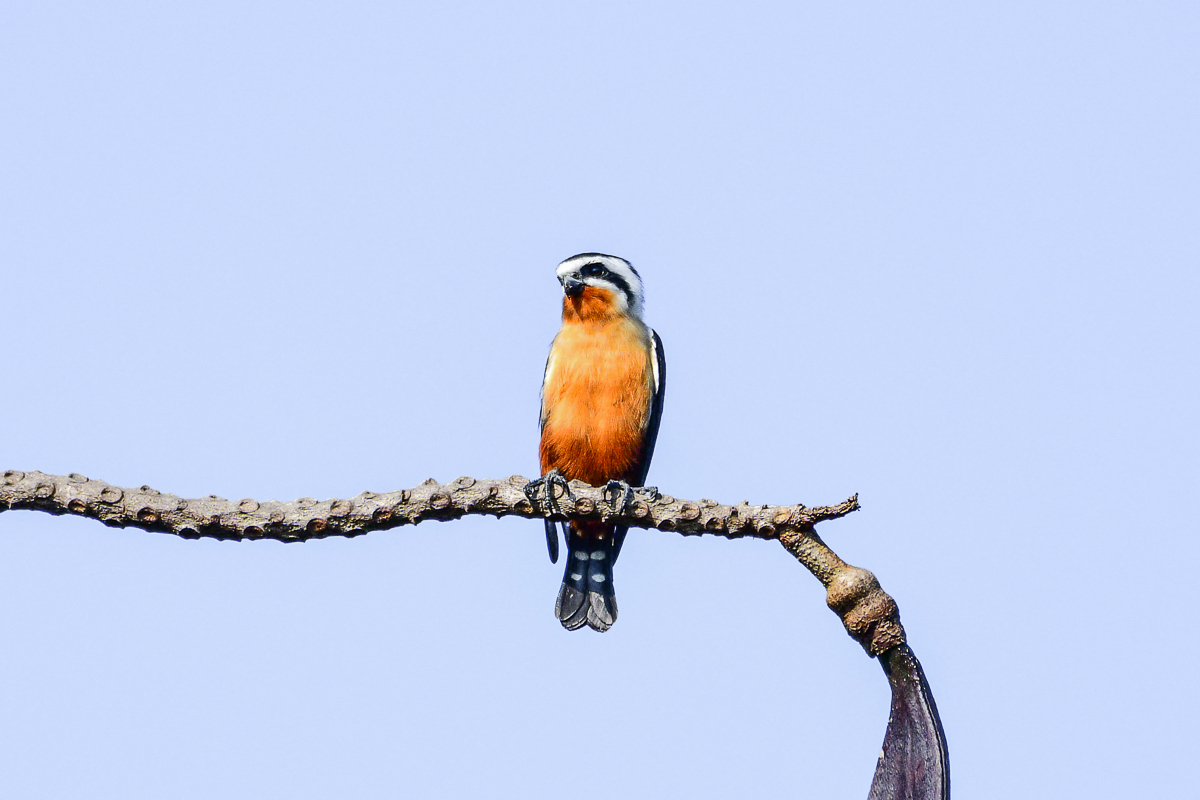
Collared Falconet
- Common Name: Collared Falconet
- Scientific Name: Microhierax caerulescens
- Nepali Name(s): पौरी वाज (Pauri Baaz)
- IUCN Red List Status: Least Concern (LC)
- National Red List Status (Nepal): Near Threatened (NT)
- CITES Appendix: Appendix II
- CMS Appendix: Not listed
Measurements & Physical Profile
- Body Length: 14–18 cm
- Wingspan: 28–34 cm
- Weight: 30–50 g
Did You Know?
The Collared Falconet is one of the smallest birds of prey in the world, barely larger than a sparrow! Despite its diminutive stature, it is a ferocious predator. It often hunts in a "shrike-like" manner, perching on exposed branches at the very top of tall trees to scan for prey. Because of its tiny size, it is incredibly agile, capable of darting through dense foliage to snatch insects or small birds right out of the air.
Distribution & Habitat
Global Distribution
The Collared Falconet is native to the northern and eastern portions of the Oriental realm. Its resident distribution forms a narrow belt along the Himalayan foothills of northern Pakistan, India, Nepal, and Bhutan, expanding eastward across northeastern India (Assam, West Bengal) and into Myanmar, Thailand, Cambodia, Laos, and Vietnam.
Distribution within Nepal
In Nepal, it is a resident breeder operating primarily within the lowland plains and lower foothill ecosystems. It maintains highly stable populations across the Churia (Siwalik) hills, the Bhabar forest belt, and the inner Tarai valleys. It is regularly documented and monitored within protected strongholds including Chitwan National Park, Parsa National Park, Bardia National Park, and the lower subtropical buffer-zone woodlots, but also adapts well to community-managed Sal forests outside protected boundaries.
Preferred Habitats
It is an open-canopy and forest-edge specialist. It actively thrives along clearings, wide riverine forest tracks, mature deciduous Sal (Shorea robusta) woodlands, and traditional open hill cultivations that retain plenty of standing dead trees (snags). It strictly avoids dense, unbroken closed-canopy rainforests as well as completely barren, treeless agricultural landscapes.
Elevational Range
Predominantly a lowland and lower-subtropical specialist, occurring most frequently from plains level at 75 meters up to 1,200 meters. Exceptional records have been documented up to 1,800 meters in the Himalayan mid-hills during warm pre-monsoon foraging movements.
Seasonal Occurrence
A strict, permanent resident. Pairs maintain year-round territory fidelity, shifting only slightly between the high canopy during the breeding season and lower forest edges during the peak monsoon emergence of insects.
Behavior & Ecology
Flight & Foraging Behavior
The flight silhouette is incredibly rapid, characterized by fast, buzzing wingbeats interspersed with short, flat glides. It relies on high-speed maneuverability rather than soaring. While frequently encountered alone or in tight-knit pairs, it is uniquely social for a raptor outside the breeding season, often foraging and roosting in small, cooperative family cohorts of 3 to 7 individuals.
Social & Roosting Habits
Highly vocal during courtship and territorial defenses. The primary call is a high-pitched, piercing, rapidly delivered series of metallic whistles: "killi-killi-killi" or "kli-kli-kli". Mated pairs frequently engage in coordinated duets, uttering long series of rising and falling peeping whistles ("pseep-pseep-pseep") while sitting side-by-side on exposed snags.
Diet & Ecosystem Role
- Insects (Primary ~85-90%): Heavy specialization on large, hard-bodied nocturnal and diurnal insects: Large beetles (Coleoptera), cicadas, dragonflies, grasshoppers, and mantises. They routinely hunt large butterflies, stripping the wings off systematically before consuming the abdomen.
- Small Vertebrates: Opportunistic and highly aggressive: Takes small lizards (skinks, geckos) off tree bark, small bats, and rodents. They are accomplished avian predators, successfully hunting small passerine birds (such as munias, tits, and white-eyes) and have even been documented taking larger species like the Crested Treeswift.
- Ecological Role: As a small, insectivorous raptor, it helps regulate populations of flying insects and small vertebrate prey within the forest canopy. It serves as an indicator of healthy, diverse forest ecosystems that provide ample nesting cavities.
Breeding Biology
The active breeding cycle spans from late February through May, timed perfectly to exploit the explosive emergence of large insects. Courtship involves conspicuous mutual preening and head-bobbing displays performed on prominent dead branches.
It is a strict secondary cavity nester, utilizing abandoned holes excavated by larger primary cavity nesters such as Lineated Barbets, Great Slaty Woodpeckers, or Greater Flamebacks. Nests are typically situated 7 to 12 meters high in dead standing trunks of Sal or Silk-cotton trees. The interior is half-filled with a compact layer of dried leaves and a massive accumulation of insect parts, which serve as insulating padding. The female lays 3 to 5 pure white eggs. Incubation lasts roughly 28 days; in some groups, "helper birds" (offspring from previous clutches) assist the primary pair with nest defense and food delivery. Chicks fledge after 25 to 30 days.
Migration
- Status: Resident; non-migratory.
- Movement: Established breeding adults maintain strict year-round site fidelity. Sub-adults may disperse to adjacent forest patches to find vacant territories.
Population Status
- Global Population Estimate: No population estimates available.
- Population Trend: Decreasing
- National Population Estimate (Nepal): No population estimates available, however populations have suspected to decline
- Monitoring & Surveys: Monitored largely through opportunistic sightings and general biodiversity surveys within protected areas.
Threats
- Removal of Standing Snags: Active silvicultural management and local firewood gathering that targets dead, decaying trees destroys the necessary nesting and roosting cavities.
- Intensification of Insecticides: Broad application of chemical pesticides in valley agricultural fields degrades their primary prey base and poses risks of chemical bioaccumulation.
- Loss of Large Primary Woodpeckers: The decline of large woodpeckers—the species that create the cavities the falconets rely on—directly impacts the availability of future nesting sites.
Conservation Actions
Existing Measures
- Legal Protections: Protected under the National Parks and Wildlife Conservation Act in Nepal and listed under CITES Appendix II.
- Protected Areas: Well-represented in Nepal’s lowland national parks where large, old-growth trees are preserved.
Recommended Measures
- Retaining Dead Trees in Community Forestry: Embedding strict guidelines within Community Forest User Groups (CFUGs) to leave a minimum number of dead standing snags per hectare.
- Eco-Agricultural Buffer Zones: Encouraging reduced pesticide usage in agricultural valleys that border national park buffer zones to safeguard the large insect populations.
- Acoustic and Cavity Mapping: Utilizing point-counts to map falconet breeding densities and track long-term population baselines.
References
- BirdLife International (2024). Species factsheet: Collared Falconet Microhierax caerulescens. Downloaded from https://datazone.birdlife.org/species/factsheet/collared-falconet-microhierax-caerulescens on 05/08/2026
- Clark, W. S. and G. M. Kirwan (2020). Collared Falconet (Microhierax caerulescens), version 1.0. In Birds of the World (J. del Hoyo, A. Elliott, J. Sargatal, D. A. Christie, and E. de Juana, Editors). Cornell Lab of Ornithology, Ithaca, NY, USA. https://doi.org/10.2173/bow.colfal1.01
-
Inskipp C., Baral H. S., Phuyal S., Bhatt T. R., Khatiwada M., Inskipp, T, Khatiwada A., Gurung S., Singh P. B., Murray L., Poudyal L. and Amin R. (2016). The status of Nepal’s Birds: The national red list series. Zoological Society of London, UK.
- Ferguson-Lees, J., & Christie, D. A. (2001). Raptors of the World. Christopher Helm, London.
- Sivakumar, S., et al. (2004). Notes on the population density and feeding ecology of the Collared Falconet Microhierax caerulescens in Buxa Tiger Reserve. Forktail, 20.