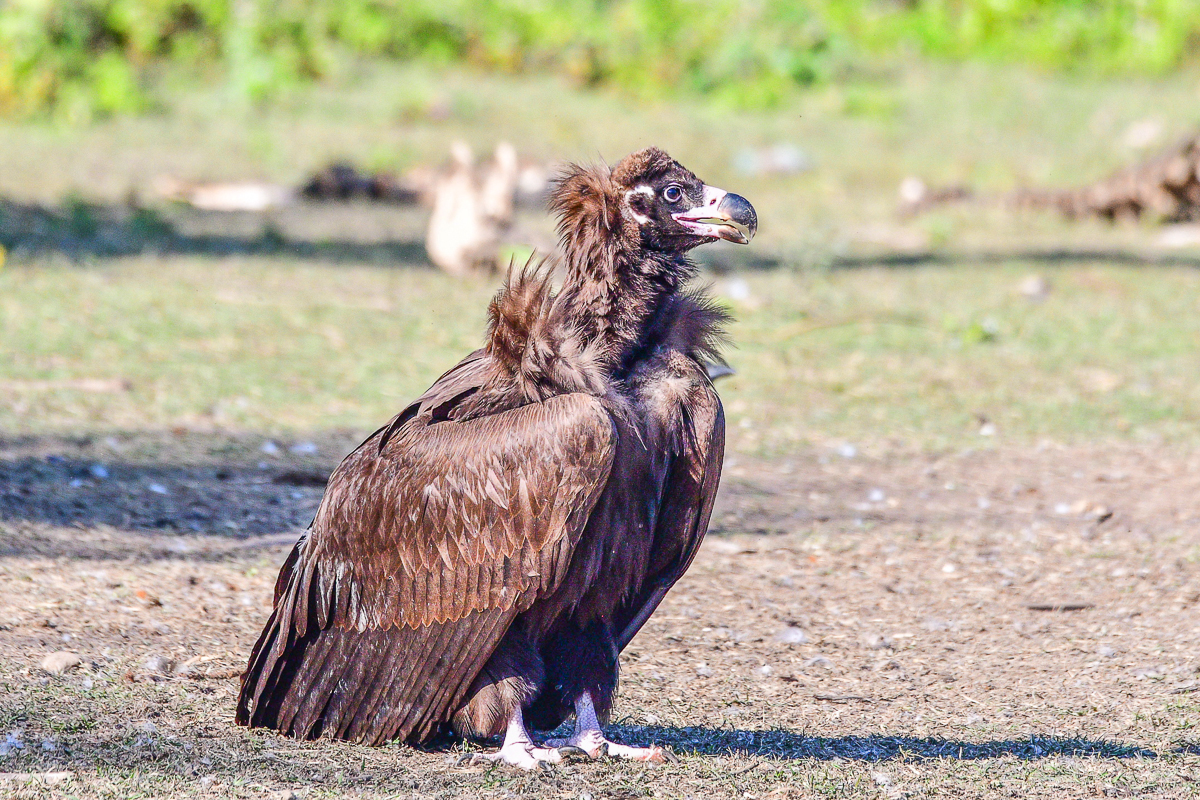
Cinereous Vulture
- Common Name: Cinereous Vulture (historically known as the Eurasian Black Vulture)
- Scientific Name: Aegypius monachus
- Nepali Name(s): राज गिद्ध (Raj Giddha)
- IUCN Red List Status: Near Threatened (NT)
- National Red List Status: Endangered (EN)
- CITES Appendix: Appendix II
- CMS Appendix: Appendix I & II
Measurements & Physical Profile
- Body Length: 100–120 cm
- Wingspan: 250–300 cm
- Weight: 7.0–12.5 kg
Did You Know?
The Cinereous Vulture is one of the two largest true birds of prey in the entire world, possessing a massive, rectangular wingspan that matches the Andean Condor. It sports a distinctive, dark "monk’s cowl" of feathers around its neck and a naked, bluish-pink head. Because of its sheer size and immense, heavy bill, it acts as the ultimate "carcass opener" in the vulture hierarchy, tearing through tough hides and tendons that smaller vultures cannot penetrate.
Distribution & Habitat
Global Distribution
The Cinereous Vulture has a massive, highly fragmented distribution. Its breeding range extends from Spain and isolated patches in southern Europe, eastward across Turkey, the Caucasus, Iran, and Central Asia to Mongolia, northern China, and southeastern Siberia. Populations breeding in the northern latitudes are highly migratory, wintering south in the Middle East, the southern foothills of the Himalayas, northeastern India, southern China, North Korea and South Korea.
Distribution within Nepal
In Nepal, it is primarily a regular, widespread winter visitor and passage migrant. It is observed soaring across the skies of both the lowland Tarai plains and the Himalayan mid-hills. Key wintering and monitoring zones include throughout the Tarai belt, Pokhara Valley, Shukla Gandaki, Dang, and various vulture safe zones and "vulture restaurants" across the country.
Preferred Habitats
Open, high-altitude alpine meadows, rugged mountain valleys, dry steppes, and semi-arid scrublands. Forested foothills, open river basins, rubbish dumps, and pasturelands adjacent to rural settlements where livestock carcasses are available.
Elevational Range
An incredibly versatile flyer, distributed from lowland plains at 75 meters during winter foraging, up to alpine passes over 4,500 meters above sea level during migration across the Himalayan range.
Seasonal Occurrence
Primarily present from October through April. It arrives as a winter migrant fleeing the freezing Siberian and Mongolian winter plains, returning northward in early spring to breed.
Behavior & Ecology
Flight & Foraging Behavior
The Cinereous Vulture is a solitary and majestic glider, utilizing its massive wings to ride thermal currents for hours with minimal flapping. Unlike colonial vultures, it is typically solitary or found in pairs when foraging, though multiple individuals will gather at large carcasses. On the ground, it is dominant over almost all other avian scavengers due to its intimidating size.
Social & Roosting Habits
Generally silent and quiet away from carcasses. When competing for food or defending a spot on a carcass, it emits a variety of guttural grunts, harsh croaks, and high-pitched hisses.
Diet & Ecosystem Role
- Diet: A strict, obligate scavenger feeding on carcasses of wild herbivores (blue sheep, wild boar) and domestic livestock (cattle, water buffalo, yaks). It specializes in consuming the toughest parts of a carcass—including skin, tough cartilage, tendons, and muscles.
- Ecological Role: As an apex scavenger, it provides vital ecosystem services by rapidly cleaning up large animal remains. This quick decomposition cycle prevents the build-up of harmful bacteria and limits the spread of infectious diseases like anthrax, rabies, and brucellosis.
Breeding Biology
- Breeding Status in Nepal: Non-breeding winter visitor.
- General Breeding Habits: In its northern breeding range (e.g., Mongolia, Central Asia, Siberia, Spain), it is a solitary nester. Unlike many other vultures that choose cliffs, it prefers to build a massive stick nest—often measuring over 2 meters across—on the flat tops or crown forks of mature, sturdy trees (such as old pines or oaks) or occasionally on isolated rocky ledges. The female lays a single egg, incubated by both parents for roughly 50 to 55 days. The chick stays in the nest for up to 4 months before fledging.
Migration
- Status: Highly migratory (Northern populations).
- Movement: Birds breeding in Mongolia, Central Asia, and Siberia fly thousands of kilometers southward over broad fronts to winter in the warmer climates of South Asia. They regularly cross high-altitude Himalayan mountain passes to spend the winter in the valleys and plains of Nepal and northern India.
Population Status
- Global Population Estimate: The global population is 16,800 – 22,800 mature individuals.
- Population Trend: Decreasing globally due to habitat loss and poisoning.
- National Population Estimate (Nepal): No reliable estimates of wintering population, but has a small (less than 400) wintering population.
- Monitoring & Surveys: Monitored via migration watch site at Thoolakharka, and winter population counts at feeding stations.
Threats
- NSAID Poisoning: Ingestion of livestock carcasses treated with toxic non-steroidal anti-inflammatory drugs (e.g., diclofenac, aceclofenac, ketoprofen) causes severe kidney failure.
- Secondary Poisoning: Incidental ingestion of toxic baits set by farmers to kill mammalian predators.
- Food Scarcity: Changes in livestock management, carcass burial practices, and declining wild ungulate numbers.
- Electrocution and Collision: Collisions with uninsulated high-voltage power lines and wind turbines along migratory paths.
Conservation Actions
Existing Measures
- International Conventions: Listed on CITES Appendix II and CMS Appendix I.
- NSAID Bans: Nepal has legally banned veterinary diclofenac and actively monitors pharmacies to phase out other harmful NSAIDs.
- Vulture Restaurants: Community-managed Vulture Safe Feeding Sites provide a steady supply of safe, diclofenac-free cattle carcasses.
Recommended Measures
- Expanding Vulture Safe Zones: Strengthening the network of toxic-NSAID-free zones along known wintering and migratory corridors.
- Insulating Power Grids: Modifying and insulating power lines and poles near key feeding areas and trash dumps to prevent electrocution.
- Continuous Monitoring: Regular population counts and tracking to monitor survival rates of the wintering population.
References
- BirdLife International (2021). Species factsheet: Cinereous Vulture Aegypius monachus. Downloaded from https://datazone.birdlife.org/species/factsheet/cinereous-vulture-aegypius-monachus on 05/08/2026
- Ferguson-Lees, J., & Christie, D. A. (2001). Raptors of the World. Christopher Helm, London.
- Inskipp C., Baral H. S., Phuyal S., Bhatt T. R., Khatiwada M., Inskipp, T, Khatiwada A., Gurung S., Singh P. B., Murray L., Poudyal L. and Amin R. (2016). The status of Nepal’s Birds: The national red list series. Zoological Society of London, UK.
- Naoroji, R. (2006). Birds of Prey of the Indian Subcontinent. Om Books International, New Delhi.
- Salvador, A. (2024). Cinereous Vulture (Aegypius monachus), version 3.0. In Birds of the World (G. M. Kirwan and B. K. Keeney, Editors). Cornell Lab of Ornithology, Ithaca, NY, USA. https://doi.org/10.2173/bow.cinvul1.03
- The Peregrine Fund (2026) Cinereous Vulture. Available at: https://peregrinefund.org/explore-raptors-species/vultures/cinereous-vulture (Accessed: 5 August 2026).