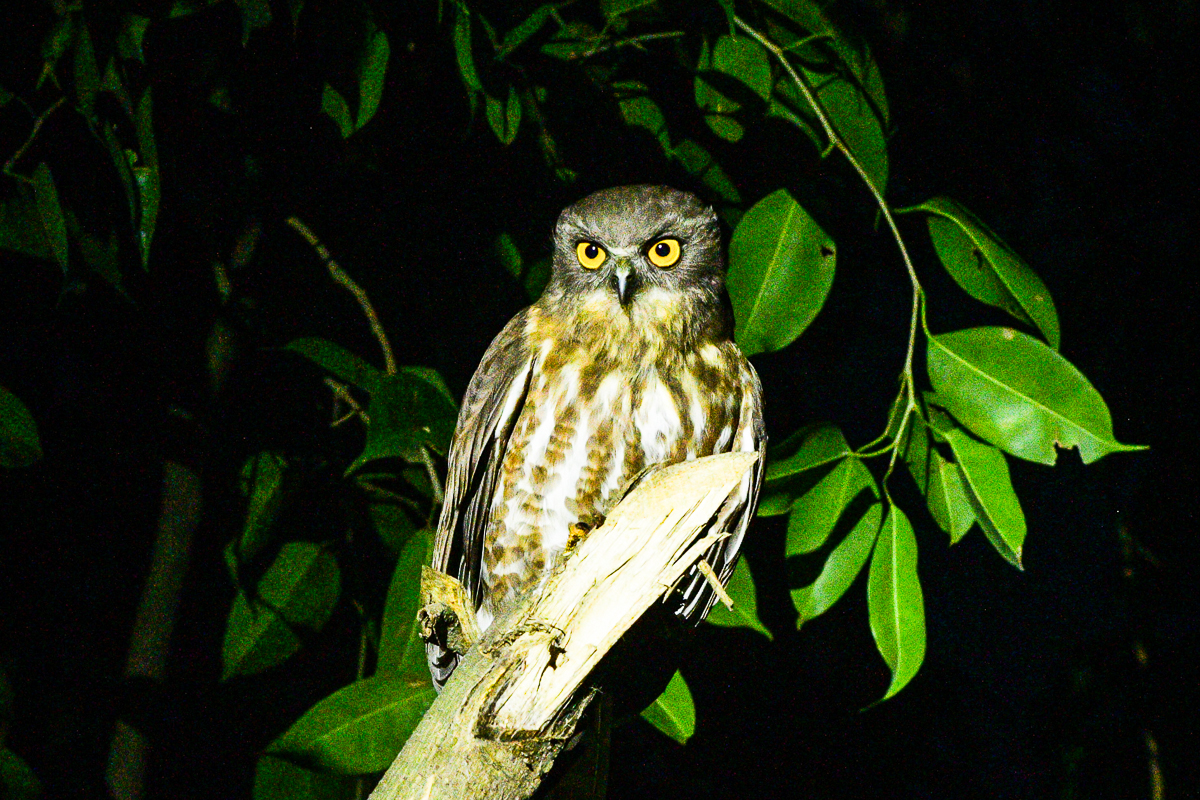
Brown Boobook
- Common Name: Brown Boobook (historically known as the Brown Hawk-Owl)
- Scientific Name: Ninox scutulata
- Nepali Name(s): कालपेचक (Kaalpechak)
- IUCN Red List Status: Least Concern (LC)
- National Red List Status (Nepal): Least Concern (LC)
- CITES Appendix: Appendix II
- CMS Appendix: Not listed
Measurements & Physical Profile
- Body Length: 27–33 cm
- Wingspan: 60–80 cm
- Weight: 146–227 g
Did You Know?
Unlike typical owls with large, flat facial discs and soft, silent feathers, the Brown Boobook looks and flies remarkably like a small hawk or falcon. It has a heavily reduced facial disc, bright staring yellow eyes, and long, pointed wings. Even more unique is its hunting style: it is a high-speed aerial acrobat that regularly hawks for large insects around forest campfires, streetlights, and riverbanks, snatching fast-flying moths and beetles right out of mid-air with incredible hawk-like agility!
Distribution & Habitat
Global Distribution
The Brown Boobook is widely distributed across the Oriental and eastern Palearctic realms. Its resident and breeding range stretches from the Indian Subcontinent, Sri Lanka, and the Himalayan foothills, eastward across Bangladesh, Myanmar, Indochina, southern China, and into the Malay Peninsula, Sumatra, and Borneo. Northern populations (sometimes split as distinct subspecies or sister species, such as the Northern Boobook Ninox japonica) breed in eastern Siberia, Japan, and Korea, migrating south to winter in Southeast Asia.
Distribution within Nepal
In Nepal, it is a locally common resident breeder distributed primarily through the lowlands and foothills. It is regularly documented across the forested belts of the Tarai plains, the Churia (Siwalik) hills, and the inner Tarai valleys. It is well-represented within protected lowland forests but also occurs in suitable riverine woodlots and mature orchards outside protected areas.
Preferred Habitats
Lowland tropical and subtropical deciduous forests, dense riverine forests, and evergreen foothills. Mature well-wooded gardens, old orchards, rubber or mango plantations, and forest edges adjacent to wetlands, rivers, or small human settlements. It heavily avoids deep, high-altitude alpine zones and completely deforested, open agricultural plains.
Elevational Range
Predominantly a lowland and foothill specialist, operating most frequently from the plains at 75 meters up to 1,200 meters above sea level. It is rarely recorded above 1,500 meters in the Himalayan mid-hills.
Seasonal Occurrence
Observed year-round across its low-to-mid elevation habitats in Nepal as a permanent breeding resident. Some winter fluctuations may occur as northern migratory sub-species pass through or winter in the warmer lowlands of South Asia.
Behavior & Ecology
Flight, Activity & Vocalization
The Brown Boobook is primarily nocturnal and crepuscular, becoming intensely active at dusk and dawn. Its flight is fast, direct, and agile, featuring strong, rhythmic wingbeats interspersed with long glides that closely mimic the flight silhouette of a small sparrowhawk (Accipiter).
It is highly vocal during the breeding season, producing a characteristic, far-carrying, musical two-note call: "whoo-wup" or "pomp-pom", repeated monotonically at intervals of a few seconds, often continuing uninterrupted for hours through the night.
Social & Roosting Habits
Typically lives as solitary individuals or in well-bonded monogamous pairs. During the daytime, it roosts cryptically in dense foliar cover, hugging close to the main trunk of a tall leafy tree or hidden inside tangled vines and bamboo clumps. If disturbed during the day, it flies out quickly and directly to another dark canopy rather than freezing in place like other owls.
Diet & Ecosystem Role
Diet Breakdown
The Brown Boobook is a highly active, predatory insectivore and small-vertebrate hunter:
- Insects (Primary): Large nocturnal insects, including beetles (Coleoptera), moths (Lepidoptera), cicadas, grasshoppers, crickets, and swarming winged termites.
- Small Vertebrates: Small rodents (mice and rats), shrews, small bats (snatched while foraging), frogs, lizards, and occasionally small roosting passerine birds.
Ecological Role
By consuming immense quantities of large nocturnal beetles, locusts, and rodents, the Brown Boobook acts as an invaluable biological pest-control agent. It helps maintain the ecological balance in both natural riverine forests and surrounding traditional agricultural orchards by suppressing insect irruptions that can devastate local crops.
Breeding Biology
The breeding season in the Indian subcontinent and Nepal runs from March to July, timed to exploit the high abundance of nocturnal insects emerging during the warm pre-monsoon and early monsoon months.
It is a strict cavity nester, utilizing natural hollows in mature tree trunks, old knot-holes, or abandoned holes excavated by larger woodpeckers or barbets. These nest cavities are typically located between 5 to 15 meters above the ground in large trees like Sal (Shorea robusta) or Silk-cotton (Bombax ceiba). The female usually lays 2 round, glossy white eggs directly onto the natural debris or decayed wood at the bottom of the hollow. Incubation lasts for approximately 25 days and is performed entirely by the female, while the male vigorously defends the nesting territory and brings food. The chicks are cared for by both parents and fledge after roughly 24 to 28 days, remaining dependent on the parents for food while they perfect their aerial hunting techniques.
Migration
- Status: Mostly resident with regional movements.
- Movement: Lowland populations in Nepal are permanent year-round residents, maintaining stable territories. However, northern Palearctic subspecies are highly migratory, flying south over broad fronts to winter across South and Southeast Asia. These wintering or passage individuals opportunistically supplement regional numbers during the late autumn and winter months.
Population Status
- Global Population Estimate: The global population has not been quantified, but the species is described as widespread and common across most of its extensive Asian range.
- Population Trend: Considered decreasing globally.
- National Population Estimate (Nepal): Evaluated as Least Concern (LC) nationally. It remains locally common across intact lowland forest networks, though it faces localized declines where mature, cavity-bearing trees are cleared.
- Monitoring & Surveys: Monitored primarily through nocturnal vocalization surveys, point counts in protected lowland corridors (such as Chitwan and Bardia National Parks), and incidental documentation in multi-species forest bird monitoring projects.
Threats
- Loss of Mature Cavity Trees: The systematic removal of old-growth, decaying trees and dead wood (silvicultural management or firewood collection) directly destroys their critical nesting cavities.
- Pesticide Overuse: High applications of chemical insecticides in agricultural lands adjacent to forests severely deplete their large insect prey base and expose the owls to secondary chemical bioaccumulation.
- Habitat Fragmentation: Widespread clearing of riverine forests and conversion of mature orchards into urban settlements eliminate essential foraging and roosting corridors.
- Light Pollution Hazards: While artificial streetlights draw insects and provide temporary foraging opportunities, intense urban light pollution disrupts their nocturnal vision and exposes them to high collision risks with vehicles and glass infrastructure.
Conservation Actions
Existing Measures
- International Conventions: Fully listed under CITES Appendix II to monitor and restrict any international wildlife trade.
- Protected Areas: Well-protected within Nepal's premier lowland reserves, including Chitwan National Park, Bardia National Park, Shukla Phanta National Park, and Koshi Tappu Wildlife Reserve.
Recommended Measures
- Retaining Cavity-Bearing Trees: Promoting eco-friendly forestry practices that mandate leaving old, hollow-bearing trees and dead standing snags intact during timber harvesting and community forest management.
- Community Orchard Awareness: Encouraging orchard owners (such as mango and litchi farmers in the Tarai) to limit toxic chemical pesticide use, framing the Brown Boobook as a free, natural pest-control ally.
- Nest Box Installation: Trialing the deployment of artificial wooden nest boxes in restored community forests and modified woodlots that lack natural tree hollows to boost local breeding success.
- Mitigating Roadside Hazards: Ensuring that new infrastructure and lighting along highways intersecting forested buffer zones utilize downward-shielded, low-intensity eco-lighting to minimize wildlife disorientation.
References
- BirdLife International (2021). Species factsheet: Brown Boobook Ninox scutulata. Downloaded from https://datazone.birdlife.org/species/factsheet/brown-boobook-ninox-scutulata on 07/08/2026
- Inskipp C., Baral H. S., Phuyal S., Bhatt T. R., Khatiwada M., Inskipp, T, Khatiwada A., Gurung S., Singh P. B., Murray L., Poudyal L. and Amin R. (2016). The status of Nepal’s Birds: The national red list series. Zoological Society of London, UK.
- Olsen, P.D., E. de Juana, and J. S. Marks (2020). Brown Boobook (Ninox scutulata), version 1.0. In Birds of the World (J. del Hoyo, A. Elliott, J. Sargatal, D. A. Christie, and E. de Juana, Editors). Cornell Lab of Ornithology, Ithaca, NY, USA. https://doi.org/10.2173/bow.brnhao1.01
- The Peregrine Fund. (2026). Brown Boobook. Available at: https://peregrinefund.org/explore-raptors-species/owls/brown-boobook (Accessed: 7 August 2026).