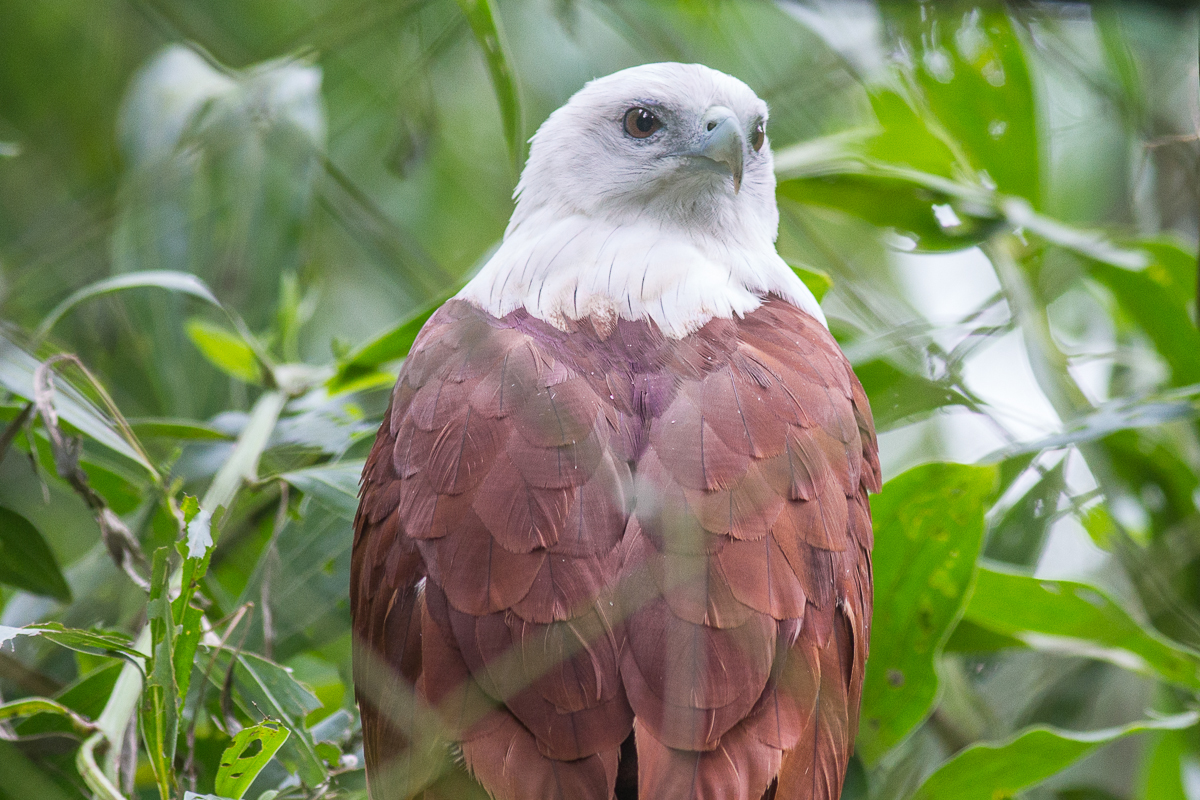
Brahminy Kite
- Common Name: Brahminy Kite
- Scientific Name: Haliastur indus
- Nepali Name(s): सेतोटाउके चिल (Seto Tauke Chil)
- IUCN Red List Status: Least Concern (LC)
- National Red List Status: Critically Endangered (CE)
- CITES Appendix: II
- CMS Appendix: Not listed
Measurements & Physical Profile
- Body Length: 45–50 cm
- Wingspan: 105–125 cm
- Weight: 320–670 g
Did You Know?
The Brahminy Kite is one of the most recognizable raptors in Asia, distinguished by its vibrant, contrasting plumage: a rich chestnut-red body set against a stark white head and breast. In many parts of its range, it is considered a sacred bird and a symbol of good fortune. Unlike many other raptors that are strictly predatory, it is an opportunistic scavenger often found near water, frequently seen "dipping" into lakes or rivers to snatch floating food items with its talons.
Distribution & Habitat
Global Distribution
Widely distributed across tropical Asia and Australia. Its range stretches from the Indian subcontinent, through Southeast Asia (including the Philippines and Indonesia), to northern and eastern Australia.
Distribution within Nepal
In Nepal, it is a rare resident in the lowlands. It is found in the Terai, inner valleys (Dun valleys), and along major river systems. Sightings are infrequent in the wetlands of the southern plains and occasionally in mid-hill river valleys and around lakes.
Preferred Habitats
Wetlands are the quintessential habitat for this species. It favors large rivers, lakes, marshes, coastal areas, and lagoons. It is also highly adapted to human-modified landscapes and is often found near agricultural fields, village ponds, and urban water bodies.
Elevational Range
Mainly observed in the lowlands and foothills, ranging from 75 meters up to 1,500 meters above sea level. While rare at higher altitudes, individuals have been sighted following river systems into mid-mountain valleys.
Seasonal Occurrence
A permanent, year-round resident in Nepal. It does not undertake significant seasonal migrations, although local movements occur in response to food availability and water levels.
Behavior & Ecology
Flight & Foraging Behavior
The Brahminy Kite has a characteristic buoyant, leisurely flight with shallow wingbeats, often spending hours soaring over water bodies. It is a generalist feeder; it hunts by gliding low over water or ground, using its sharp talons to seize prey. It is frequently seen harassing other birds to steal their food (kleptoparasitism).
Social & Roosting Habits
Generally solitary, though they may congregate in small, loose groups near abundant food sources (such as fish markets or large landfills). They are typically monogamous and roost in groups in tall trees, often near their primary hunting grounds.
Diet & Ecosystem Role
- Diet: Extremely varied. Includes fish, crabs, small mammals, amphibians, insects, carrion, and occasionally human food scraps.
- Ecological Role: Functions as a scavenger and opportunist predator. It plays a role in aquatic ecosystem maintenance by consuming dead organic matter from the water surface, helping to keep small water bodies cleaner.
Breeding Biology
The breeding season in Nepal is generally from December to April, often coinciding with the dry season when water levels are lower. The pair builds a nest—a loose platform of sticks, twigs, and leaves—usually high up in a tall tree, often near water or in a grove of trees near agricultural land.
The female lays 2 to 3 dull white or bluish-white eggs. Both parents share incubation duties for approximately 26 to 35 days. The chicks fledge and leave the nest after about 45 to 55 days of intensive care.
Migration
- Status: Permanent resident.
- Movement: Sedentary. There is no evidence of true migration, though populations may move locally to follow water sources or food cycles.
Population Status
- Global Population Estimate: The global population is 67,000 mature individuals, however the data quality is poor.
- Population Trend: Decreasing.
- National Population Estimate (Nepal): Considered very rare in Nepal and total population is considered below 20 individuals.
- Monitoring & Surveys: Monitored as part of general bird surveys and wetland biodiversity assessments.
Threats
- Pollution: Bioaccumulation of pesticides and heavy metals from agricultural runoff into wetlands and river systems.
- Habitat Degradation: Drainage of wetlands, loss of riparian forest cover, and water pollution in urbanized areas.
- Electrocution: While less frequent than for larger vultures, they remain susceptible to collision with poorly located power lines near water bodies.
Conservation Actions
Existing Measures
- Protected Areas: Well-represented in the major wetland-rich protected areas of Nepal, including Chitwan National Park, Koshi Tappu Wildlife Reserve, and Shuklaphanta National Park.
Recommended Measures
- Wetland Protection: Preservation of riparian corridors and natural wetlands is essential to maintain foraging grounds.
- Water Quality Management: Reducing chemical runoff into agricultural water bodies to prevent long-term toxicity.
- Community Awareness: Continued promotion of bird-friendly agricultural practices, especially in the Terai region.
References
- BirdLife International (2024). Species factsheet: Brahminy Kite Haliastur indus. Downloaded from https://datazone.birdlife.org/species/factsheet/brahminy-kite-haliastur-indus on 05/08/2026
- Ferguson-Lees, J., & Christie, D. A. (2001). Raptors of the World. Christopher Helm, London.
- Inskipp C., Baral H. S., Phuyal S., Bhatt T. R., Khatiwada M., Inskipp, T, Khatiwada A., Gurung S., Singh P. B., Murray L., Poudyal L. and Amin R. (2016). The status of Nepal’s Birds: The national red list series. Zoological Society of London, UK.
- Kirwan, G. M., S. J. S. Debus, E. R. Wein, T. S. David, and J. S. Marks (2024). Brahminy Kite (Haliastur indus), version 1.3. In Birds of the World (B. K. Keeney and P. Pyle, Editors). Cornell Lab of Ornithology, Ithaca, NY, USA. https://doi.org/10.2173/bow.brakit1.01.3