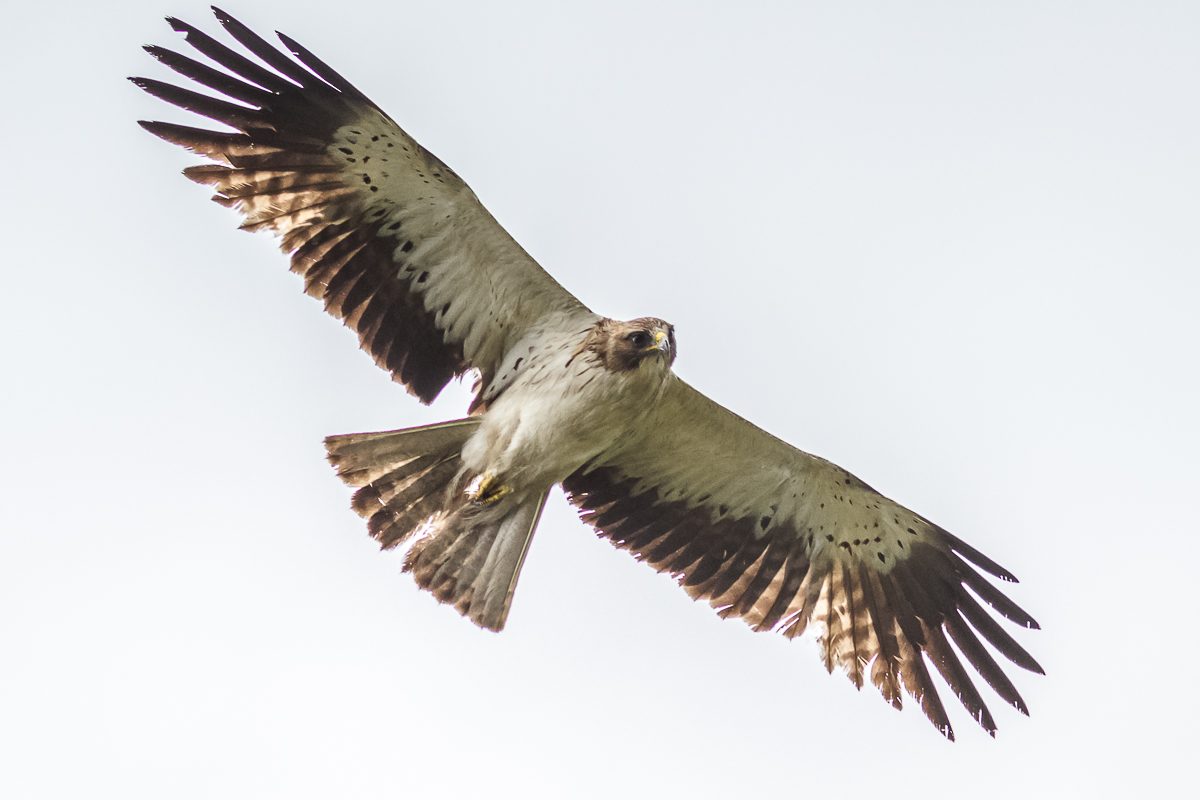
Booted Eagle
- Common Name: Booted Eagle
- Scientific Name: Hieraaetus pennatus
- Nepali Name(s): काँधचन्द्र चिल (Kandhchandra Chil)
- IUCN Red List Status: Least Concern (LC)
- National Red List Status: Least Concern (LC)
- CITES Appendix: Appendix II
- CMS Appendix: Appendix II
Measurements & Physical Profile
- Body Length: 42–51 cm
- Wingspan: 110–132 cm
- Weight: 510–1,025 g (Males average smaller; females are significantly heavier)
Did You Know?
The Booted Eagle is a dimorphic species, meaning it occurs in two completely distinct color variations (morphs): a pale morph (stark white underparts with contrasting dark flight feathers) and a dark morph (uniform soot-brown). This small eagle is named for its heavily feathered legs ("boots") and is famous for its breathtaking hunting style. Upon spotting a target, it will close its wings tight against its body and execute a vertical, high-speed power dive from great heights, cutting through the air like a falcon!
Distribution & Habitat
Global Distribution
The Booted Eagle has a wide breeding range that spans Southwestern Europe, North Africa, and Eastern Europe, extending across Central Asia into Mongolia and northwestern China. It is a highly migratory species, with Western Palearctic populations wintering in sub-Saharan Africa, while Eastern Palearctic populations travel south over the Himalayas to winter across the Indian Subcontinent and parts of Southeast Asia.
Distribution within Nepal
In Nepal, the Booted Eagle is recorded primarily as a common autumn and spring passage migrant, as well as a regular winter visitor. It is observed across the country along a broad front, with frequent records along the mid-hill ridges, the Kathmandu and Pokhara Valleys, and across the open landscapes of the lowland Tarai plains.
Preferred Habitats
- Migration & Wintering: Open woodlands, forest edges, scrubby hillsides, agricultural valleys, savannas, and orchards.
- Breeding Grounds (Global): Prefers a mix of old-growth deciduous or coniferous forests adjacent to extensive open country for foraging. It strictly avoids deep, unbroken interior forest tracts.
Elevational Range
Regularly observed at low-to-mid elevations, spanning from 100 meters up to 2,200 meters above sea level. During peak autumn migration, large numbers are recorded flying over high mountain ridges and trans-Himalayan passes well above 3,000 to 4,000 meters.
Seasonal Occurrence
Primarily present during the autumn migration corridor (September to November) and the return spring migration (March to May). A stable population stays throughout the winter months (November to February) in the warmer valleys and lowland plains.
Behavior & Ecology
Flight & Foraging Behavior
The flight profile of the Booted Eagle is remarkably light, agile, and hawk-like, featuring a relatively long, square-ended tail and landing lights (small white patches at the base of the wings visible from the front). It spends long periods soaring effortlessly on flat wings. It is an active, high-velocity hunter that relies on high-altitude soaring or active quartering over hillsides to locate prey. Once a target is selected, it stoops at immense speed, navigating through tree canopies with great agility to ambush its quarry.
Social & Roosting Habits
Generally observed travelling singly or in small, loose groups during seasonal migration, often mixing into larger multi-species raptor kettles alongside Black Kites and Steppe Eagles. They are solitary birds during the wintering period, defending temporary foraging areas. They roost cryptically on dense, high branches of mature leafy trees or on electricity pylons overlooking open fields, blending seamlessly into the canopy shadows.
Diet & Ecosystem Role
Diet Breakdown
The Booted Eagle is an aggressive, highly capable predator that routinely captures prey nearly as large as itself:
- Birds (Primary): A vast array of small-to-medium birds, including pigeons, doves, mynas, bulbuls, quails, partridges, and young crows.
- Mammals: Small mammals such as wild rabbits, hares, ground squirrels, pikas, and various field rodents.
- Reptiles: Lizards, skinks, and small snakes are regularly taken on open, sun-drenched hillsides.
Ecological Role
As a mid-tier apex avian predator, the Booted Eagle plays an important regulatory role in open woodland and agricultural ecosystems. By feeding heavily on fast-reproducing medium-sized birds and field rodents, it limits overpopulation of opportunistic flocking birds, minimizes crop damage in terrace farms, and acts as a key indicator of functional food-web biodiversity along its global migration path.
Breeding Biology
(Note: The Booted Eagle does not breed within Nepal; the following describes its Palearctic breeding biology).
The breeding season takes place in the Palearctic region from April to August. Courtship features spectacular, high-altitude aerial sky-dances, where the male performs steep vertical loops, side-slips, and thunderous power dives over the canopy, accompanied by a high-pitched, chattering call: “kwee-kwee-kwee”.
The breeding pair constructs a substantial platform nest out of sticks and twigs, which they line heavily with fresh green leaves. The nest is typically positioned high up (10 to 25 meters above the ground) in the main fork of a large forest tree, such as an oak, pine, or beech. The female lays a clutch of 1 to 2 unspotted, dull white or pale greenish eggs. Incubation lasts for approximately 36 to 40 days and is performed almost entirely by the female, while the male is responsible for bringing food to the nest. The young are altricial and require close care; they grow quickly and reach their fledging stage, leaving the nest roughly 50 to 55 days after hatching.
Migration
[Breeding Grounds: Central Asia / Siberia] (May - Aug)
- Status: Fully migratory passage migrant and winter visitor in Nepal.
- Routes: Central Asian breeding populations travel south-southwestward, crossing the formidable Himalayan mountain barrier along a broad front to reach their wintering grounds in South Asia.
- Timing: Outbound autumn migration across Nepal peaks between October and November; the return northward spring journey occurs between March and April.
- Important Stopover Sites: High-altitude ridge bottlenecks and mid-hill watch sites—such as the Thoolakharka watch site near Pokhara—serve as critical monitoring points where hundreds of migrating Booted Eagles are counted annually.
Population Status
- Global Population Estimate: The global population is large and considered secure, estimated to exceed 100,000 to 250,000 mature individuals.
- Population Trend: Stable globally.
- National Population Estimate (Nepal): Not precisely quantified due to its transient passage migrant and wintering status; hundreds pass through the Himalayan flyways annually.
- Monitoring & Surveys: Extensively counted during autumn raptor migration monitoring initiatives along the mid-hill ridges and through long-term citizen science datasets (e.g., eBird).
Threats
- Habitat Destruction & Clearing: The removal of woodlots, mature groves, and fragmentation of open woodlands along river valleys reduce their winter foraging territories.
- Pesticide & Rodenticide Contamination: High exposure to secondary chemical poisoning from consuming rodents and insectivorous birds that have ingested agricultural pesticides and rat poisons.
- Electrocution Hazards: Accidental electrocution on poorly insulated overhead power distribution lines and utility poles, which they frequently use as vantage perches in open farmlands.
- Hunting & Persecution: Occasional illegal shooting or trapping by local poultry farmers or hunters along their migratory bottleneck paths.
Conservation Actions
Existing Measures
- International Conventions: Listed globally under CITES Appendix II to regulate and prevent international trade and included under the CMS Raptors MOU.
- Protected Area Matrix: Recorded regularly across the buffer zones and open habitats of various Nepalese protected areas.
Recommended Measures
- Insulating Power Grids: Retrofitting and insulating electrical crossarms and transformers along known high-density migratory ridge corridors to eliminate electrocution hotspots.
- Promoting Safe Agriculture: Encouraging local farming communities to adopt Integrated Pest Management (IPM) practices, reducing the use of toxic chemical rodenticides that poison predatory birds.
- Flyway Network Protection: Preserving mid-hill forest patches and riverine woodlots that serve as critical resting and foraging stopovers for eagles during their trans-Himalayan journeys.
References
- BirdLife International (2021). Species factsheet: Booted Eagle Hieraaetus pennatus. Downloaded from https://datazone.birdlife.org/species/factsheet/booted-eagle-hieraaetus-pennatus on 05/08/2026
- Ferguson-Lees, J., & Christie, D. A. (2001). Raptors of the World. Christopher Helm, London.
- Inskipp C., Baral H. S., Phuyal S., Bhatt T. R., Khatiwada M., Inskipp, T, Khatiwada A., Gurung S., Singh P. B., Murray L., Poudyal L. and Amin R. (2016). The status of Nepal’s Birds: The national red list series. Zoological Society of London, UK.
- Orta, J., P. F. D. Boesman, and J. S. Marks (2020). Booted Eagle (Hieraaetus pennatus), version 1.0. In Birds of the World (J. del Hoyo, A. Elliott, J. Sargatal, D. A. Christie, and E. de Juana, Editors). Cornell Lab of Ornithology, Ithaca, NY, USA. https://doi.org/10.2173/bow.booeag1.01