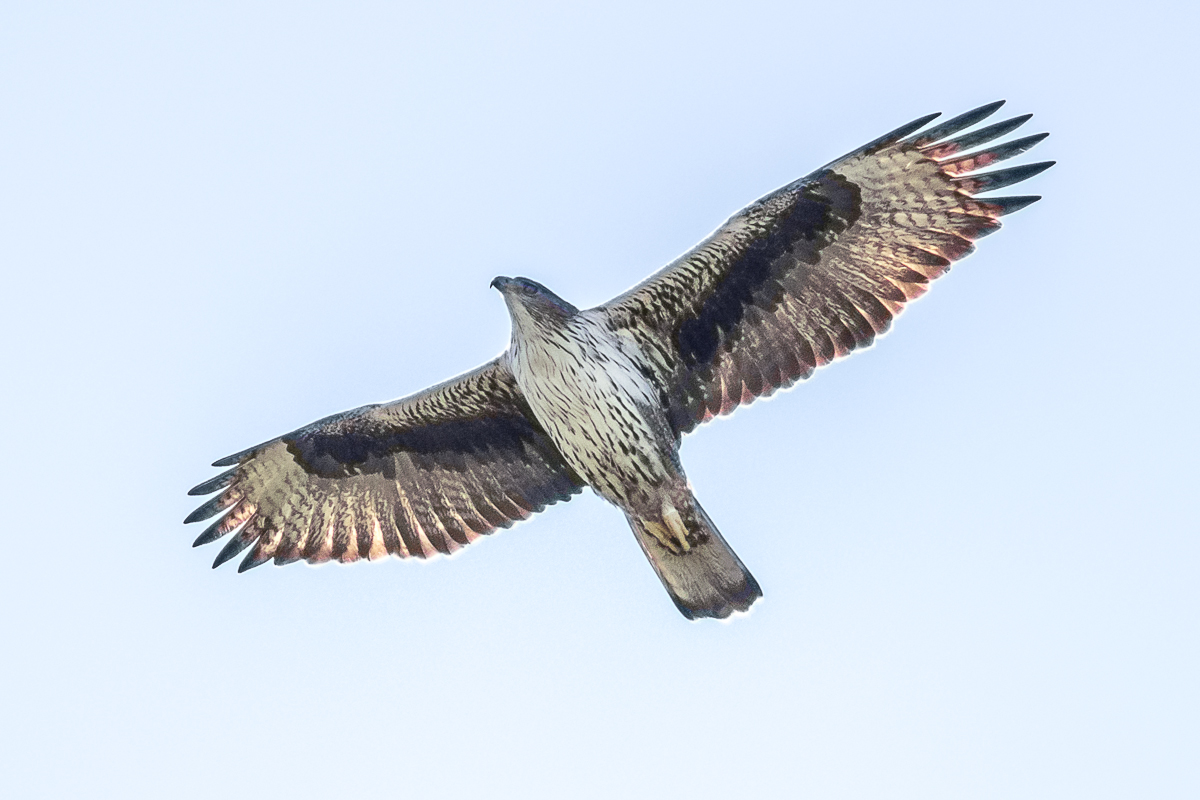
Bonelli's Eagle
- Common Name: Bonelli's Eagle
- Scientific Name: Aquila fasciata
- Nepali Name(s): मोरङ्गी चिल (Morangi Chil)
- IUCN Red List Status: Least Concern (LC)
- National Red List Status: Least Concern (LC)
- CITES Appendix: Appendix II
- CMS Appendix: Appendix II
Measurements & Physical Profile
- Body Length: 65–75 cm
- Wingspan: 150–180 cm
- Weight: 1,500–2,500 g
Did You Know?
Bonelli's Eagle is built like a massive, oversized nest rather than a typical heavy-bodied eagle. Possessing long, powerful legs and exceptionally sharp, agile talons, it is one of the fastest and most aggressive hunters in the sky. It routinely flies at high speeds close to the ground, utilizing hillsides, ridges, and rocky outcrops as tactical cover to execute lightning-fast, hawk-like ambush strikes on highly agile quarry like flying pigeons, crows, and wild hares!
Distribution & Habitat
Global Distribution
Bonelli's Eagle has a wide, fragmented distribution across the Palearctic, Indo-Malayan, and Afrotropical realms. Its range extends across Southern Europe (the Mediterranean basin), North Africa, the Middle East, and Central Asia, stretching eastward across the Indian subcontinent, southern China, and parts of Southeast Asia.
Distribution within Nepal
In Nepal, it is an uncommon, localized resident breeder and winter passage visitor. It is distributed patchily along the dry mid-hills, rocky river gorges, and the trans-Himalayan rain-shadow regions. Sighted infrequently from west to east, its presence is most consistently documented in the foothills of the Annapurna Conservation Area, the upper catchments of the Gandaki River system, and across dry, rugged mountain valleys.
Preferred Habitats
Arid and semi-arid mountain ridges, deep rocky river canyons, rugged open hillsides, and precipitous cliffs. Open, low-intensity agricultural lands, scrubby hillsides, and savanna edges adjacent to rocky outcrops. It strongly avoids dense, contiguous interior broadleaved forests and flat, featureless plains.
Elevational Range
Mainly observed in the low-to-mid mountain belts, operating mostly from 300 meters up to 2,000 meters above sea level. However, foraging individuals and sub-adults regularly ascend into high-altitude alpine zones and trans-Himalayan steppes up to 3,500 meters during the summer months.
Seasonal Occurrence
Observed year-round as a permanent resident across its established hilly territories. Local populations are sometimes supplemented during autumn and winter by dispersing sub-adults or regional passage movers traveling along the Himalayan migratory corridors.
Behavior & Ecology
Flight & Foraging Behavior
The flight silhouette of Bonelli's Eagle is exceptionally athletic, featuring a relatively long tail, a white underbody, and broad wings with a distinct dark band across the underwing coverts. It displays immense speed and aerial agility. Unlike heavier eagles that rely almost exclusively on high-altitude soaring, Bonelli's Eagle frequently hunts via low-altitude quartering or quick contour-chasing, hugging mountain slopes closely to surprise its prey. It is also an expert at diving perpendicularly from an elevated cliff perch to strike terrestrial animals.
Social & Roosting Habits
Typically observed hunting in highly coordinated pairs or living as solitary individuals. Mated pairs exhibit strong cooperative hunting behavior, where one eagle flies high to flush out prey (such as a flock of pigeons) while the other waits down-slope to ambush the fleeing target. They are highly territorial, maintaining large home ranges that they defend aggressively against other large raptors. They roost cryptically on deep, inaccessible cliff ledges or inside rocky crevices that overlook their hunting valleys.
Diet & Ecosystem Role
Diet Breakdown
Bonelli's Eagle is a powerful, highly specialized predator that favors medium-sized birds and mammals:
- Birds (Primary): Feral and wild pigeons, doves, crows, partridges, waterbirds, and occasionally large gamebirds like Kalij Pheasants.
- Mammals: Wild hares, rabbits, pikas, marmots, and large rodents like fruit bats or rats.
- Reptiles: Large lizards and snakes are taken opportunistically on sun-drenched rocky slopes.
Ecological Role
As a top-tier avian predator of rugged, open hill ecosystems, Bonelli's Eagle occupies a key ecological niche. By targeting fast-breeding medium-sized mammals (like hares and rodents) and flocking birds (like pigeons and crows), it helps prevent overpopulation of opportunistic species, limits crop damage in hill terrace farms, and functions as a direct indicator of healthy, unfragmented hillside biodiversity.
Breeding Biology
The breeding season in Nepal spans from December to May, utilizing the stable winter and early spring conditions. Courtship involves loud, high-pitched screaming calls accompanied by spectacular, high-velocity sky-dances, where pairs execute dramatic roller-coaster dives and loops over their nesting cliffs.
The pair works together to construct a massive, structurally solid platform nest out of thick sticks, branches, and roots, which can measure up to 1.5 meters across. They line the nest cup heavily with fresh pine needles or green leaves. These nests are almost invariably placed on secure, inaccessible cliff ledges, inside deep rocky caves, or occasionally in the fork of a massive tree growing on a steep hillside. The female lays a clutch of 1 to 2 broad, off-white eggs that are lightly flecked with pale brown or lavender markings. Incubation lasts for approximately 37 to 41 days and is performed primarily by the female, while the male provides food. Although two chicks may hatch, the older chick often outcompetes the younger one. The surviving chick reaches its fledging stage and leaves the nest after 60 to 70 days of intensive parental care.
Migration
- Status: Permanent resident and localized nomad.
- Movement: Established breeding adults maintain strict, year-round site fidelity to their nesting cliffs and valleys. However, sub-adults and immature eagles exhibit highly nomadic post-fledging dispersal behavior, wandering widely across adjacent mountain ranges and lower river valleys in search of food and vacant hunting territories before finding a permanent mate.
Population Status
- Global Population Estimate: The global population of this species is estimated to be between 20,000 and 50,000 mature individuals.
- Population Trend: The current global population trend is considered stable, with decreasing trends in some ranges due to habitat loss and persecution.
- National Population Estimate (Nepal): The breeding population inside Nepal is small, fragmented, and facing increasing pressure from infrastructure expansion along mid-hill river valleys.
- Monitoring & Surveys: Monitored primarily during regional raptor migration monitoring projects along mid-hill ridges (such as Thoolakharka) and via targeted cliff-nesting monitoring surveys.
Threats
- Habitat Alteration & Disturbance: Rapid construction of mountain roads, quarrying, and rural expansion along river gorges directly destroy their cliff-side foraging environments.
- Electrocution & Collisions: The rapid expansion of high-voltage transmission lines and distribution networks across mountain ridges poses a severe risk of electrocution for these high-velocity hunters.
- Prey Base Decline: Intensive local hunting of wild partridges, pheasants, and hares reduces the eagle's essential food supply during the critical winter chick-rearing season.
- Deliberate Persecution: Occasional retaliatory shooting, trapping, or nest destruction by local communities who perceive them as a threat to domestic poultry or racing pigeons.
- Disturbance at Nest Sites: Increasing human presence, tracking, and livestock grazing near nesting cliffs can cause high stress, leading to nest failure.
Conservation Actions
Existing Measures
- International Conventions: Fully protected under CITES Appendix II to prevent illegal international wildlife trade and listed under the CMS Raptors MOU.
- Protected Areas: Present within several hill and mountain reserves in Nepal, including parts of the Annapurna Conservation Area and Langtang National Park buffer zones.
Recommended Measures
- Insulating High-Risk Power Lines: Working with national energy grids to maps and retro-insulate electrical pylons and crossarms located near known raptor ridge-lines and nesting cliffs.
- Cliff Protection Zones: Enforcing a seasonal buffer zone (completely banning mining, blasting, or road construction within 1 km) around active eagle nests during the December–May breeding window.
- Community Advocacy: Launching targeted awareness campaigns for mid-hill farming communities, emphasizing the eagle's role in controlling rodent and crow populations that damage crops.
- National Nest Registry: Establishing a systematic, community-monitored database of active cliff nests to track annual breeding success and identify localized threat factors.
References
- BirdLife International (2025). Species factsheet: Bonelli's Eagle Aquila fasciata. Downloaded from https://datazone.birdlife.org/species/factsheet/bonellis-eagle-aquila-fasciata on 05/08/2026
- Ferguson-Lees, J., & Christie, D. A. (2001). Raptors of the World. Christopher Helm, London.
- Inskipp C., Baral H. S., Phuyal S., Bhatt T. R., Khatiwada M., Inskipp, T, Khatiwada A., Gurung S., Singh P. B., Murray L., Poudyal L. and Amin R. (2016). The status of Nepal’s Birds: The national red list series. Zoological Society of London, UK.
- Orta, J., G. M. Kirwan, D. A. Christie, P. F. D. Boesman, J. S. Marks, and E. Garcia (2020). Bonelli's Eagle (Aquila fasciata), version 1.0. In Birds of the World (J. del Hoyo, A. Elliott, J. Sargatal, D. A. Christie, and E. de Juana, Editors). Cornell Lab of Ornithology, Ithaca, NY, USA. https://doi.org/10.2173/bow.boneag2.01