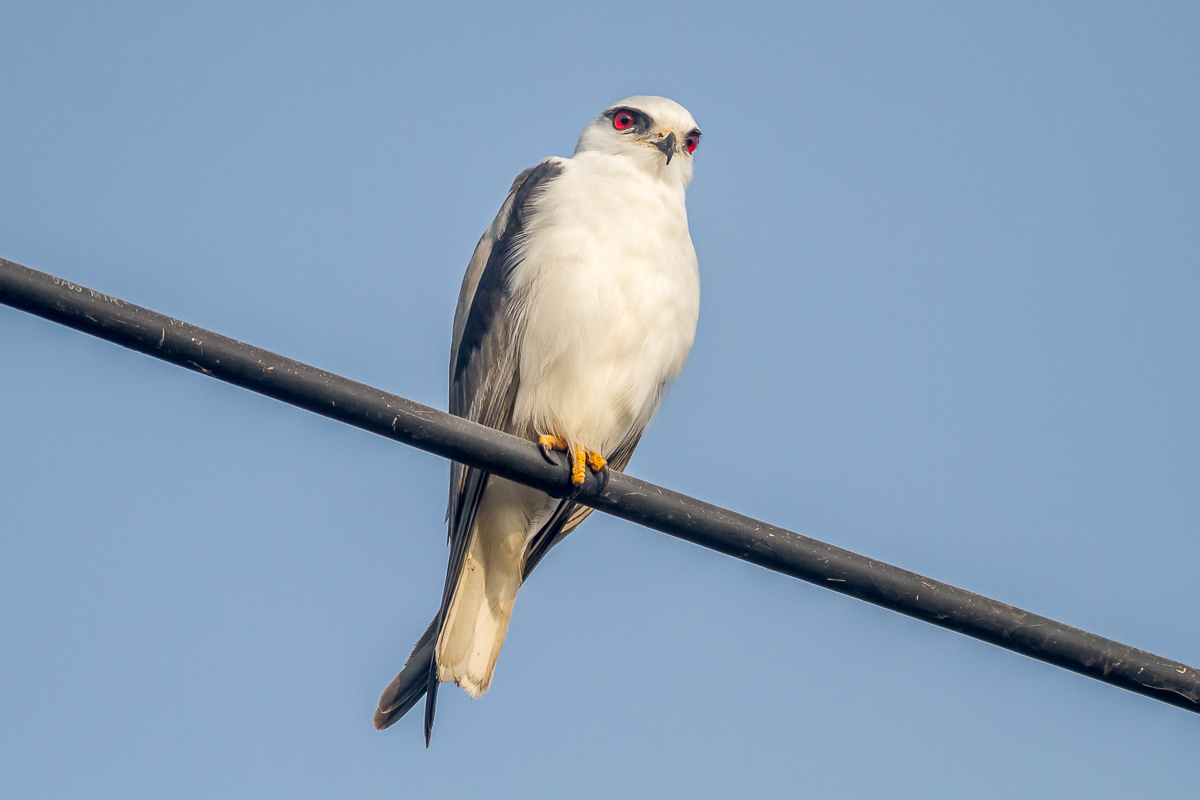
Black-winged Kite
- Common Name: Black-winged Kite (Black-shouldered Kite)
- Scientific Name: Elanus caeruleus
- Nepali Name(s): मुसे चिल (Muse Chil)
- IUCN Red List Status: Least Concern (LC)
- National Red List Status: Least Concern (LC)
- CITES Appendix: Appendix II
- CMS Appendix: Not listed
Measurements & Physical Profile
- Body Length: 31–35 cm
- Wingspan: 75–88 cm
- Weight: 180–300 g
Did You Know?
The Black-winged Kite is instantly recognizable by its striking stark-white and pale-grey plumage, accented by deep black shoulder patches and piercing, ruby-red eyes. It has a remarkable hunting technique: it can stall in mid-air and hover completely stationary over grasslands like a miniature helicopter, keeping its head perfectly still while scanning the blades of grass for rodents before executing a vertical, silent dive!
Distribution & Habitat
Global Distribution
The Black-winged Kite has an extensive global range that includes open habitats across sub-Saharan Africa, North Africa, southwestern Europe (notably the Iberian Peninsula), Southern Asia, and Southeastern Asia, extending across the Indonesian archipelago.
Distribution within Nepal
It is a widespread and relatively common resident breeder throughout the lowland Tarai plains and the lower Churia (Siwalik) foothills of Nepal. It is also a regular seasonal visitor or altitudinal mover across wide river valleys in the mid-hills, including the Pokhara and Kathmandu Valleys.
Preferred Habitats
Open grasslands, savannas, agricultural fields (especially rice, wheat, and sugarcane stubble), and semi-arid scrublands. Roadside verges, clearings near human settlements, forest edges, and fallow lands. It strictly avoids dense, contiguous interior forest tracts.
Elevational Range
Mainly a lowland specialist, most abundant from 100 meters up to 1,000 meters above sea level. However, during post-breeding dispersal and summer months, individuals frequently ascend into mid-hill agricultural valleys up to 2,000 meters.
Seasonal Occurrence
Observed year-round across its core lowland range in Nepal. In the mid-hills, its presence is more seasonal, appearing primarily during the autumn, winter, and spring months when harvested agricultural fields provide optimal rodent hunting grounds.
Behavior & Ecology
Flight & Foraging Behavior
The flight style of the Black-winged Kite is exceptionally buoyant, graceful, and gull-like, consisting of casual, deliberate wingbeats interspersed with long glides on slightly raised wings (forming a shallow 'V' or dihedral). It is a highly specialized hover-hunter. It frequently perches on exposed vantage points like telephone wires, fence posts, or dead tree snags, before launching into the wind to hover 10 to 20 meters above the ground, tracking movement below before dropping down with extended talons.
Social & Roosting Habits
Usually observed hunting solo or in mated pairs. While they maintain and defend exclusive hunting territories during the active nesting cycle, they are surprisingly social during the non-breeding season. At dusk, small family groups and regional populations gather to form communal roosts in dense leafy trees, orchards, or bamboo groves, sometimes numbering from 10 to over 50 individuals.
Diet & Ecosystem Role
Diet Breakdown
The Black-winged Kite is a highly efficient, specialized carnivorous predator:
- Mammals (Primary): Small rodents, particularly field mice, rats, and shrews, make up over 80% to 90% of its regular diet.
- Insects: Large grasshoppers, locusts, crickets, beetles, and swarming termites, often captured or pursued on the wing.
- Reptiles & Amphibians: Small lizards, skinks, and occasionally small frogs.
- Birds: Highly opportunistic; they occasionally take small, ground-dwelling songbirds or injured nestlings.
Ecological Role
As a premier rodent specialist in agricultural landscapes, the Black-winged Kite serves as an indispensable natural ally to farmers. By consuming immense quantities of destructive field mice and voles, they act as an efficient biological pest control agent, significantly lowering crop damage and eliminating the need for hazardous chemical rodenticides.
Breeding Biology
The breeding season in Nepal is highly flexible and opportunistic, capable of occurring year-round depending on rodent abundance, though distinct nesting peaks are observed from January to April and again from August to October. Courtship features beautiful, high-altitude chasing flights, accompanied by a soft, whistling “wheee-oh” call, and spectacular food-passing rituals where the male transfers prey to the female mid-air.
Both sexes contribute to building a neat, relatively flat, and loose platform nest out of thin sticks, twigs, and roots. The nest is lined lightly with fine grass or green leaves and is typically placed in the upper canopy or thorny outer branches of a standalone tree or bush, such as an acacia or a lone fruit tree in an open field, usually 4 to 12 meters above the ground. The female lays a clutch of 3 to 4 cream-colored eggs, beautifully covered in dense, reddish-brown blotches. Incubation lasts around 26 to 28 days and is performed almost entirely by the female, while the male hunts. The chicks are altricial, growing very quickly, and fledge at approximately 35 days old, though they continue to receive supplementary food from their parents for several weeks.
Migration
- Status: Resident, nomadic, and altitudinal mover.
- Movement: The species does not engage in long-distance, cross-continental migrations. Instead, it exhibits highly nomadic behavior. Kites will rapidly vacate a region if rodent populations crash and irrupt into new districts where a sudden surge of rodents or insects (such as locust swarms) occurs. Local populations also perform short-distance altitudinal movements, pushing up into hill valleys during the warm post-monsoon harvest season.
Population Status
- Global Population Estimate: The global population is vast and currently expanding, though it has not been precisely quantified into a single metric.
- Population Trend: Stable to Increasing globally, as deforestation and the clearance of woodlands for agriculture continuously create new open grassland and foraging habitats.
- National Population Estimate (Nepal): Widespread, common, and secure throughout the Tarai and outer foothills; populations are thought to be declining in the current years, however no population estimation has been made.
- Monitoring & Surveys: Frequently counted during roadside raptor transect surveys, farmland avian assessments, and citizen-science mapping initiatives (e.g., eBird).
Threats
- Pesticide & Rodenticide Poisoning: The single greatest threat to this species is secondary chemical poisoning. When they consume rodents that have ingested agricultural rodenticides (like bromadiolone), the toxins accumulate in the kite, leading to internal bleeding, reproductive failure, or rapid death.
- Electrocution: Because they regularly use roadside utility poles and live wires as hunting perches, they face a consistent risk of electrocution on uninsulated distribution lines.
- Loss of Perches and Nesting Trees: The removal of isolated, standalone trees and snags in agricultural fields strips away their essential hunting platforms and nesting sites.
- Nest Predation: Because nests are often built in small, isolated trees, they are vulnerable to disturbance and predation by crows, feral cats, and humans.
Conservation Actions
Existing Measures
- International Conventions: Universally protected under CITES Appendix II, which monitors and outlaws illegal international trade of the birds or their feathers.
- Farmland Adaptability: Flourishing within local community-managed farmlands and buffer zones across Nepal’s lowland protection networks.
Recommended Measures
- Restricting Toxic Rodenticides: Promoting integrated pest management (IPM) techniques among farmers, encouraging the protection of birds of prey as a substitute for chemical rat poisons.
- Perch Preservation: Encouraging farmers to leave dead snags or install simple, artificial wooden T-perches in agricultural fields to facilitate natural raptor hunting.
- Power Pylon Insulation: Collaborating with regional electricity authorities to retro-insulate high-risk transformers and open wiring across key lowland agricultural belts.
References
- BirdLife International (2019). Species factsheet: Black-winged Kite Elanus caeruleus. Downloaded from https://datazone.birdlife.org/species/factsheet/black-winged-kite-elanus-caeruleus on 05/08/2026
- Ferguson-Lees, J., & Christie, D. A. (2001). Raptors of the World. Christopher Helm, London.
- Inskipp C., Baral H. S., Phuyal S., Bhatt T. R., Khatiwada M., Inskipp, T, Khatiwada A., Gurung S., Singh P. B., Murray L., Poudyal L. and Amin R. (2016). The status of Nepal’s Birds: The national red list series. Zoological Society of London, UK.
- Kemp, A. C., G. M. Kirwan, J. S. Marks, A. Motis, and E. Garcia (2020). Black-winged Kite (Elanus caeruleus), version 1.0. In Birds of the World (J. del Hoyo, A. Elliott, J. Sargatal, D. A. Christie, and E. de Juana, Editors). Cornell Lab of Ornithology, Ithaca, NY, USA. https://doi.org/10.2173/bow.bkskit1.01