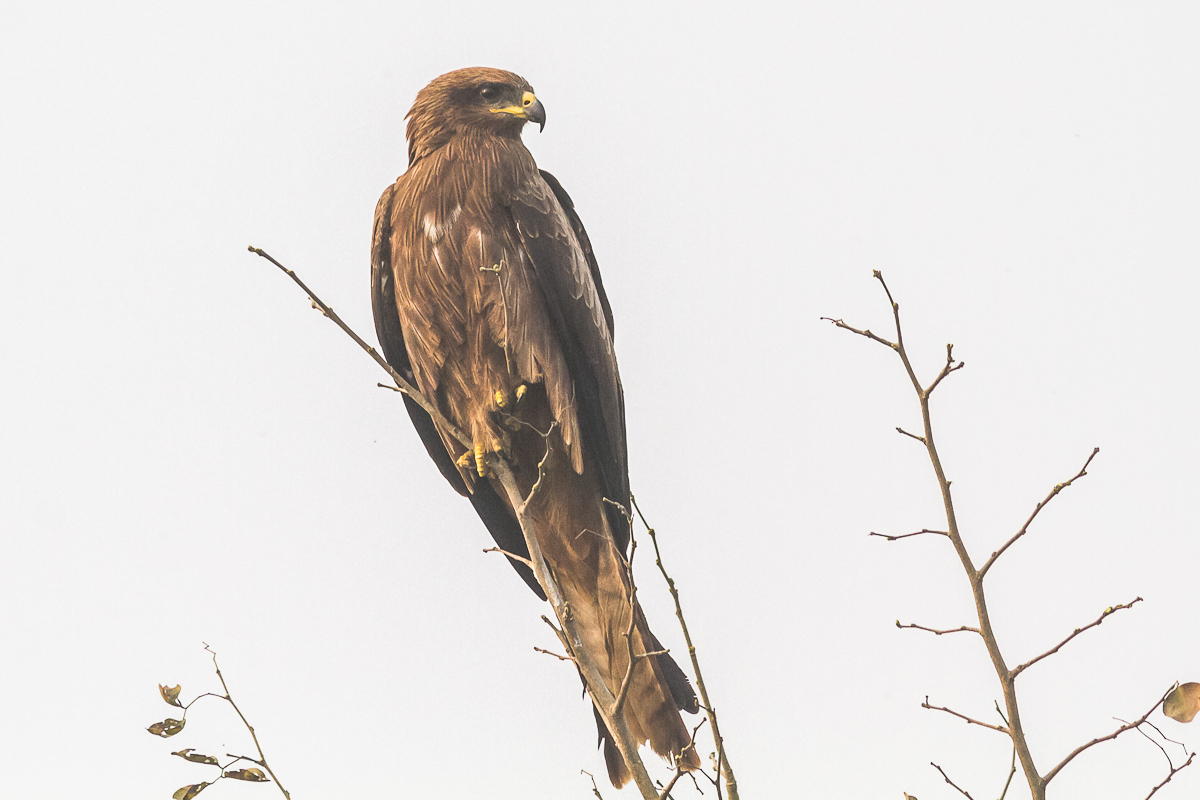
Black Kite
- Common Name: Black Kite
- Scientific Name: Milvus migrans
- Nepali Name(s): कालो चिल (Kalo Chil)
- IUCN Red List Status: Least Concern (LC)
- National Red List Status: Least Concern (LC)
- CITES Appendix: Appendix II
- CMS Appendix: Appendix II
Measurements & Physical Profile
- Body Length: 55–60 cm
- Wingspan: 130–155 cm
- Weight: 630–930 g
Did You Know?
The Black Kite is arguably the most successful and widespread raptor on the planet. It has adapted flawlessly to human environments. In flight, it can easily be recognized by its long, deeply forked tail, which acts like a constant, twisting aircraft rudder as it scans the ground. These bold birds are legendary for their aerial agility, capable of swooping down into busy city streets or open-air markets to snatch food directly out of a person’s hand in the blink of an eye!
Distribution & Habitat
Global Distribution
The Black Kite has an incredibly vast global range that spans across Europe, Africa, Asia, and Australasia. The nominate race and various subspecies breed across the Palearctic region and migrate south for the winter, while other subspecies—such as the Black-eared Kite (Milvus migrans lineatus) found throughout northern and eastern Asia—show complex regional wintering and migratory behaviors across the Indian subcontinent.
Distribution within Nepal
It is a highly abundant, widespread, and ubiquitous resident breeder and passage migrant across Nepal. It is commonly found across all major urban centers, towns, and villages, with dense concentrations in the Kathmandu Valley, Pokhara Valley, and throughout the lowland Tarai towns.
Preferred Habitats
Urban environments, suburban fringes, refuse dumps, landfills, fish farms, open-air slaughterhouses, and large livestock markets. Open woodlands, savanna margins, wide river plains, lake edges, and agricultural fields. It generally avoids dense, contiguous interior forest tracts.
Elevational Range
Commonly breeds and forages throughout the lowlands and mid-hills from 100 meters up to 2,200 meters above sea level. During seasonal migration, massive flocks are routinely recorded traversing high-altitude mountain passes well above 4,000 to 5,000 meters.
Seasonal Occurrence
Present year-round in Nepal as a resident population. However, local numbers swell drastically between October and December when thousands of migratory birds traveling from northern Asia pass south through the country's major river valleys and ridge bottlenecks.
Behavior & Ecology
Flight & Foraging Behavior
The Black Kite displays a buoyant, effortless, and highly maneuverable flight style. It spends long hours on the wing, circling slowly over urban streets or landfills using minimal wingbeats, constantly flexing and twisting its distinctively forked tail to adjust its direction. It is an exceptional opportunist and scavenger, hunting via low-altitude quartering or snatching discarded organic waste and small prey from the ground or water surfaces without landing.
Social & Roosting Habits
Highly gregarious and tolerant of both humans and its own species. While they forage independently, hundreds or even thousands of individuals gather at communal feeding sites like landfills. At dusk, they form massive, spectacular communal roosts in large trees, bamboo groves, or high-voltage electricity pylons within or bordering cities. They are generally non-territorial except for a tight, aggressively defended zone immediately surrounding their active nest platform.
Diet & Ecosystem Role
Diet Breakdown
The Black Kite is a highly versatile, omnivorous scavenger and predator:
- Carrion & Refuse (Primary): Kitchen waste, discarded offal from slaughterhouses, fish scraps, and roadkill.
- Mammals: Small rodents, rats, mice, and shrews common in urban areas.
- Birds: Nestlings, injured birds, and feral pigeons.
- Insects & Amphibians: Swarming termites, locusts, earthworms, frogs, and lizards.
Ecological Role
As a premier urban scavenger, the Black Kite provides a vital ecosystem sanitation service. By quickly disposing of organic refuse, animal carcasses, and slaughterhouse waste in densely populated cities, they keep streets clean and severely limit the breeding grounds for disease vectors, playing a major role in metropolitan public health.
Breeding Biology
The breeding season in Nepal begins in the winter months of January and runs through May, taking advantage of dry conditions for chick-rearing. Courtship involves loud, whinnying calls—a distinctive, high-pitched, vibrating “kleee-errr” trill—accompanied by mutual circling, high-speed aerial chases, and occasional talons-locking maneuvers.
Both sexes work together to build a messy, bulky platform nest out of twigs, sticks, and roots. Reflecting their urban adaptation, they heavily line the nest with human debris such as rags, old clothes, plastic bags, paper, and pieces of string. Nests are placed in the forks of tall trees (like eucalyptus, peepal, or kapok) near human dwellings, or on artificial structures like pylons and building ledges. The female lays a clutch of 2 to 4 off-white eggs, beautifully spotted and smeared with dark brown. Incubation takes around 30 to 34 days and is handled mostly by the female. The chicks grow rapidly, fed by both parents, and fledge at about 42 to 50 days old.
Migration
- Status: Resident and passage migrant.
- Movement: Local breeding populations are sedentary or show short-distance seasonal wandering. However, Nepal serves as a massive migratory corridor for the East Asian subspecies (lineatus), which breeds in Siberia, Mongolia, and northern China. These northern birds travel south over the Himalayas to winter in India. Some birds also winters in Kathmandu, Pokhara valley and in lowlands of Nepal. They funnel across famous migratory watch sites, such as Thoolakharka, moving in large, loose waves from east to west along the mountain ridges between October and December.
Population Status
- Global Population Estimate: The global population is immense, conservatively estimated to exceed 4 to 6 million mature individuals.
- Population Trend: Stable globally or increasing in some places due to expanding urbanization, which provides endless artificial foraging opportunities.
- National Population Estimate (Nepal): Widespread, highly abundant, and secure. Population numbers are stable or increasing across urbanized valleys.
- Monitoring & Surveys: Extensively counted during autumn raptor migration monitoring initiatives along the mid-hill ridges and through long-term citizen science datasets (e.g., eBird).
Threats
- Electrocution & Collisions: Because they roost and nest on utility structures, accidental electrocution on poorly insulated overhead power lines or collision with distribution cables is a major cause of urban mortality.
- Poisoning: High exposure to secondary poisoning from consuming rodents that have ingested rodenticides, or from ingesting toxic chemicals at poorly managed industrial landfill sites.
- Kite-String Entanglement: During regional festivals (like Dashain), many kites likely to entangle in discarded glass-coated strings (manjha), leading to severe wing injuries or death.
- Persecution: Occasional retaliatory shooting or nest destruction by poultry farmers or urban residents who view them as nuisances.
Conservation Actions
Existing Measures
- Legal Shield: Listed globally under CITES Appendix II to control any commercial trade and included under the CMS Raptors MOU.
- Protected Areas: Well-represented across virtually all buffer zones and multi-use landscapes surrounding Nepal's protected area network.
Recommended Measures
- Insulating Power Infrastructure: Retrofitting and insulating high-voltage electrical transformers and crossarms inside major cities to eliminate raptor electrocution hotspots.
- Safe Waste Management: Enforcing cleaner waste-disposal covers at landfills to prevent birds from accidentally ingesting hazardous chemical toxins.
- Festival Awareness Campaigns: Promoting the use of eco-friendly, non-glass-coated cotton strings during kite-flying festivals to protect urban raptors from wing lacerations.
References
- BirdLife International (2021). Species factsheet: Black Kite Milvus migrans. Downloaded from https://datazone.birdlife.org/species/factsheet/black-kite-milvus-migrans on 05/08/2026
- David, T. S., J. Orta, J. S. Marks, E. Garcia, and G. M. Kirwan (2021). Black Kite (Milvus migrans), version 1.1. In Birds of the World (S. M. Billerman, Editor). Cornell Lab of Ornithology, Ithaca, NY, USA. https://doi.org/10.2173/bow.blakit1.01.
- Ferguson-Lees, J., & Christie, D. A. (2001). Raptors of the World. Christopher Helm, London.
- Inskipp C., Baral H. S., Phuyal S., Bhatt T. R., Khatiwada M., Inskipp, T, Khatiwada A., Gurung S., Singh P. B., Murray L., Poudyal L. and Amin R. (2016). The status of Nepal’s Birds: The national red list series. Zoological Society of London, UK.