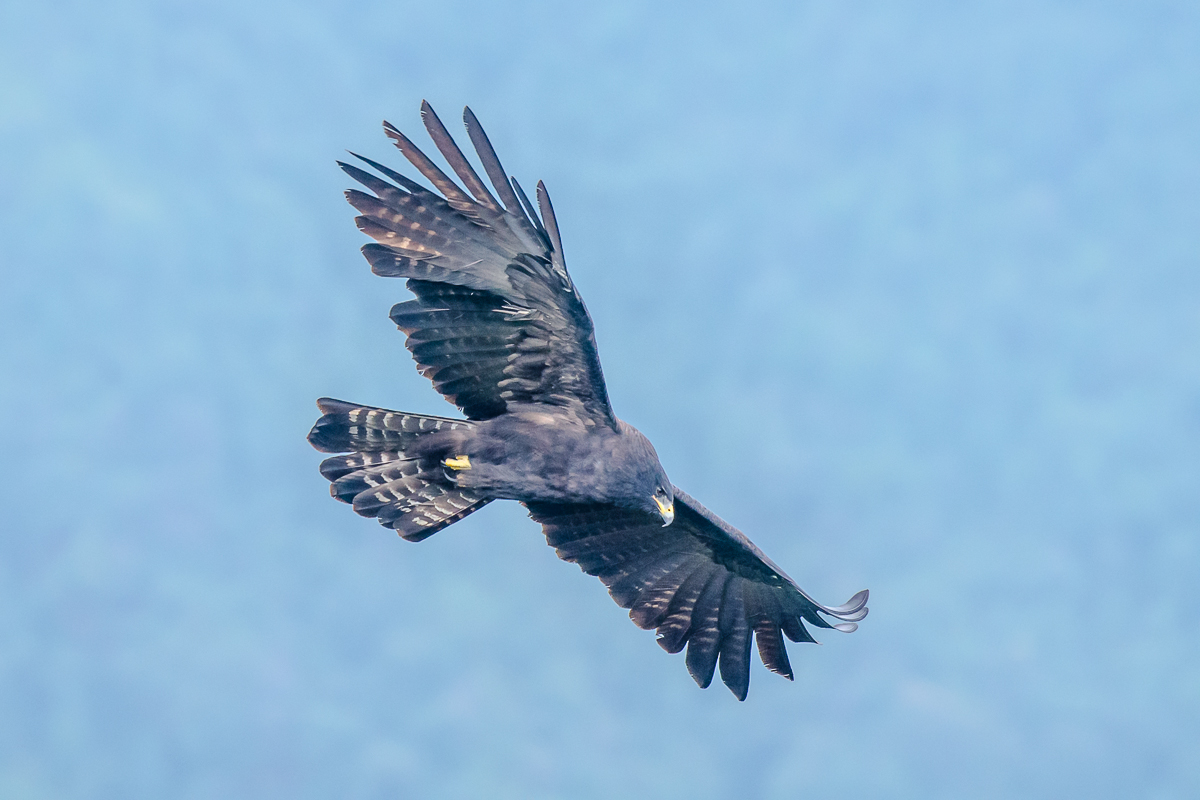
Black Eagle
- Common Name: Black Eagle
- Scientific Name: Ictinaetus malaiensis
- Nepali Name(s): द्रोणक चिल (Dronak Chil)
- IUCN Red List Status: Least Concern (LC)
- National Red List Status: Least Concern (LC)
- CITES Appendix: Appendix II
- CMS Appendix: Not listed
Measurements & Physical Profile
- Body Length: 67–81 cm
- Wingspan: 164–178 cm
- Weight: 1,000–1,600 g
Did You Know?
Unlike most eagles that swoop down to crush large prey on the ground, the Black Eagle is a highly specialized nest raider. It has unique, widely spaced, and relatively straight talons with an exceptionally long outer toe. This evolutionary adaptation acts like a pair of specialized salad tongs, allowing the eagle to fly up to a tree or cliff nest, snatch the entire nest out of the branches (including the eggs or nestlings inside), and carry it away to a quiet perch to eat at leisure!
Distribution & Habitat
Global Distribution
The Black Eagle is widely distributed across the tropical and subtropical hill forests of Southern and Southeastern Asia. Its range extends along the Himalayan foothills from northern Pakistan, India, Nepal, and Bhutan, eastward into southern China and Taiwan, and southward through Myanmar, Thailand, Indochina, the Malay Peninsula, and the major islands of Indonesia (Sumatra, Java, Borneo, and Sulawesi).
Distribution within Nepal
It is a widespread and relatively common resident breeder throughout the mid-hills of Nepal. It is regularly recorded spanning from the far-west to the far-east, with high encounter rates in well-wooded valleys, mountain ridges, and protected hill forests including the Shivapuri Nagarjun National Park and the lower valleys of the Annapurna and Manaslu Conservation Areas.
Preferred Habitats
Heavy montane forests, subtropical evergreen forests, and moist deciduous broadleaved woodlands on steep hillsides. They frequently patrol forest edges, clearings, deep river gorges, and the airspace just above the tree canopy of intact forest tracts.
Elevational Range
Primarily inhabits the mid-hill altitudinal belt, ranging between 300 meters up to 2,500 meters above sea level, though individuals are occasionally observed foraging over alpine ridges up to 3,500 meters during the summer months.
Seasonal Occurrence
Year-round permanent resident. The species demonstrates high site-fidelity and does not engage in long-distance seasonal migrations, though minor altitudinal adjustments down into lower valleys may occur during severe winter weather.
Behavior & Ecology
Flight & Foraging Behavior
The Black Eagle possesses an exceptionally distinct and recognizable flight profile. It has very long, broad wings with deeply fingered primary feathers (primary splaying) and a long tail. It excels at slow, buoyant, low-speed soaring just at or right above the forest canopy level. It utilizes minimal flapping, relying on its high-aspect wings to glide effortlessly through tight thermal contours along mountain slopes. This "canopy-skimming" strategy allows it to scan dense foliage closely for hidden bird and mammal nests.
Social & Roosting Habits
Typically observed flying solitary or in well-coordinated breeding pairs. They are highly territorial birds that maintain large home ranges across forested ridges. While they spend hours on the wing during the mid-day hours, they roost cryptically on large, densely leafed branches within the upper canopy of mature trees, blending perfectly into the deep shadows due to their uniform black plumage.
Diet & Ecosystem Role
Diet Breakdown
The Black Eagle is a specialized carnivorous predator with a highly targeted foraging ecology:
- Birds & Eggs (Primary): Tree-nesting songbirds, pigeons, doves, gamebirds (like pheasants or junglefowl), and critically, a high volume of bird eggs and nestlings stolen directly from nests.
- Mammals: Arboreal mammals including squirrels (especially flying squirrels), tree shrews, bats, and small rodents.
- Reptiles & Insects: Occasional consumption of tree lizards, geckos, snakes, and large forest insects when mammalian or avian prey is less accessible.
Ecological Role
As a specialized predator of arboreal mammals and nesting birds, the Black Eagle occupies a distinct ecological niche within the mid-hill forest canopy. By regulating populations of squirrels, rodents, and canopy birds, it prevents overgrazing of forest seeds and fruits, thereby indirectly contributing to natural forest regeneration and helping maintain a balanced forest ecosystem structure.
Breeding Biology
The breeding season in Nepal spans from November to April, taking advantage of the cooler dry winter and early spring months. Courtship involves breathtaking aerial acrobatics, including high-altitude power dives, upward swoops, and spectacular talons-locking cartwheels performed by the breeding pair along steep forested valleys.
The pair constructs a massive, bulky platform nest out of thick sticks and branches, which can measure up to 1.5 meters across. This nest is heavily lined with fresh green leaves and is typically positioned high up in the fork of a large forest tree growing on a steep slope, or occasionally on an inaccessible, forested cliff ledge. The female lays a clutch of 1 to 2 broad, oval eggs that are whitish to pale pink, beautifully blotched with reddish-brown and lavender. Incubation lasts for approximately 35 to 40 days and is performed primarily by the female, while the male provisions the nest. Generally, only a single chick successfully fledges after a long nestling period of about 60 to 70 days.
Migration
- Status: Permanent resident; non-migratory.
- Movement: Adults remain within their established forest territories year-round. Sub-adult and immature eagles exhibit localized nomadic dispersal movements, wandering across adjacent mountain valleys and forest tracts in search of food and vacant territories.
Population Status
- Global Population Estimate: The global population has not been precisely quantified, but the species is described as locally common to uncommon, depending on the status of remaining contiguous forest canopies.
- Population Trend: Decreasing globally due to forest loss and rapid forest conversion.
- National Population Estimate (Nepal): Widespread and considered stable across its primary mid-hill distribution ranges.
- Monitoring & Surveys: Monitored via standard raptor point-counts, ridge-line watch site observations during seasonal movements of other raptors, and citizen science avian mapping datasets.
Threats
- Habitat Destruction & Fragmentation: Large-scale clearing of mature hill forests for road construction, agriculture, and urban expansion directly removes the contiguous canopies they require for hunting.
- Loss of Nesting Trees: Selective logging of large, old-growth canopy trees reduces the availability of secure, structurally sound nesting sites.
- Human Disturbance: Encroachment, forest fires, and intensive non-timber forest product harvesting during the winter and early spring can cause stress and nest abandonment.
- Prey Base Decline: Widespread degradation of forest understories can lead to a drop in the populations of small arboreal mammals and forest birds that the eagle relies on for food.
Conservation Actions
Existing Measures
- Habitat Safety: Securely represented within several mid-hill and montane protected areas in Nepal, including Shivapuri Nagarjun National Park, Makalu Barun National Park, and the Langtang National Park buffer zones.
- International Frameworks: Fully listed under CITES Appendix II, ensuring strict global legal protection against the commercial trapping, collection, or trade of live birds or their parts.
Recommended Measures
- Canopy Corridor Protection: Maintaining continuous, unfragmented forest strips along mountain ridges and deep river valleys to facilitate safe foraging corridors.
- Community Forest Engagement: Informing local Community Forest User Groups (CFUGs) about the presence of active nests, encouraging them to halt timber extraction within a buffer zone during the critical November–April breeding window.
- Long-term Nest Monitoring: Establishing a dedicated monitoring database for known breeding sites in the mid-hills to evaluate long-term breeding success trends in relation to human land-use changes.
References
- BirdLife International (2024). Species factsheet: Black Eagle Ictinaetus malaiensis. Downloaded from https://datazone.birdlife.org/species/factsheet/black-eagle-ictinaetus-malaiensis on 05/08/2026
- Clark, W. S., J. S. Marks, G. M. Kirwan, and P. F. D. Boesman (2020). Black Eagle (Ictinaetus malaiensis), version 1.0. In Birds of the World (J. del Hoyo, A. Elliott, J. Sargatal, D. A. Christie, and E. de Juana, Editors). Cornell Lab of Ornithology, Ithaca, NY, USA. https://doi.org/10.2173/bow.blaeag1.01
- Ferguson-Lees, J., & Christie, D. A. (2001). Raptors of the World. Christopher Helm, London.
- Inskipp C., Baral H. S., Phuyal S., Bhatt T. R., Khatiwada M., Inskipp, T, Khatiwada A., Gurung S., Singh P. B., Murray L., Poudyal L. and Amin R. (2016). The status of Nepal’s Birds: The national red list series. Zoological Society of London, UK.