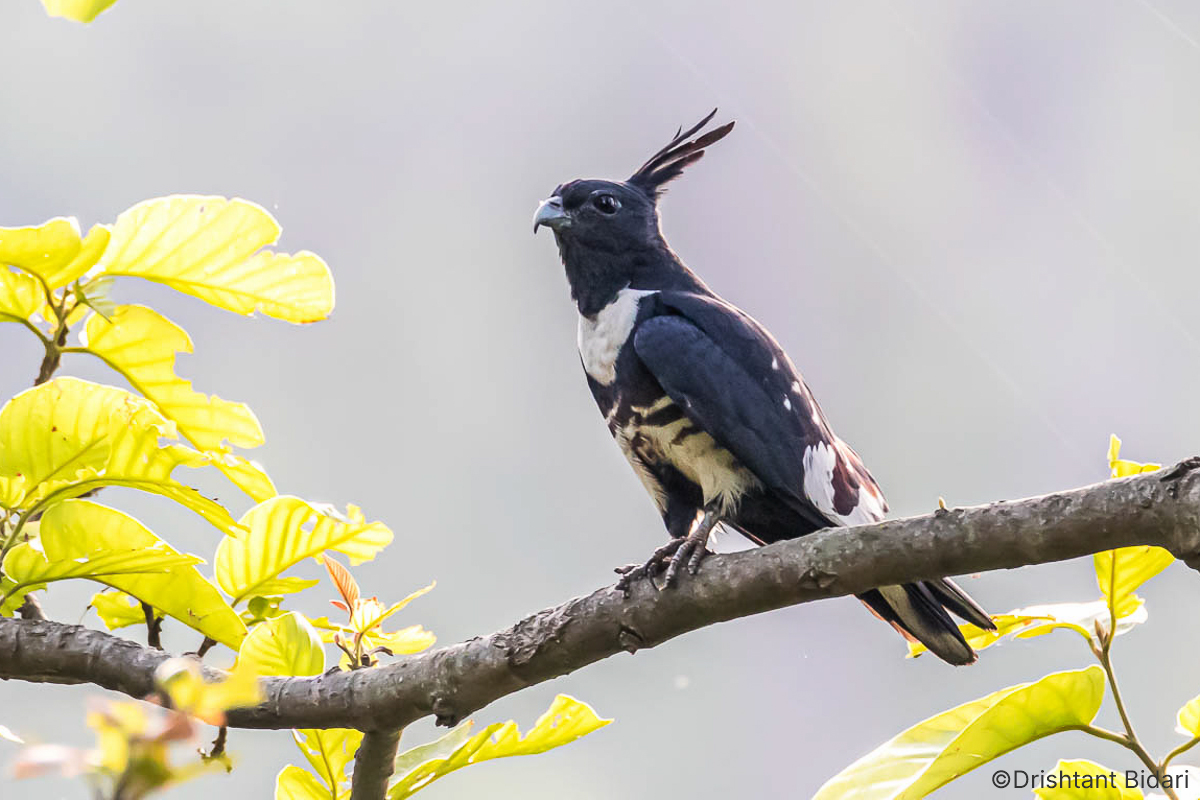
Black Baza
- Common Name: Black Baza
- Scientific Name: Aviceda leuphotes
- Nepali Name(s): कालो जुरेबाज (Kalo Jure Baaz)
- IUCN Red List Status: Least Concern (LC)
- National Red List Status: Near Threatened (NT)
- CITES Appendix: Appendix II
- CMS Appendix: Not listed
Measurements & Physical Profile
- Body Length: 30–35 cm
- Wingspan: 66–80 cm
- Weight: 168–224 g
Did You Know?
With its striking black-and-white plumage, bold chestnut breast bands, and a long, prominent crest that it erects when perched, the Black Baza looks remarkably like a giant butterfly or a lapwing in flight. Unlike most solitary birds of prey, these highly social raptors love to play in the wind, performing playful, buoyant aerial acrobatics in small, tight-knit family groups over the forest canopy!
Distribution & Habitat
Global Distribution
The Black Baza is native to the Indo-Malayan realm. Its breeding range stretches across the eastern Himalayas, Northeast India, southern China, and parts of Indochina. Populations from the northernmost parts of its range migrate south to spend the winter in Southern India, Sri Lanka, the Malay Peninsula, Sumatra, and parts of Java.
Distribution within Nepal
In Nepal, the Black Baza is a rare and highly localized summer breeding visitor and passage migrant. It is primarily recorded in the dense forests of the eastern and central lowlands (Tarai), particularly within well-wooded protected zones and riverine forests, with sightings decreasing significantly further west.
Preferred Habitats
Lowland tropical and subtropical evergreen forests, moist deciduous broadleaved woodlands, and dense riverine forests. Forest clearings, edge habitats near streams, older plantations, and well-wooded swampy areas.
Elevational Range
Strictly a lowland specialist in Nepal, generally found at elevations below 300 meters, though occasional migrants or foraging individuals are recorded up to 900 meters above sea level in the Churia (Siwalik) foothills.
Seasonal Occurrence
An exclusively summer visitor to Nepal, arriving in April ahead of the monsoon to breed, and departing southward by late August or September as the autumn migration begins.
Behavior & Ecology
Flight & Foraging Behavior
The Black Baza exhibits a distinctive, slow flight style featuring deep, deliberate wingbeats interspersed with short glides, giving it a remarkably buoyant, crow-like appearance. It is primarily a crepuscular hunter, showing peak activity during the dawn and dusk hours. It often hunts from an exposed dead branch high in the canopy, launching swift sallying flights to snatch large insects directly from the air, or dropping down to glean prey off foliage.
Social & Roosting Habits
Highly gregarious and social, this species is frequently seen in pairs or small family parties of 3 to 5 birds, which can swell into loose flocks of 20 or more individuals during seasonal migration. They are generally non-territorial outside the immediate vicinity of their nest site. At night, they roost communally in the upper branches of tall, leaf-laden forest trees, often calling to one another with a distinctive, sharp, double-noted whistle: “che-chew” or “ti-tiu”.
Diet & Ecosystem Role
Diet Breakdown
The Black Baza is overwhelmingly insectivorous, though it opportunistically takes small vertebrates:
- Insects (Primary): Large flying insects including mantises, grasshoppers, locusts, beetles, winged termites, cicadas, and large moths.
- Vertebrates: Tree frogs, small arboreal lizards (such as calotes/garden lizards), geckos, and occasionally small bats or nestling songbirds.
- Fruit: Uniquely among small raptors, they have been occasionally observed consuming the oil-rich husks of certain forest fruits, though this is rare.
Ecological Role
Operating as an arboreal insectivore, the Black Baza serves as a key regulator of canopy-dwelling invertebrate populations. By feeding heavily on large herbivorous insects and swarming pests along tropical forest edges, they protect the health of the forest canopy and contribute directly to the intricate web of biological pest management.
Breeding Biology
The breeding season in Nepal occurs from April to June, closely matching the arrival of pre-monsoon insect swarms. Courtship involves spectacular, rolling aerial displays where pairs chase each other over the tree canopy, calling loudly with their crests fully erect.
Both sexes cooperate closely to build a relatively small, compact platform nest made of twigs and sticks, which they carefully line with fresh green leaves and grass. The nest is typically hidden high up (10 to 25 meters above the ground) in the upper fork of a tall, densely leafed tree, often near a forest clearing or stream edge. The female lays a clutch of 2 to 3 greenish-white eggs that are lightly spotted with grey or brown. Both parents share the incubation duties for roughly 26 to 27 days and jointly feed the nestlings. The young are altricial and receive attentive parental care until they fledge and leave the nest approximately 29 to 33 days after hatching.
Migration
- Status: Summer breeding visitor and passage migrant.
- Movement: Populations visiting Nepal are fully migratory. They arrive from their southern wintering grounds in Peninsular India or Southeast Asia in early spring to exploit the abundance of insects during the warm monsoon months. By late summer, adults and newly fledged young gather into small groups and travel south-southeastward along low-altitude river valleys to escape the cooler post-monsoon months.
Population Status
- Global Population Estimate: The global population size has not been accurately quantified, but it is considered locally common across its core Southeast Asian range.
- Population Trend: Decreasing globally due to rapid tropical deforestation.
- National Population Estimate (Nepal): Rare and localized; listed as Near Threatened nationally because its breeding population in Nepal is small and strictly confined to specialized, vanishing lowland forest fragments.
- Monitoring & Surveys: Monitored via seasonal raptor counts, breeding-season nest mapping in lowland protected areas, and data gathered from citizen science projects (e.g., eBird).
Threats
- Habitat Destruction: Rapid clearing and fragmentation of lowland tropical evergreen and riverine forests due to agricultural expansion and infrastructure construction.
- Loss of Nesting Trees: Severe logging and illegal timber extraction target the mature, tall canopy trees that these birds require for nesting safety.
- Pesticide use: Heavy application of chemical pesticides in agricultural lands surrounding lowland forest patches reduces their insect prey base and poses risks of chemical bioaccumulation.
- Climate Change: Shifts in monsoon onset timing can disrupt the synchronization between the hatching of their chicks and peak insect swarms.
Conservation Actions
Existing Measures
- Protected Area Safetynet: Core breeding pairs find refuge within Nepal's eastern and central protected lowlands, including Chitwan National Park, Parsa National Park, and Koshi Tappu Wildlife Reserve.
- Global Trade Safeguards: Listed internationally under CITES Appendix II, ensuring strict regulation and monitoring against illegal trade of the species.
Recommended Measures
- Riverine Forest Preservation: Implementing strict protection zones for remaining old-growth riverine forests outside of protected park boundaries.
- Community Agroforestry: Encouraging community forest user groups to maintain buffer zones with mature canopy trees adjacent to agricultural areas.
- Targeted Breeding Surveys: Launching specialized pre-monsoon surveys in the eastern Tarai to identify and shield active nesting zones from human disturbance during the critical summer months.
References
- BirdLife International (2021). Species factsheet: Black Baza Aviceda leuphotes. Downloaded from https://datazone.birdlife.org/species/factsheet/black-baza-aviceda-leuphotes on 05/08/2026
- Clark, W. S. and G. M. Kirwan (2020). Black Baza (Aviceda leuphotes), version 1.0. In Birds of the World (J. del Hoyo, A. Elliott, J. Sargatal, D. A. Christie, and E. de Juana, Editors). Cornell Lab of Ornithology, Ithaca, NY, USA. https://doi.org/10.2173/bow.blabaz1.01
- Ferguson-Lees, J., & Christie, D. A. (2001). Raptors of the World. Christopher Helm, London.
- Inskipp C., Baral H. S., Phuyal S., Bhatt T. R., Khatiwada M., Inskipp, T, Khatiwada A., Gurung S., Singh P. B., Murray L., Poudyal L. and Amin R. (2016). The status of Nepal’s Birds: The national red list series. Zoological Society of London, UK.