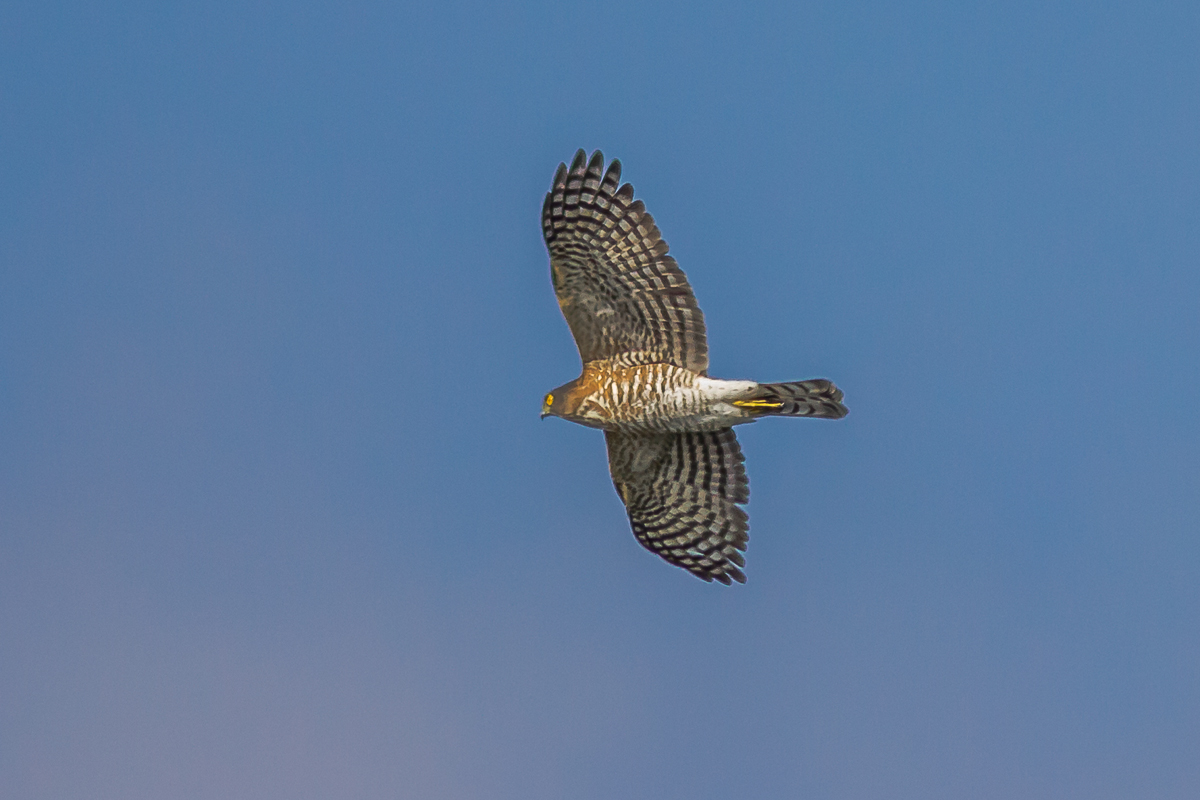
Besra
- Common Name: Besra (Besra Sparrowhawk)
- Scientific Name: Tachyspiza virgata
- Nepali Name(s): बेसरा (Besra)
- IUCN Red List Status: Least Concern (LC)
- National Red List Status: Least Concern (LC)
- CITES Appendix: Appendix II
- CMS Appendix: Not listed
Measurements & Physical Profile
- Body Length: 29–36 cm
- Wingspan: 50–65 cm
- Weight: Male: 83–140 g | Female: 131–218 g
Did You Know?
The Besra exhibits extreme sexual dimorphism, with females being up to 60% heavier than males. This size difference allows a breeding pair to split the hunting duties perfectly: the smaller, ultra-agile male zips through dense forest canopies to ambush small songbirds and large insects, while the larger female is powerful enough to tackle lizards and sizeable game birds like doves or quails!
Distribution & Habitat
Global Distribution
The Besra is widely distributed across Southern, Eastern, and Southeastern Asia. Its breeding and resident range stretches across the Indian subcontinent, the Himalayas, southern China, Taiwan, and down through Myanmar, Thailand, Indochina, the Malay Peninsula, and the Indonesian archipelago.
Distribution within Nepal
It is a widespread resident and breeding species throughout Nepal. It is commonly found inhabiting the forested belts of the lowlands (Tarai), the Churia (Siwalik) hills, and extensively across the mid-hills (Mahabharat range) from west to east.
Preferred Habitats
Dense subtropical and tropical broadleaved forests, mature evergreen woodlands, and montane forests. Disturbed forest edges, dense secondary growth, well-wooded river valleys, and occasionally old-growth orchards or groves near forest-adjacent villages.
Elevational Range
Typically ranges from the lowland plains at 100 meters up to 2,000 meters above sea level, occasionally foraging up to 3,000 meters in the temperate forest zones during the summer breeding months.
Seasonal Occurrence
Year-round permanent resident across most of its range in Nepal. However, individuals breeding at higher elevations perform minor altitudinal migrations, moving down into lower valleys and the Tarai plains during the harsh winter months.
Behavior & Ecology
Flight & Foraging Behavior
The Besra possesses the classic Accipiter hunting profile: short, rounded wings and a long, narrow tail that acts as an efficient rudder. This body shape allows it to fly with spectacular agility through tight spaces in dense tree canopies. It is a classic ambush predator, sitting quietly and completely concealed on an inner forest perch before launching a sudden, lightning-fast pursuit to surprise its prey.
Social & Roosting Habits
A highly secretive, solitary, and elusive raptor that spends most of its time hidden within dense foliage, making it far more often heard than seen. It establishes and fiercely defends a breeding territory during the spring. During the breeding season, it becomes highly vocal, uttering a loud, piercing, shrill, rapid call—often rendered as “kwee-kwee-kwee-kwee”—from high tree perches to mark its domain.
Diet & Ecosystem Role
Diet Breakdown
The Besra is an aggressive and specialized carnivore:
- Birds (Primary): A wide variety of forest songbirds, sparrows, bulbuls, babblers, and occasionally larger birds like barbets or small doves.
- Insects: Large flying insects such as cicadas, beetles, locusts, and grasshoppers, frequently taken on the wing.
- Reptiles & Amphibians: Small lizards, skinks, geckos, and small tree frogs.
- Mammals: Small rodents, such as forest mice and shrews, are occasionally taken when bird activity is low.
Ecological Role
As a specialized avian predator within dense forest ecosystems, the Besra acts as a vital regulator of lower-trophic bird and insect populations. By targeting vulnerable or abundant songbirds and large insects, it helps maintain biodiversity balance and prevents overpopulation of specific herbivorous insect species within subtropical woodlands.
Breeding Biology
The breeding season in Nepal occurs from March to June, aligning with the warm pre-monsoon and early summer months. Courtship involves rapid, undulating territorial flights above the forest canopy accompanied by persistent calling.
Unlike falcons, the Besra builds its own nest. Both the male and female cooperate to construct a compact, relatively small platform nest out of twigs, which they line with fresh green leaves. The nest is typically placed high up in the fork of a tall forest tree, often a well-foliaged deciduous or coniferous tree, between 8 to 20 meters off the ground. The female lays a clutch of 2 to 5 eggs, which are white with bold, variable blotches of reddish-brown. The female handles the vast majority of the incubation duties for approximately 28 days, while the male provides her with food. The altricial chicks grow rapidly under parental care and fledge, leaving the nest around 28 to 32 days after hatching.
Migration
- Status: Resident and altitudinal migrant.
- Movement: The species does not undertake massive cross-continental migrations like the Amur Falcon. Instead, its movements are localized. Populations breeding in the higher altitudinal zones of the Himalayas shift downslope into lower, warmer river valleys and the southern Tarai lowlands from October to March to escape freezing mountain temperatures and follow wintering songbird flocks.
Population Status
- Global Population Estimate: The global population size has not been precisely quantified, however estimated to have 40,000 - 400,000 mature individuals.
- Population Trend: Decreasing.
- National Population Estimate (Nepal): Widespread and considered locally common; its precise numbers are difficult to census due to its highly secretive forest behavior.
- Monitoring & Surveys: There are no active monitoring programs in Nepal; however, species numbers are recorded in various citizen science-based programs and general bird-watching activities.
Threats
- Habitat Fragmentation: The clearing of mature forest patches, logging, and infrastructure development in the mid-hills disrupt their preferred contiguous dense canopies.
- Loss of Nesting Trees: The selective extraction of tall, mature trees by local communities reduces optimal nesting sites.
- Pesticide Bioaccumulation: The heavy use of chemical agricultural pesticides in valleys adjacent to forests can lead to secondary poisoning when they consume insectivorous songbirds or large insects.
- Human Disturbance: Encroachment and intensive forest-product gathering during the spring can cause nest desertion.
Conservation Actions
Existing Measures
- Habitat Protection: Present in several key protected areas across Nepal.
- Trade Regulations: Protected internationally under CITES Appendix II, ensuring any international trade of live birds or parts is strictly regulated.
Recommended Measures
- Community Forest Management: Encouraging community forestry user groups (CFUGs) to retain blocks of dense, mature canopy trees and protect active raptor nests during the spring.
- Sustainable Logging Policies: Implementing selective logging practices that preserve old-growth nesting forks within managed forest reserves.
- Flyway & Corridor Conservation: Maintaining continuous forest corridors along river valleys to ensure safe pathways for altitudinal movements during the winter.
References
- BirdLife International (2021). Species factsheet: Besra Accipiter virgatus. Downloaded from https://datazone.birdlife.org/species/factsheet/besra-accipiter-virgatus on 04/08/2026
- Clark, W. S. and J. S. Marks (2024). Besra (Tachyspiza virgata), version 1.1. In Birds of the World (J. del Hoyo, A. Elliott, J. Sargatal, D. A. Christie, and E. de Juana, Editors). Cornell Lab of Ornithology, Ithaca, NY, USA. https://doi.org/10.2173/bow.besra1.01.1
- Ferguson-Lees, J., & Christie, D. A. (2001). Raptors of the World. Christopher Helm, London.
- Grimmett, R., Inskipp, C., & Inskipp, T. (2016). Birds of Nepal. Christopher Helm, London.
- Inskipp C., Baral H. S., Phuyal S., Bhatt T. R., Khatiwada M., Inskipp, T, Khatiwada A., Gurung S., Singh P. B., Murray L., Poudyal L. and Amin R. (2016). The status of Nepal’s Birds: The national red list series. Zoological Society of London, UK..