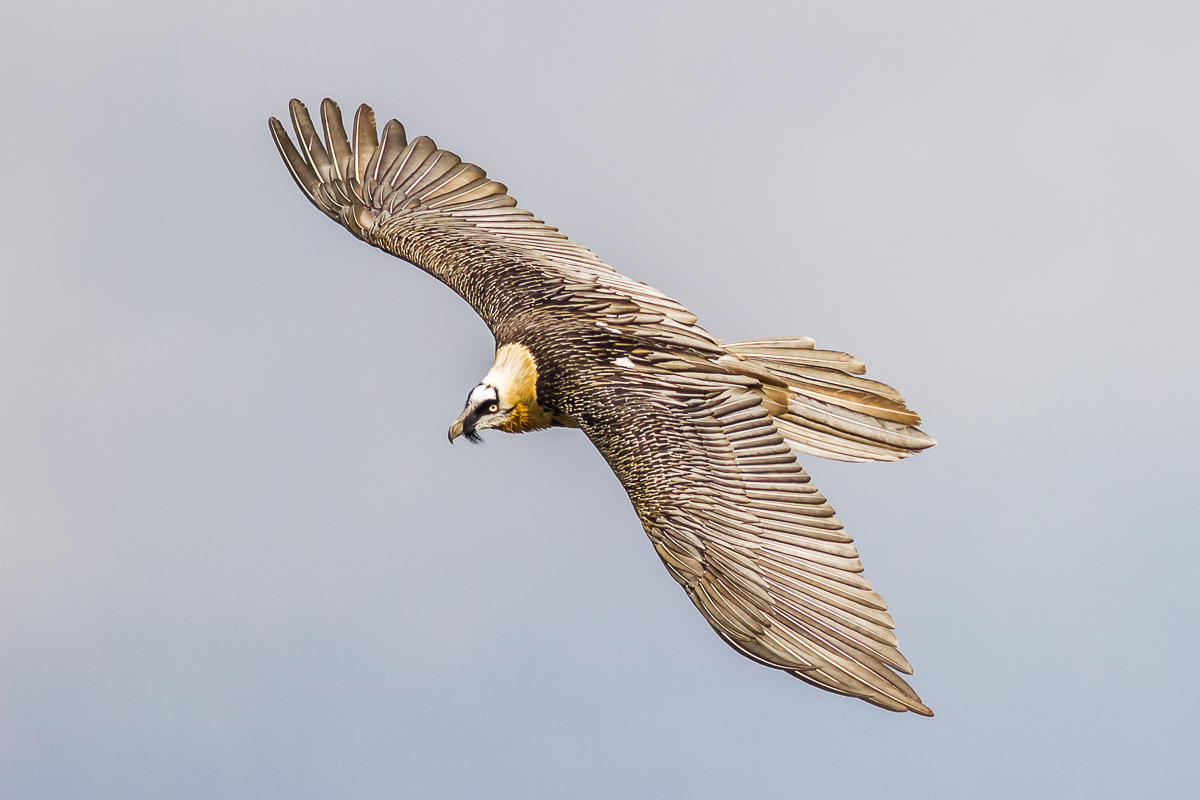
Bearded Vulture
- Common Name: Bearded Vulture (also known as Lammergeier)
- Scientific Name: Gypaetus barbatus
- Nepali Name(s): हाडफोर गिद्ध (Haadfor Giddha)
- IUCN Red List Status: Near Threatened (NT)
- National Red List Status: Vulnerable (VU)
- CITES Appendix: Appendix II
- CMS Appendix: Appendix II
Measurements & Physical Profile
- Body Length: 94–125 cm
- Wingspan: 231–283 cm
- Weight: 4.5–7.1 kg
Did You Know?
True to its Nepali name "Haadfor," the Bearded Vulture is the only animal on Earth whose diet consists almost entirely (70% to 90%) of bones! When a bone is too large to swallow, this highly intelligent bird flies up to 100 meters high and drops it onto favorite rocky platforms called "ossuaries" to smash it into digestible pieces. Furthermore, their stomach acid has a pH of less than 1, allowing them to digest solid bone fragments completely within 24 hours.
Distribution & Habitat
Global Distribution
The Bearded Vulture occurs in fragmented, high-altitude mountain ranges across the Palearctic and Afrotropical regions. Its distribution includes the Pyrenees and Alps in Europe, the Caucasus, the mountains of Central Asia, the Iranian plateau, the Atlas Mountains in Africa, and the extensive Himalayan mountain chain.
Distribution within Nepal
In Nepal, it is a resident breeder distributed continuously along the high Himalayas, from the far-west to the far-east. It is frequently recorded in high-altitude protected areas such as the Annapurna Conservation Area, Langtang National Park, Sagarmatha National Park, and the trans-Himalayan rain-shadow zones of Mustang and Dolpo.
Preferred Habitats
Steep montane valleys, alpine meadows, rocky scree slopes, high-elevation alpine steppes, and precipitous cliffs. They widely patrol open mountain terrain, high pastures where livestock graze, and valleys below mountain villages.
Elevational Range
Typically ranges from 1,200 meters up to 5,000 meters above sea level, regularly foraging at extreme altitudes exceeding 7,000 meters around mountain peaks.
Seasonal Occurrence
Year-round permanent resident in the high mountains. They do not migrate long distances, though young birds roam widely, and adults may move down to lower mountain valleys during severe winter blizzards.
Behavior & Ecology
Flight & Foraging Behavior
The Bearded Vulture possesses a distinct flight silhouette characterized by long, narrow, pointed wings and a large, wedge-shaped tail. It excels at low-altitude, effortless sailing along mountain ridges and cliff faces, using thermal updrafts and mountain winds to patrol massive territories without flapping its wings. Unlike other vultures, it does not typically gather in large, competitive squaffles at carcasses; instead, it waits patiently for other scavengers to finish before moving in to collect the remaining skeleton.
Social & Roosting Habits
Generally solitary or found in territorial breeding pairs. They are quiet, non-gregarious birds that roost on inaccessible, sheltered cliff ledges. Adults maintain and fiercely defend large, overlapping home ranges that can span hundreds of square kilometers. A fascinating behavior unique to this species is cosmetic bathing: they deliberately rub secretes of iron-oxide-rich mud into their feathers, tinting their natural white underparts a brilliant orange-rufous color.
Diet & Ecosystem Role
Diet Breakdown
The Bearded Vulture is a highly specialized scavenger:
- Carrion & Bones (Primary): Solid bones, skeletal fragments, and marrow make up the vast majority of its intake. It easily swallows bones up to 20–25 cm long.
- Mammals: Carcasses of wild ungulates (e.g., Blue Sheep, Himalayan Tahr) and mountain domestic livestock (yaks, goats).
- Birds, Reptiles, Fish: Extremely rare; they may occasionally kill small, vulnerable prey like tortoises or rodents by dropping them from heights, but live hunting is uncommon.
Ecological Role
This species plays a critical, final role in ecosystem sanitation. By consuming the bones and marrow left behind by mammalian predators and other vulture species, they ensure the complete removal of carcasses. This unique bone-clearing mechanism prevents the long-term accumulation of decaying skeletal remains and helps limit the spread of bone-borne pathogens in fragile alpine environments.
Breeding Biology
The breeding cycle is exceptionally long, spanning from October to June to ensure that chicks hatch when food availability peaks in the spring. Courtship involves spectacular, synchronized loop-the-loop aerial displays and tandem flights along cliff walls.
They build massive, bulky stick nests lined with wool, animal hair, skin pieces, and old rags. These nests are placed deep inside sheltered cliff caves or under overhanging rock ledges at high elevations. The female typically lays a clutch of 2 eggs, spaced several days apart. Incubation lasts for 53 to 58 days and is shared by both parents. Although two chicks often hatch, severe obligate siblicide (Cainism) occurs, where the older, stronger chick kills the younger sibling. The surviving chick receives intensive parental care and remains in the nest for a long fledging period of 100 to 130 days.
Migration
- Status: Resident; non-migratory.
- Movement: Established breeding adults maintain strict year-round site fidelity to their nesting cliffs. Immature and sub-adult birds show significant nomadic dispersal behavior, wandering across the entire length of mountain chains in search of food before establishing their own permanent territories.
Population Status
- Global Population Estimate: Estimated at 1,300 to 6,700 mature individuals globally.
- Population Trend: Decreasing globally, though Himalayan populations are considered a stronghold for the species.
- National Population Estimate (Nepal): Estimated to be relatively stable within its remote, high-altitude strongholds, though localized declines occur where livestock management practices are changing.
- Monitoring & Surveys: Monitored via foot transect survey mainly in the Mustang region of Annapurna, localized cliff nest-site monitoring, and community or citizen scientist-based reports.
Threats
- Poisoning: Highly vulnerable to secondary poisoning from veterinary drugs or deliberate poisoning targeted at mammalian predators (like wolves or snow leopards), where vultures consume the contaminated carcasses.
- Food Scarcity: Modern shifts in livestock carcass disposal methods and declines in wild mountain ungulates reduce the availability of carcasses.
- Infrastructure Hazards: Collisions with high-voltage power lines and expanding wind energy turbines installed along mountain ridges and foraging areas.
- Disturbance: Increasing human disturbance from high-altitude mountaineering, tourism, and helicopter traffic near sensitive cliff nesting sites.
Conservation Actions
Existing Measures
- Legal Protections: Protected under the National Parks and Wildlife Conservation Act in Nepal, listed under CITES Appendix II, and included in the CMS Raptors MOU.
- Vulture Safe Zones: Benefitting from regional initiatives in Nepal that have successfully eliminated toxic veterinary NSAIDs like diclofenac from the landscape.
- Research: GPS transmitters based study to understand habitat used, movements and threats; breeding ecology, population monitoring.
Recommended Measures
- Carcass Safety Monitoring: Continuing to promote safe, poison-free carcass disposal practices among high-altitude pastoralist communities.
- Infrastructure EIA Rigor: Enforcing strict Environmental Impact Assessments (EIAs) for power lines and wind farms in mountain corridors to prevent collision mortalities.
- Nest Protection Zones: Establishing seasonal disturbance buffer zones around active cliff nests to restrict low-flying helicopters and heavy trekking traffic during the winter breeding season.
References
- BirdLife International (2021). Species factsheet: Bearded Vulture Gypaetus barbatus. Downloaded from https://datazone.birdlife.org/species/factsheet/bearded-vulture-gypaetus-barbatus on 05/08/2026
- Ferguson-Lees, J. & Christie, D.A. (2001). Raptors of the World. Christopher Helm, London.
- Inskipp C., Baral H. S., Phuyal S., Bhatt T. R., Khatiwada M., Inskipp, T, Khatiwada A., Gurung S., Singh P. B., Murray L., Poudyal L. and Amin R. (2016). The status of Nepal’s Birds: The national red list series. Zoological Society of London, UK.
- Orta, J., E. de Juana, J. S. Marks, C. J. Sharpe, and E. Garcia (2020). Bearded Vulture (Gypaetus barbatus), version 1.0. In Birds of the World (J. del Hoyo, A. Elliott, J. Sargatal, D. A. Christie, and E. de Juana, Editors). Cornell Lab of Ornithology, Ithaca, NY, USA. https://doi.org/10.2173/bow.lammer1.01