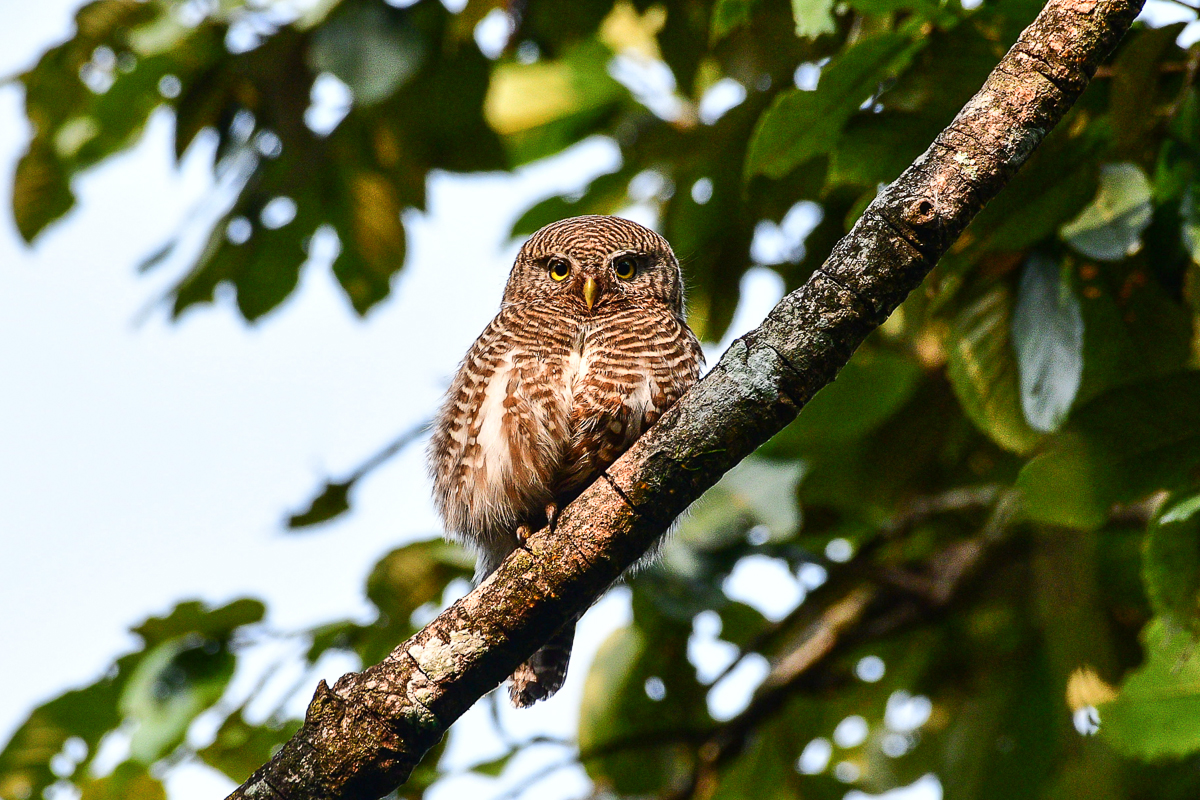
Asian Barred Owlet
- Common Name: Asian Barred Owlet
- Scientific Name: Glaucidium cuculoides
- Nepali Name(s): ठूलो डुन्डुल (Thoolo Dundul)
- IUCN Red List Status: Least Concern (LC)
- National Red List Status: Least Concern (LC)
- CITES Appendix: Appendix II
- CMS Appendix: Not listed
Measurements & Physical Profile
- Body Length: 22–25 cm
- Wingspan: 40–45 cm
- Weight: 150–240 g
Did You Know?
Unlike most of its nocturnal cousins, the Asian Barred Owlet is highly diurnal and crepuscular, frequently seen hunting under the brilliant midday sun. To protect itself from being mobbed by smaller birds while it sits in the open, it features an incredible defence mechanism: a pair of false, striking "eyespots" (ocelli) on the back of its head to trick potential attackers into thinking it is always watching them!
Distribution & Habitat
Global Distribution
The Asian Barred Owlet is widely distributed across the Indian subcontinent and Southeast Asia. Its range extends from the sub-Himalayan tracts of northern India, Nepal, Bhutan, and Bangladesh eastward through Myanmar, Thailand, Cambodia, Laos, Vietnam, and southern China.
Distribution within Nepal
It is a widespread resident across Nepal. It is particularly abundant in the lowlands of the Tarai, the Siwalik hills (Churia range), and throughout the mid-hills (Mahabharat range), spanning from the far-west to the far-east of the country.
Preferred Habitats
Open subtropical and tropical forests, broadleaved deciduous woodlands, and pine forests. Logged forests, agricultural edges, orchards, groves, large gardens, and rural wooded areas close to human settlements.
Elevational Range
Typically ranges from the lowland plains at 100 meters up to approximately 2,000 meters above sea level, occasionally reaching up to 2,700 meters in the high mid-hills during summer.
Seasonal Occurrence
Year-round permanent resident. It does not perform long-distance migrations, though minor altitudinal movements down to lower valleys may occur during harsh winter spells.
Behavior & Ecology
Flight & Foraging Behavior
The flight of the Asian Barred Owlet is characteristically undulating, rapid, and heavy, resembling a woodpecker's. When hunting, it typically perches conspicuously on bare branches, fence posts, or telephone wires, tracking movement on the ground before launching a sudden, steep dive to seize its prey.
Social & Roosting Habits
This species is primarily solitary or found in pairs. While it roosts in dense foliage or tree cavities at times, it is frequently active, vocal, and out in the open in the morning and late afternoon. It has a remarkably loud, bubbling, and musical call that speeds up toward the end—a sound that frequently alerts birdwatchers to its presence. It maintains a strict year-round territory, which it aggressively defends against intruding owls.
Diet & Ecosystem Role
Diet Breakdown
The Asian Barred Owlet is a fierce and opportunistic predator, frequently taking down prey nearly as large as itself:
- Insects (Primary): Beetles, grasshoppers, cicadas, locusts, and large moths.
- Vertebrates: Small rodents (mice, rats), shrews, small lizards, skinks, frogs, and crabs.
- Birds: Small songbirds, nestlings, and occasionally juvenile gamebirds.
Ecological Role
As an apex invertebrate and small-vertebrate predator in the mid-hill ecosystems, this owlet serves as an exceptional natural pest controller. By regulating rodent and destructive insect populations near forest edges and agricultural fields, it helps mitigate crop damage and maintains a healthy ecological balance.
Breeding Biology
The breeding season runs from March to June, aligning with the pre-monsoon and early summer months. Courtship begins with enthusiastic, dual-vocal duets between mates and frequent mutual preening.
True to its family, it does not construct a nest from scratch. Instead, it utilizes natural tree hollows or abandoned nesting holes excavated by larger woodpeckers (such as barbets or woodpeckers) in broadleaved trees, usually situated between 3 to 10 meters above the ground. The female lays a clutch of 3 to 4 smooth, round, white eggs directly onto the unlined floor of the cavity. Incubation is performed almost exclusively by the female for roughly 26 to 28 days, during which the male hunts and delivers food to the nest. Both parents fiercely guard the nest site, and the altricial chicks fledge and leave the safety of the hollow approximately 30 to 35 days after hatching.
Migration
- Status: Permanent year-round resident; non-migratory.
- Movement: They show high site-fidelity, staying within their established territories their entire adult lives. Slight elevational adjustments may occur within the Himalayan river valleys to avoid extreme winter weather, but they do not migrate across geographic borders.
Population Status
- Global Population Estimate: The global population size has not been precisely quantified, but the species is described as common to abundant across most of its extensive range.
- Population Trend: Increasing
- National Population Estimate (Nepal): Widespread and highly common; population numbers are considered stable across its primary altitudinal belt.
- Monitoring & Surveys: Monitored primarily through localized avian point counts, call-playback surveys during breeding seasons, and community-led citizen science reporting (e.g., eBird data collection).
Threats
- Habitat Loss & Degradation: The removal of old, mature trees and dead standing snags (which provide critical nesting hollows) due to firewood collection and commercial logging.
- Pesticide Overuse: Broad-spectrum chemical insecticides used in adjacent agricultural lands reduce their primary insect food base and cause chemical bioaccumulation.
- Human Disturbance: Encroachment and development in the mid-hills create noise and disturbance during their highly sensitive spring nesting period.
- Superstition & Poaching: Occasional target of opportunistic hunting due to deep-seated local superstitions regarding owls, or accidental capture in traps meant for other animals.
Conservation Actions
Existing Measures
- Protected Area Coverage: Well-represented and protected within Nepal’s extensive network of protected areas.
- International Safeguards: Listed globally under CITES Appendix II to monitor and regulate any international trade of the species or its parts.
Recommended Measures
- Snag Retention Policies: Promoting community forestry guidelines that discourage the clearing of dead, hollow-bearing trees to preserve nesting sites.
- Organic Farming Initiatives: Encouraging low-chemical or organic buffer zones around forest fringes to maintain healthy prey populations.
- Community Education: Enhancing local awareness campaigns to dispel negative myths surrounding owls, highlighting their immense value to farmers as rodent predators.
References
- BirdLife International (2024). Species factsheet: Asian Barred Owlet Glaucidium cuculoides. Downloaded from https://datazone.birdlife.org/species/factsheet/asian-barred-owlet-glaucidium-cuculoides on 04/08/2026
- Grimmett, R., Inskipp, C., & Inskipp, T. (2016). Birds of Nepal. Christopher Helm, London.
- Holt, D. W., R. Berkley, C. Deppe, P. L. Enríquez, J. L. Petersen, J. L. Rangel Salazar, K. P. Segars, K. L. Wood, and J. S. Marks (2020). Asian Barred Owlet (Glaucidium cuculoides), version 1.0. In Birds of the World (J. del Hoyo, A. Elliott, J. Sargatal, D. A. Christie, and E. de Juana, Editors). Cornell Lab of Ornithology, Ithaca, NY, USA. https://doi.org/10.2173/bow.asbowl1.01
- Inskipp C., Baral H. S., Phuyal S., Bhatt T. R., Khatiwada M., Inskipp, T, Khatiwada A., Gurung S., Singh P. B., Murray L., Poudyal L. and Amin R. (2016). The status of Nepal’s Birds: The national red list series. Zoological Society of London, UK.