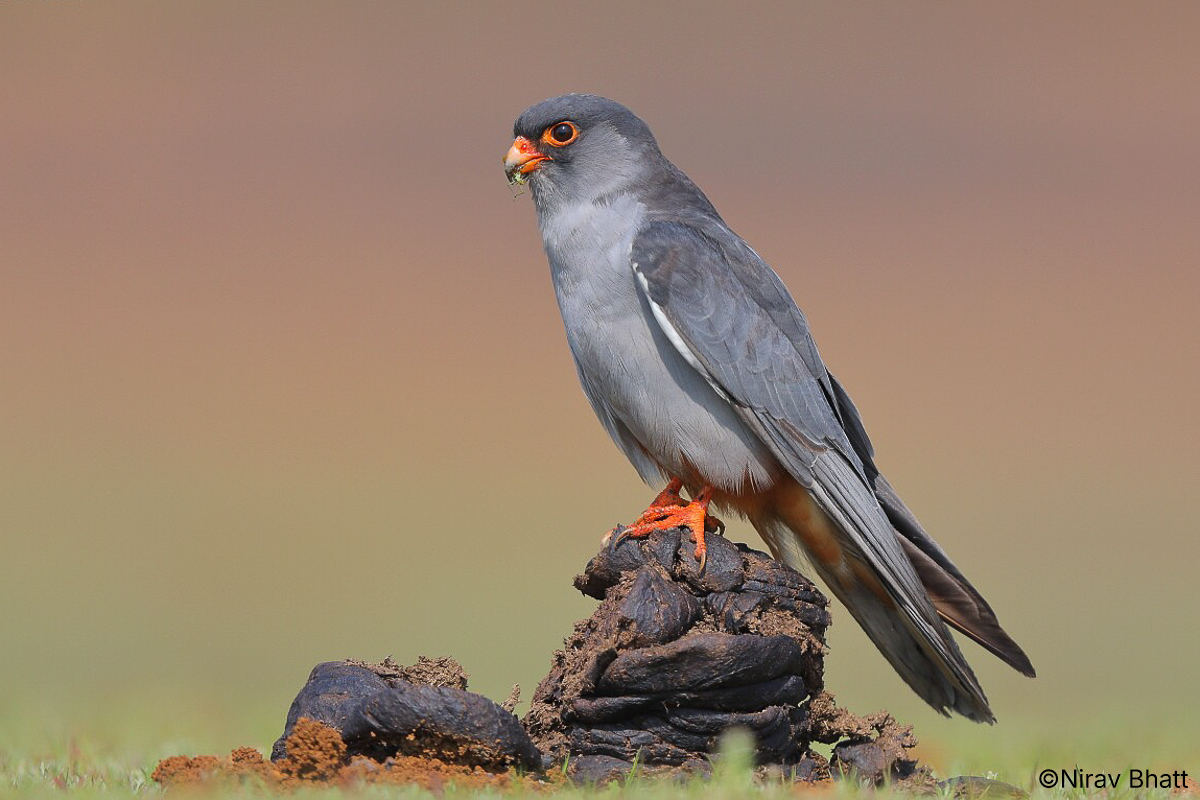
Amur Falcon
- Common Name: Amur Falcon
- Scientific Name: Falco amurensis
- Nepali Name(s): अमूर बाज (Amur Baaj)
- IUCN Red List Status: Least Concern (LC)
- National Red List Status: Least Concern (LC) / Vagrant Passage Migrant
- CITES Appendix: Appendix II
- CMS Appendix: Appendix II
Measurements & Physical Profile
- Body Length: 28–31 cm
- Wingspan: 63–71 cm
- Weight: 97–188 g
Did You Know?
Amur Falcons complete one of the most daring long-distance migrations of any raptor on Earth. They fly a staggering 22,000-kilometer round trip annually from their breeding grounds in East Asia all the way to Southern Africa. Remarkably, this epic journey includes an exhausting, non-stop, three-day flight directly across the open waters of the Arabian Sea, perfectly timed to ride strong monsoon tailwinds and feed on migrating dragonflies mid-air!
Distribution & Habitat
Global Distribution
The Amur Falcon breeds across East Asia, spanning southeastern Siberia, Amurland, Eastern Mongolia, and northeastern China into parts of North Korea. It travels down a broad migratory front through India, crossing the Arabian Sea to reach its primary wintering grounds in Southern and East Africa.
Distribution within Nepal
In Nepal, the Amur Falcon is recorded primarily as an uncommon autumn or spring passage migrant. Individuals or small groups are occasionally sighted across the mid-hills, Thoolakharka Raptor migration watch site, Kathmandu Valley, Koshi Tappu wildlife reserve and surrounding areas and some other lowland Tarai regions while passing through the country's north-to-south river valleys.
Preferred Habitats
- Breeding Grounds: Open areas and wooded steppe, forest edges, marshes, and agriculture areas.
- Migration & Wintering: Open grasslands, savannas, agricultural fields, reclaimed land, and open woodland margins. They frequently gather near major water reservoirs during migratory stopovers.
Elevational Range
Typically observed at lower to mid-elevations in Nepal during passage, ranging from the lowlands around 100 meters up to 2,000 meters above sea level. During active migratory flight, flocks often travel at high altitudes, above 1,000 to 3,000 meters.
Seasonal Occurrence
Observed briefly in Nepal during the autumn migration window (primarily October to November) and occasionally during the return spring migration (April to May).
Behavior & Ecology
Flight & Foraging Behavior
Amur Falcons display highly agile, swift, and kestrel-like flight. They excel at capturing a wide range of aerial insects directly on the wing. They hunt using diverse strategies, including low-altitude soaring, hovering over open fields, and launching sudden swoops from exposed perches like telephone poles or wires.
Social & Roosting Habits
Highly social and gregarious, this species travels, feeds, and roosts in massive communal flocks that can number in the thousands or tens of thousands during migration. They are primarily crepuscular, showing intense activity peaks late in the evening and early in the morning. At night, they roost colonially on exposed tree branches or power lines, often intermixing with Lesser Kestrels and Red-footed Falcons.
Diet & Ecosystem Role
Diet Breakdown
The Amur Falcon is predominantly insectivorous, though its diet shifts depending on the season:
- Insects (Primary): Termites, locusts, ants, grasshoppers, beetles, and dragonflies, particularly during swarms triggered by tropical rains or migrations.
- Vertebrates (Breeding Season): Small mammals (rodents), small birds, reptiles, and amphibians captured to feed developing young.
Ecological Role
As a high-volume insectivore, the Amur Falcon acts as a critical biological pest control agent. By consuming millions of insects—such as swarming locusts and termites—along their global migration path, they prevent agricultural crop devastation and maintain ecological balance in fragile grassland and savanna biomes.
Breeding Biology
The breeding season spans from May to June in the Palearctic region. Courtship involves spectacular aerial displays, loops, and vocalizations near potential nest sites. Like all falcons, they do not build their own nests. Instead, they reuse abandoned stick nest platforms built by corvids or other raptors—significantly favoring the domed structures of the Eurasian Magpie (Pica pica)—as well as natural tree hollows.
A standard clutch consists of 3 to 4 white eggs heavily marked with reddish-brown spots, laid at two-day intervals. Both parents share incubation duties for approximately 28 to 30 days, with the male heavily investing in bringing food to the female. Nestlings are altricial and require close parental care; however, they grow rapidly and reach their fledging period, leaving the nest within 30 days of hatching.
Migration
- Status: Fully migratory, long-distance passage migrant.
- Routes: From East Siberia, they fly south-southwest across China to mass congregations in Northeast India (Nagaland, Assam, Manipur). From there, they launch a non-stop trans-oceanic crossing over the Arabian Sea to East and Southern Africa.
- Timing: Outbound migration occurs between September and November; return journey happens from March to May.
- Important Stopover Sites: The Doyang Reservoir in Nagaland, India, hosts the single largest concentration of Amur Falcons in the world.
Population Status
- Global Population Estimate: Estimated at 200,000 to 700,000 mature individuals globally.
- Population Trend: Stable.
- National Population Estimate (Nepal): Not precisely quantified due to its status as a transient passage migrant; numbers fluctuate yearly based on wind conditions during flight.
- Monitoring & Surveys: Extensive satellite-tagging programs run by international consortiums track regional flight patterns. Citizen science platforms (e.g., eBird) help monitor passage dates across the Himalayan corridor.
Threats
- Hunting & Persecution: Historically, illegal trapping using vertical mist-nets at roosting sites for commercial meat sales was a catastrophic threat during stopovers (notably the 2012 hunting crisis in Nagaland, India).
- Habitat Loss & Degradation: Land conversion of wetlands, marshes, and open grasslands to intensive agricultural use impacts insect prey availability.
- Poisoning: High exposure to secondary chemical poisoning from agricultural pesticides, which decimates the locusts and termites they rely on.
- Infrastructure Hazards: Mortalities via collisions with wind turbines and electrocution on poorly insulated overhead power lines along major migratory flyways.
Conservation Actions
Existing Measures
- International Conventions: Listed under CITES Appendix II and protected under the Convention on Migratory Species (CMS) Raptors MOU.
- Community-Led Conservation: Successful transition of former hunters into community protection squads in Northeast India, combined with intensive local awareness campaigns by NGOs.
Recommended Measures
- Transboundary Cooperation: Strengthen international flyway joint initiatives between Russia, China, India, Nepal, and South African nations to secure unhindered flyway safety.
- Safe Infrastructure Zoning: Mapping and insulating electrical infrastructure in known high-density migratory bottleneck zones.
- Habitat Preservation: Protecting core stopover marshes and roosting forests from commercial encroachment.
References
- BirdLife International (2021). Species factsheet: Amur Falcon Falco amurensis. Downloaded from https://datazone.birdlife.org/species/factsheet/amur-falcon-falco-amurensis on 14/07/2026
- Grimmett, R., Inskipp, C., & Inskipp, T. (2016). Birds of Nepal. Christopher Helm, London.
- Inskipp C., Baral H. S., Phuyal S., Bhatt T. R., Khatiwada M., Inskipp, T, Khatiwada A., Gurung S., Singh P. B., Murray L., Poudyal L. and Amin R. (2016). The status of Nepal’s Birds: The national red list series. Zoological Society of London, UK.
- Orta, J., G. M. Kirwan, P. F. D. Boesman, and J. S. Marks (2020). Amur Falcon (Falco amurensis), version 1.0. In Birds of the World (J. del Hoyo, A. Elliott, J. Sargatal, D. A. Christie, and E. de Juana, Editors). Cornell Lab of Ornithology, Ithaca, NY, USA. https://doi.org/10.2173/bow.amufal1.01
- The Peregrine Fund (2026). Amur Falcon. Available at: https://peregrinefund.org/explore-raptors-species/falcons/amur-falcon (Accessed: 14 July 2026).